|


Fundamental Theory and Practice For The Solitary Apprentice
Weiser Books 2004 ISBN #1-57863-318-4
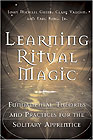 I found this to be a very interesting book from the get go. The very first thing that I noted was the authorization page - the work being authorized for publication by the High Council of the Rose, COR. In the introduction we find out that the lessons contained within this book were originally compiled as an introductory course for members of an independent Hermetic Order. That order, now know as the Companions of the Rose (COR) are still active, but follow a different course of training. It was decided by the governing body of the COR to present to the wider occult community, as students may find it useful. I think useful may be an understatement! Learning Ritual Magic reflects a gentle voice, a serious intent and a true humbleness - no inflated egos running around here, no secret passwords, no beating around the bush. It asks one thing - that 30 minutes a day be devoted to study. The course as it is set out is meant to cover a nine month period of study. It should take at least that amount of time, for proper attention to be paid to each of the lessons. It can take more time, as we all understand that sometimes life interferes, and we cannot accomplish all that we wish to in the time that we wish to. However, if this study is taking an inordinate amount of time, I would toss this thought out there: that the student needs to take another look at their priorities. If the student is consciously (or subconsciously) avoiding their studies, it may be because they are dealing with their own shadow issues, and they need to take a look at that so that they can progress in both their spiritual and their mundane lives. The course material is based on the lessons provided in the book; personal tools (such as a straight back chair, a ruler, a compass, a set of colored pencils and a blank notebook); a suitable place to practice, with open floor space; an appropriate Tarot deck (the choices listed are: The Rider-Waite Tarot, The Universal Waite Tarot, The Albano-Waite Tarot, The Magickal Tarot, The Gareth Knight Tarot, The Hermetic Tarot, The Golden Dawn Tarot, and The Golden Dawn Ritual Tarot); and the students choice of three of the following books (W.E. Butler, The Magician: His Training and Work; Dion Fortune, The Mystical Qabalah; William Gray, The Ladder of Lights; John Michael Greer, Paths of Wisdom; Gareth Knight, A Practical Guide to Qabalistic Symbolism; Israel Regardie, The Tree of Life). Each lesson builds on itself, and lays the foundation for the one to come. The first lesson has many fascinating sections to it. The student is walked through drawing a very simple version of the Tree of Life; how to perform opening and closing hand gestures; a relaxation exercise and journaling; beginning to familiarize themselves with their choice of Tarot deck. The student is asked to work on these things for a period of no less than two weeks before moving on to the next lesson. I loved the next lesson - the first thing that the student is asked to do is to review and assess the work that they have done over the past two weeks! This shows thought - because if the student was having problems within the first two weeks, and whatever they were having an issue with was not noted and corrected, the house of cards that was built on this foundation would only be as good as the foundation - and would tumble with the first hint of a breeze. The student is then introduced to the five levels of being (physical, etheric, astral, mental and spiritual), and some very interesting ways of arranging them. The student is also asked to read the first chapter from one of their books, and jot down the seven most important sentences that they find in it on seven note cards. Each day, they will be working with one sentence, and placing it in their life. Work with the Tarot is also continued, focusing on the Trumps. Posture and breathing are addressed, as well as the performance of the Qabalistic Cross. The student is asked to continue this work for a minimum of two weeks before moving on. The third lesson addresses the Minor Arcana of the Tarot, continues on with the selecting of seven sentences from the next two chapters of the chosen book (one chapter each week), continuing work with meditation and learning to perform the Lesser Banishing Ritual of the Pentagram. While the first three lessons were very much focused on practice, starting with lesson four theory and practice are both presented. The reading and meditating exercises are continued for the next two weeks, along with daily practice of the Lesser Banishing Ritual of the Pentagram, and working on the number one (Kether on the Tree of Life), and the eleventh, twelfth and thirteenth paths (on the Tree of Life). Lesson five focuses on the concept of duality, the number two (Chokmah on the Tree of Life), the fourteenth, fifteenth and sixteenth paths (on the Tree of Life), meditation and reading exercises, performance of the Lesser Banishing Ritual of the Pentagram, and working on the will exercise. Lesson six focuses on the macrocosm and the microcosm, the levels of self, the number three (Binah on the Tree of Life), the seventeenth and eighteenth paths, the reading and meditation exercises, the will exercise and the performance of the Lesser Banishing Ritual of the Pentagram. Lesson seven focuses on Tarot exercises, reading, meditation, number and will exercises, and introduces the Middle Pillar exercise. Lesson eight focuses on self-knowledge, Chesed (on the Tree of Life), the nineteenth, twentieth and twenty-first paths (on the Tree of Life), continuation of the reading and meditation exercises, introduction of the self-perception and art of memory exercises, and continued work with the performance of the Middle Pillar exercise. Lesson nine focuses on the will, Geburah (on the Tree of Life), the twenty-second and twenty-third paths (on the Tree of Life), the introduction of the transmutation of self exercise, continuation with the reading, meditation, number and will exercises, and the performance of the Middle Pillar exercise. Lesson ten focuses on motives, Tiphareth (on the Tree of Life), the twenty-fourth, twenty-fifth and twenty-sixth paths (on the Tree of Life), the continuation of the reading, meditation, number, will and transformation exercises, the introduction of the motive exploration exercise and the performance of the Middle Pillar exercise. Lesson eleven focuses on the Alchemical Great Work, the continuation of the reading, meditation, number and will exercises, the introduction of a Tarot Trump exercise, and the first expansion of the Middle Pillar exercise. Lesson twelve focuses on Netzach (on the Tree of Life), on the twenty-seventh, twenty-eighth and twenty-ninth paths (on the Tree of Life), continuation of the reading, will, meditation and self-perception exercises, the introduction of Tarot storytelling, and the performance of the expanded Middle Pillar exercise. Lesson thirteen focuses on Hod (on the Tree of Life), the thirtieth and thirty-first paths (on the Tree of Life), continuation of the reading, will, meditation, number and self-perception exercises, the introduction of Tarot pattern making, and the performance of the expanded Middle Pillar exercise. Lesson fourteen focuses on Yesod (on the Tree of Life), the thirty-second path (on the Tree of Life), the continuation of the reading, meditation, number and self-perception exercises, the introduction of a beginning divination exercise with the Tarot and performance of the expanded Middle Pillar exercise. Lesson fifteen focuses on Malkuth (on the Tree of Life), continuation of the reading, meditation, number and self-perception exercises, introduction of a Tarot divination exercise and performance of the expanded Middle Pillar exercise. Lesson sixteen focuses on the structure of a working magickal group, and review of the will and meditation exercises, introduction of an inner-plane working exercise, continued work with the Tarot divination exercise, and a second expansion of the Middle Pillar exercise. Lesson seventeen focuses on course review, introduction of a secrecy exercise, continuation of the will, meditation, inner-plane and Tarot divination exercises, and performance of the second expansion of the Middle Pillar exercise. Lesson eighteen focuses on initiation and entering a magickal order, course review, continuation of the meditation, inner-plane and Tarot divination exercises, and performance of the second expansion of the Middle Pillar exercise. At the end of the book is an appendix covering self initiation, followed by an extensive bibliography. Maybe all of this is more than you wanted to know about this book. Maybe it is exactly what you needed to know to make the decision whether this path was for you or not. I find this book to be well written, well researched, and presented in a very cohesive manner. It deserves to be part of the library of any magickal worker, and easily serves not only as a foundation for magickal practice, but as an excellent resource for all levels of student.
Bonnie Cehovet
 View My Guestbook Sign My Guestbook

Graphics by Art for the web |