|
Types of Volcanoes
Cinder
cones are the most widespread type of volcano.
Also called Scoria cones, they are the smallest variation,
with heights that rarely go over 1,000 feet.
Properties:
-Made up almost entirely of basaltic tephra, which builds up
around the opening to create
the cone.
-Usually have steep slopes, up to 35 degrees; older, eroded
cones can be anywhere from 15 to 20 degrees in slope.
-They have
straight sides and rather large crates at the peak, for their size.
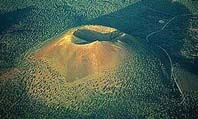
Sunset Crater which is a cinder cone
Shield
volcanoes are low-slung and wide volcanoes with bases that
can extend to miles in diameter.
Properties:
-Generally balsatic in their lava composition, they are
formed by the gentle spreading
of basaltic lava from the summit
area over a large area.
-The slope of the sides is usually very gentle (2-3 degrees),
but does get steeper as the
slope approaches the middle (up
to about 10 degrees) and flattens out at the top.
-Examples are Hawaiian and Icelandic volcanoes.

Mauna Loa on Hawaii
Composite
cones, or stratovolcanoes, are the most diverse group in
shape and makeup, and also the deadliest.
Properties:
-Slopes tend to start gently, but veer upward towards the
crater, which is usually relatively small.
-Can be formed by a mixture of lava flow, tephra falling from
the air, and debris, thus
forming many shapes.
-Average composition is andestite; can change go through the
whole spectrum of lava
(basaltic to rhyolite) in a single
eruption.
-Mountains such as Mt. St. Helens in the United States and
Mt. Fuju in Japan are examples
of composite cone
volcanoes.
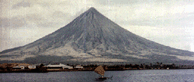
Mt.Mayon which is a composite
cone
|


