|
How Eruptions Work
A few things you should know beforehand:
The basic premise of a volcano eruption is when
magma, or melted rock, comes up from inside the Earth and breaks
Earth’s surface.
The Earth’s outer layer, or lithosphere, is
broken up into several tectonic plates, each of which contains the
Earth’s crust and a dense layer of the Earth’s mantle; the
plates are about 100 km in thickness.
There are three types of tectonic plate
boundaries (places where the plates meet)
Convergent plate
boundaries are where plates push together and form deep
trenches, if in the ocean.
Divergent plate
boundaries are where plates pull apart, allowing ridges to
form.
Transform plate
boundaries are where plates slip past other; little
significant volcanic activity goes on here
These boundaries are where most of the world’s
volcanoes occur.
-At convergent plate boundaries, spreading
center volcanism occurs. Magma
from below the lithosphere comes to the surface and pushes up
to form ridges,
such as the Mid-Atlantic Ridge.
The pressure generated by the rising magma
tends to create fissures in the Earth’s crust, through
which the magma erupts and
creates new crust
-At divergent plate boundaries, what are commonly called subduction zones are
created. One of
the plates is pushed under at these boundaries, sending the
lithosphere into the mantle; this is called subduction.
Water carried by the
subducted plate is released into the mantle, lowering the
temperature at which the
mantle melts. The
magma then rises to form volcanoes at the surface.
-At hot spots,
magma rises to the surface at a place not near a plate boundary.
These spots are thought to be formed by the action of convection.
Convection is the displacement of something hot by something
cold.When something is heated, it expands and becomes less dense.
In the case of volcanoes, the cooler mantle pushes upwards and pushes
heated magma to the surface.
|
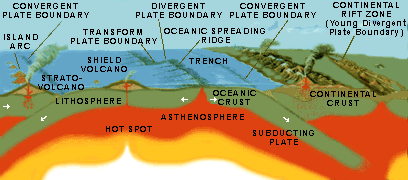
|
|
Volcanoes
at plate boundaries. From
United States Geological Service
|
Most volcanoes have pockets or chambers of magma below the
surface. The magma has
gases distilled in it by the high pressures underground.
As magma is pushed to the surface by convection and by the
force of buoyancy, the pressure decreases, allowing the gas to form bubbles.
As the magma gets closer and closer to the surface, more
bubbles form, increasing the magma’s speed upward even more.
The thicker (the more silica) the magma, the more bubbles
that are trapped, making for a more explosive eruption.
Buoyancy
plays a part in the eruption also.
The buoyant force is calculated by:
Magnitude of buoyant force=weight of fluid displaced
The magma is less dense than the surrounding rock, making it
buoyant and
allowing it to rise
Classes of Eruptions
Several
types of volcanic eruptions exist. The
type of eruption that occurs is affected by the composition of the
magma present and the amount of water vapor. Certain types of eruptions are usually associated with certain types
of volcanic landforms.
Hawaiian
eruptions-The calmest type of eruption, Hawaiian eruptions
generally emit thin basaltic lava.
These eruptions are set apart by their steady flow of lava,
which builds up large shield volcanoes, and low amount of tephra
produced.
Strombolian
eruptions-Named after the island Strombolia, near Sicily,
they are typified by periodic short and explosive eruptions of
basaltic lava that can go from a few meters to several hundred
meters in height. The tephra emitted by the eruptions usually build a scoria
cone.
Plinian
eruptions-Named after a Roman who recorded an account of the
Vesuvius eruption in 79 A.D., these eruptions usually involve felsic
magna and propel ash and pumice many kilometers into the air from a
composite or stratovolcano, which falls to cover a large area.
Pyroclastic flows and mudslides can also occur during the
course of a Plinian eruption
Vulcanian
eruptions-Named after the Roman god Vulcan, these eruptions
commence as a series of short, violent bursts, then settles into a
smaller and more sustained eruption pattern.
Less tephra is produced than in a Plinian eruption, and the
height of the eruption ranges from 5-10 km.
Hydrovolcanic
eruptions-These eruptions happen when magma touches ground
or surface water, and usually occur underwater in the ocean in
varying forms of violence and with different types of magma.
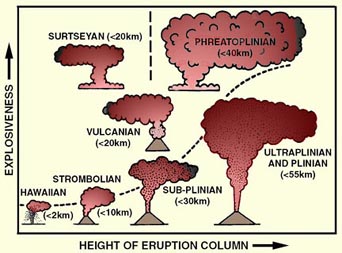 This diagram shows the amount of explosiveness relative to the
height of the eruption column for the various types of
eruptions. As you can see, the ultraplinian and plinian has
the highest explosiveness, while the hawaiian has the lowest.
This diagram shows the amount of explosiveness relative to the
height of the eruption column for the various types of
eruptions. As you can see, the ultraplinian and plinian has
the highest explosiveness, while the hawaiian has the lowest.
|


