|
|
PILLARS OF ISLAM
Shahadah: the first pillar
"There is no God but God, and Muhammad is the prophet of God."
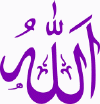
This simple statement is the creed of Islam. In Arabic it reads, "la
illaha illa Allah, Muhammad ur Rasul Lul Lah." This is how it looks
in Arabic:
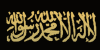
TRANSLATION: THERE IS NO DEITY BUT
ALLAH (GOD), MUHAMMAD IS A MESSENGER OF ALLAH.]
This phrase, spoken with conviction in front of Muslim witnesses,
constitutes conversion to Islam. In many Muslim cultures, it is the first
phrase spoken to a newborn baby and the last phrase spoken over a deceased
person.
Prayer: the second pillar 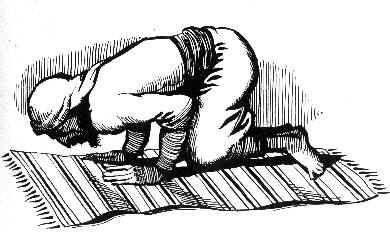
Salat, or daily prayer, is performed five times a day, facing toward Mecca
and the Kaaba. Although it's nice if Muslims can pray in a mosque, daily
prayers may be done anywhere. Friday noon prayers are a weekly worship
service where a sermon may be given.
Fasting: the third pillar
Sawm, or fasting, was encouraged by the Prophet during the month of Ramadan,
which is the ninth lunar month in the Muslim calendar. Fasting occurs
for able-bodied Muslims between sunrise and sunset of every day during
the month. Menstruating, pregnant and nursing women, the sick, and very
young children are not required to fast, although there is an obligation
to make up days missed later or to substitute acts of charity.
The end of Ramadan is celebrated with the Eid al-Fitr, the Lesser Feast,
which lasts for three days.
Charity: the fourth pillar
Early in Muhammad's career, it became clear that charity on behalf of
the needy was going to be one of the main requirements of Islam. Zakat
means "growth" and "purification," and it is purely
voluntary (though it was not in some cultures in the past). In some poorer
countries, zakat funds social welfare programs for the needy.
The Hajj: the fifth pillar
The Greater Hajj, or Pilgrimage to Mecca, takes place in the twelfth lunar
month of the Islamic calendar: the Dhu al-Hijjah. It lasts from the eighth
day to the thirteenth day, six days in all. Male pilgrims commonly wear
an ihram, a two-piece white seamless garment (women wear their customary
dress). The culmination of the pilgrimage is the Greater Feast, the Eid
al-Adha, one of the two major Muslim religious holidays (the other one
is Eid al-Fitr, the Lesser Feast, which celebrates the end of Ramadan).
During the Greater Feast, each family sacrifices a sheep, whose meat is
then given to the needy.
One of the most prominent parts of the Hajj is walking around the Kaaba
seven times. This is called tawaf:
The Kaaba is a small, cube-shaped building which Muslims believe was built
by Abraham, who was the father of Ishmael, the common ancestor of the
Arabs. The Kaaba sits on the site where Adam and Eve originally worshipped
God. In the corner of the Kaaba is a silver frame containing the Black
Stone, which pilgrims touch or kiss if they can. The Great Mosque in Mecca,
which contains the Kaaba, also contains the well of Zamzam, a sacred spring.
|


 ISLAM.COM