|
CLICK ON PICTURES
|
AL QURAN
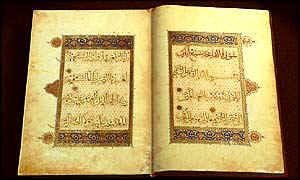
The Qur'an is the holy book for Muslims, revealed in stages
to the Prophet Muhammad (peace be upon him) over 23 years.
Qur'anic revelations are regarded by Muslims as the sacred word of God,
intended to correct any errors in previous holy books such as the Old
and New Testaments.
Origin
The Qur'an was revealed to the Prophet Mohammad (pbuh) by God in Arabic.
Some Qur'anic fragments have been dated as far back as the eighth, and
possibly even the seventh, century. The oldest existing copy of the full
text is from the ninth century.
Although early variants of the Qur'an are known to have existed, Moslems
believe that the text we have today was established shortly after the
death of the Prophet (pbuh) by the Caliph Uthman.
Contents
There are 114 chapters in the Qur'an, which is written in the old Arabic
dialect.
All the chapters except one begin with the sentence "Bismillahir
rahmanir raheem", ‘In the name of Allah the most Beneficient,
the Most Kind’. This is the thought with which Muslims should start
every action.
The longest chapter of the Qur'an is Surah Baqarah (The Cow) with 286
verses and the shortest is Surah Al-Kawther (abundance) which has 3 verses.
The arrangement of surahs does not correspond to the chronological order
in which they were revealed.
Translations
Translations of the Qur'an exist in over 40 languages but Muslims are
still taught to learn and recite it in Arabic, even if this is not their
native language and they cannot converse in it.
Translations are regarded by Muslims as new versions of the holy book,
rather than as translations in the conventional sense.
Memorising the Qur'an
At the time of the revelation of the Qur'an, books were not readily available
and so it was common for people to learn it by heart.
Committing the Qur'an to memory acted as a great aid for its preservation
and any person who is able to accomplish this is known as a hafiz.
Respect
The Qur'an is treated with immense respect by Muslims because it is the
sacred word of God.
While the Qur'an is recited aloud, Muslims should behave with reverence
and refrain from speaking, eating or drinking, or making distracting noise.
In addition to the Qur'an, the other sacred sources are the Sunnah - the
practise and examples of the Prophet Muhammad’s life and the Hadith
- the reports of what the prophet Muhammad said or approved. Both the
Hadith and Sunnah must adhere to a strict chain of narration that ensures
its authenticity, taking into account factors such as the character of
people in the chain and continuity in narration. Reports that fail to
meet such criteria will be disregarded.
One famous example is that of the scholar of Hadith literature, Imam Bukhari
who travelled several hundred miles on horseback to acquire a Hadith.
When he arrived, he saw the man that knew the Hadith deceiving his donkey
into thinking there was grain in a sack in order to induce him to move
forward. Imam Bukhari promptly left without approaching the man as he
was not willing to allow any individual with a questionable personality
to join a chain of narration or contribute knowledge that would define
the practice of the religion.
|



 ISLAM.COM