Critics said "The Ten Commandments" played around with the facts a little too freely. DeMille simply said it was a movie, not a documentary. For example, a baby Moses is placed in a basket when the elderly Pharoah orders all Hebrew babies killed. The baby is found, a princess adopts him and makes his birth mother his nurse (the name Moses means "taken from the river" so his past would not have been a secret in real life). As a young man, Moses (about age 39) saw an Egyptian beating an Israelite and killed him.
Fearing that Pharaoh would execute him, Moses fled to the Midian Desert, where he stayed another 40 years (DeMille shortened this period considerably). Then God spoke from the burning bush, telling him to lead the Israelites out of Egypt to a new homeland the British have called Palastine. Moses complains that he is slow of speach (perhaps a speach impediment) and stooped (doesn't exactly sound like Charlton Heston), so God tells him to have his brother Aaron speak for him. God then sends ten devastating plagues on Egpyt (this too was shortened up, I guess DeMille didn't have time for all 10 plagues).
In 1446 B.C., they finally leave Egypt, the Red Sea is parted, and the Pharaoh's army tries to follow (see the movie to see how that turns out). Afraid of taking on the "Giants" said to be already living in Palestine, the Israelites were doomed to wander in the desert another 40 years (this would make Moses about 120 years old when he died).
Bible scholars themselves argue about whether Ramsese II was the guy in charge at the time (he lived 1304 to 1238 BC), because it was at this time the walled city of Jericho was destroyed (the year Moses died), and it was during the reign of Ramses II that the grain-store cities of Pithom & Ramses were built by slave labor. An earlier date of 1446 BC for the Exodus from Egypt is also a possibility, because Jephthah, a judge in 1106 BC, said that Israel had occupied the new land of Canaan for 300 years.
Egyptian correspondances dated to about 1400 BC do indeed mention requests from Canaan city-states for help against invaders. This would have been Pharaoh Amenhotep III (1410 to 1377 BC). The choice for DeMille would have been obvious: it's easier for Hollywood actors to say "Rameses" than "Amenhotep."
220 minutes, color
Cast List:
Charlton Heston ... Moses
Yul Brynner ... Rameses
Anne Baxter ... Nefretiri
Edward G. Robinson ... Dathan
Yvonne De Carlo ... Sephora
Debra Paget ... Lilia
John Derek ... Joshua
Cedric Hardwicke ... Sethi
Nina Foch ... Bithiah
Martha Scott ... Yochabel
Dame Judith Anderson ... Memnet
Vincent Price ... Baka
John Carradine ... Aaron
Olive Deering ... Miriam
Douglass Dumbrille ... Jannes
Frank DeKova ... Abiram
Henry Wilcoxon ... Pentaur
Eduard Franz ... Jethro
Donald Curtis ... Mered
Lawrence Dobkin ... Hur Ben Caleb
H.B. Warner ... Amminadab
Julia Faye ... Elisheba
Fraser Clarke Heston ... Infant Moses
John Miljan ... The Blind One
Francis McDonald ... Simon
Ian Keith ... Rameses I
Paul De Rolf ... Eleazar
Woody Strode ... King of Ethiopia/litter carrier-slave
Tommy Duran ... Gershom
Eugene Mazzola ... Rameses' Son
Ramsay Hill ... Korah
Joan Woodbury ... Korah's Wife
Esther Brown ... Princess Therbis
Mike Connors ... Amalekite Herder
Clint Walker ... Sardinian Captain
Cecil B. DeMille ... Himself/Narrator
Michael Ansara ... Taskmaster (just ask Barbara Eden)
Richard Farnsworth ... Chariot Driver
Franklyn Farnum ... High Official
Joe Gold ... Egyptian Guard
John Hart ... Ambassador from Crete
Donald Hayne ... God (Pillar of Fire)
Delos Jewkes ... God
Jon Peters ... Extra (boy on donkey crossing Red Sea)
Carl 'Alfalfa' Switzer ... Slave
Robert Vaughn ... Spearman
Tim Cagney ... Moses' son (6 year old)
Herb Alpert ... Drummer on Mt. Sinai
Keith Richards ... un-named character
Directed & Produced by Cecil B. DeMille
Screenplay based on novels "Prince Of Egypt" by Dorothy Clarke Wilson,
"Pillar of Fire" by Rev. G.E. Southton; and of course the Holy Bible
(DeMille only had to pay the authors of the first two)
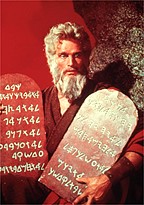

 Cecil B. De Mille made this movie twice, first as a somewhat odd silent movie (more about that later), then as a 1956 epic with state-of-the-art special effects (which won a special effects Oscar). Charlton Heston, fresh from "The Naked Jungle" (1954, about a jungle plantation surrounded by army ants) and "The Far Horizons", plays Moses, adopted brother of the future Pharaoh (Yul Brynner, later star of Westworld/Futureworld). Yul Brynner's first big starring role on Broadway had been 1951's The King & I (1,246 performances, plus a rivival on-stage in 1977). He was brought to Hollywood to repeat the role on film in 1956 and DeMille cast him as Ramses the same year. He had shaved his head for the Siamese King role and kept it that way the rest of his career with only a few exceptions.
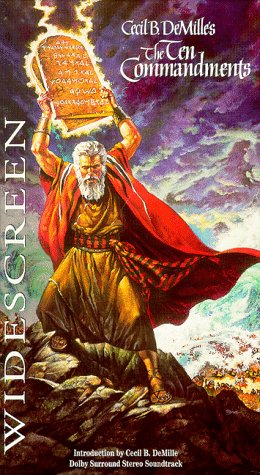 Heston's first movie was "Dark City" (1950, costarring with Jack Webb and Harry Morgan of Dragnet fame), and he made a few westerns & historical dramas, but was largely unknown before his starring role in DeMille's "Greatest Show On Earth (1952, with Jimmy Stewart as a wanted man posing as a circus clown). But Charlton Heston (real name Charles Carter) was still largely unknown by the national movie-going public and Yul Brynner completely unknown away from Broadway. This was a trademark of both DeMille and Hitchcock; to star mostly unknowns and put the money into production values.
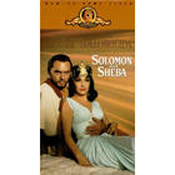 Shortly before his death in ancient Israel, King David has a vision from God telling him that his younger son Solomon (Yul Brynner) should succeed him as king.
 Nefretiri: I saved your son.