<built churches>
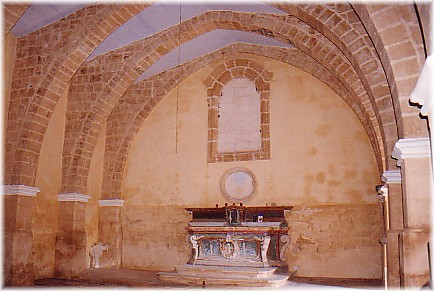
nave of santa marija ta' bir miftuh
|
|
Due to the lack of documentary proof it is hard to say how many churches Malta had in late medieval times. There are about ten churches in the countryside that can be dated before the fifteenth century. But the islands must have had more churches. A record from 1575 reports 430 churches, including the cave churches, shrines and wayside chapels. |
|
waterspout at bir miftuh |
|
|
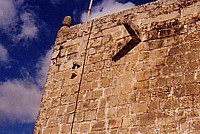
Most of these churches were in a bad state of repair. The late medieval built churches were very small and simple. They had a rectangular ground plan and the form of a plain cube, except for a slightly pitched roof. The roofs often had waterspouts on each side for draining off rainwater. |
|
|
side
facade of the old parish |
|
|
|
side
facade of santa marija |
|
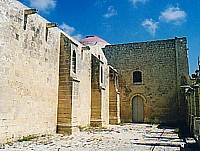
All churches consisted of one nave, which was divided into bays by pointed arches. These arches rested on wall piers, which carried the roofing slabs. Most churches had a semi- circular or rectangular apse on the east end, which was called tribuna in the documents. A lot of churches had more than one doorway. The side doorways probably had either the task to link the churches with adjoining churches, or they served as separate entrances for men and women. The doorways were mostly quite low and carried an arch. The west doorway was seldomly placed in the center and had often a hood-mould running around the ends of the voussoirs, which was a softening device for the hard angles and a feature influenced from Sicily. This is also the case with the round deep eyes, which can sometimes be found over the main door, but which seem to be a later feature. |
nave of hal millieri |
More common were slit windows on the western gable or on the side walls. A few churches had a rudimentary bell-cot on the western gable, but this might also be a later addition in some cases. A paved burial ground, called zuntier, was generally attached to the churches. It was very common to build churches in groups of two or even three or four abutting each other. Other churches were not connected to each other.
Built churches are mostly difficult to date, because they do not follow the European architectural trends and techniques from medieval or Renaissance times. They were only partly influenced by European and especially Sicilian building styles. Other features, like the stone benches between the pilasters or outside, might be derived from the tradition of the rock-cut churches. Due to Malta’s scarcity of timber, the typical Maltese limestone had to be used for the construction of churches. Limestone is very soft so that exterior buttressing was often necessary. The walls were also remarkably thick with infillings with rubble between the outer and inner skins.
direct links to related subjects: