
<the parish churches>
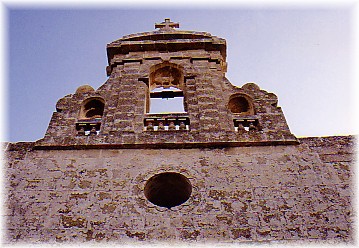
santa marija ta' bir miftuh, gudja
Malta’s number of medieval parish churches was mentioned in 1436; twelve capelle were reported from that time, among them the cave church in Mellieha. Most of these churches were enlarged or rebuilt in the fifteenth century. The only relevant architectural difference between country and parish churches was that the latter were larger and had several altars and chapels.
 |
A very interesting example for a parish church can be found near Gudja (you will actually see it when entering Malta International Airport). Santa Marija ta’ Bir Miftuh belongs to a group of five chapels abutting each other. The surviving church, dedicated to the Annunciation of the Virgin, has undergone considerable changes throughout its history. It was probably elongated, and its west facade was altered at the beginning of the sixteenth century. |
| front facade of santa marija ta' bir miftuh | |
| The western doorway was cut square and got a plain Gothic hood-mould. Above the doorway one can find a round deep eye, similar to the one at San Bazilju in Mqabba, with a geometric pattern surrounding it in a frieze on the outside and inside walls of the church. The bell-cot on the gable seems to be a later addition. The church has waterspouts and a slightly pitched roof, which might have been concealed. On the south wall one can find an arched doorway with a hood-mould. | 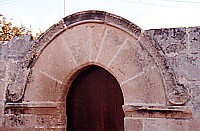
|
| The western doorway of one of the chapels abutting the Annunciation church can still be found next to the parish church. It belonged to the chapel of the Nativity and is low and arched. It is decorated with a hood-mould which contains carved acanthus leaves. |
western
doorway of
|
 |
Inside the Annunciation church five pointed arches divide the nave into bays and spring from the wall piers. The line they spring from is - like at Hal Xluq - also marked by a plain moulding. The altar, the west wall and the side walls all carry paintings which seem to originate from the late sixteenth century. |
| painting in the annunciation church |
