
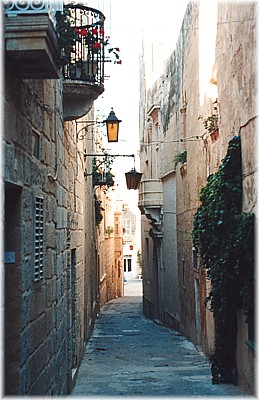
street in mdina |
Malta’s medieval town life was concentrated in its former capital Mdina and in the harbour city Birgu. Outside these towns one could only find small settlements that consisted of the caves, girnas and churches. These casali (villages) did not begin to expand until the sixteenth century. Mdina, however, was the centre of events that took place in the eleventh century, when the Arabs were occupying the island. Before the final expulsion of the Muslims, Mdina’s population came to c. 1,000. It seems that Mdina and its suburb Rabat were Malta’s most prosperous urban centres with more sophisticated buildings, such as the Mdina Cathedral. Mdina developed from the former Roman city Melite, and its citadel was probably built by the Byzantines for protection from several Muslim raids. The Birgu peninsula might have been founded by the Byzantines at the beginning of the ninth century. It was protected by a fortification built in the twelfth century. Unfortunately, the medieval towns have undergone considerable rebuilding and modifications throughout the centuries, which completely changed their urban features. |
|
The typical medieval Maltese town was characterized by introverted buildings and narrow streets. Wet rubble was often used for the construction of houses. The exterior walls were mostly made out of ashlars, while the interior walls consisted of random rubble. Faced stones were only used for some parts of the buildings, and the rest was constructed with wet rubble infill. The fact that these materials were used until the seventeenth century often makes it difficult to date the buildings. The method might have either been introduced by the Arabs or by Christian settlers in the late twelfth century. It was also used on buildings in Sicily, as well as on the aforementioned Maltese churches. |
|
|
street in birgu |


arab features in mdina: siqifah and doorway |
Some architectural elements were probably influenced by North Africa, like the building style of the town houses. These houses had flat stone roofs and were built around a cortile domorum, a courtyard, which was often entered through a siqifah, an arched passageway. The miglis, an oriental-style reception room, usually had dukkien, the stone benches that can also be found in the Maltese churches. But it is still not sure whether these features were all influenced by the Muslim Aghlabides. The presumed similarities of medieval Maltese buildings with North Africa could have reached the island filtered through the Sicilian experience but they may just as well turn out to be the result of a common central Mediterranean climate and ecological environment. |

muxrabija in sieggiewi |
Another Muslim feature is the so-called muxrabija, a peep-box, which can be found on some Maltese houses. It used to serve as an opening for the occupants who were able to look through it without being seen from outside. In Malta it was usually made of stone, sometimes of timber. It can often be found on houses in the countryside. The roundel carving was also an element probably influenced by the Muslim world. It served as decoration for walls and consisted either of geometric forms or plant and floral motifs. Obviously the carving was first produced in a specialized workshop and then added to the building so that it could also be reutilized in newly constructed buildings. |

