<the country churches>

church of the annunciation in hal millieri
The ordinary country churches served the rural settlements. Their building style did not change until the sixteenth century. The churches were entirely made of limestone, and their ground plan was rectangular. Arches divided the interior into bays. One of the best preserved and examined medieval churches and also the most important church is the Annunciation of the Virgin in Hal Millieri. The excavation, led by several archaeologists and historians, could reveal some very important facts and discoveries about medieval archaeology. The surviving church, the Church of the Annunciation, was connected to another one, the church of the Visitation, which was demolished in 1667. Some remains under the present church prove that there must have been an earlier church beneath. The Annunciation church can be dated to the early fifteenth century. |
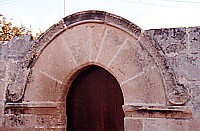
The west facade of the cubical shaped Annunciation church consists of a slightly pitched gable with a simple bell-cot, which is probably a later addition, and a square cut doorway. This doorway was totally altered; it used to be a lower and arched doorway with a simple hood-moulding, rosettes and chamfered door jambs. Traces of these and a part of the hood-moulding can still be seen over the present door. Due to alterations of the west facade, the arched doorway was recut in a square-headed shape and hood mould mutilated. The entrance leads down three steps into the church, which lies slightly below ground level. A reason for this construction could be the necessary stability for the building or an intended eschatological connection. |
| west facade of the annunciation church |
|
The eschatological connection is also given by the paved burial ground, the zuntier, outside and the tombstones on the floor inside the church. The pavement inside was made out of flagstones. The nave has a shallow, semi-circular apse at the east end and is divided into five bays by slightly pointed arches, which rise from wall piers and carry the roof. The typical low stone benches were built between the wall piers on both sides, except for in the central bay on the north wall, where a blocked doorway can be found. This side door used to serve as a connection to the Visitation church, which shared its south wall with the north wall of the Annunciation church. Due to this construction the Visitation church must have been added later to its twin. |
interior of church |
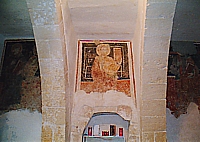
painting at annunciation church |
The exterior walls of the Annunciation church are constructed out of nearly square-cut stones (ashlars), laid in regular courses, except for the north wall, where the stonework is more irregular. The north and south walls have projecting waterspouts. The south wall contains another doorway. Inside the church the stones of the walls are smaller, undressed and rough, and they are plastered over. All walls are painted with frescoes, except for the parts where the apse and the doorway are. The life-size cult images of saints like St. George and St. Nicholas are painted in the Sicolo- Byzantinesque tradition. The frescoes can be dated to the middle of the fifteenth century. |
|
|
|
|
| side door at hal millieri | chapel opposite hal millieri | medieval olive pot at hal millieri |