
| V.2 No 1 | 79 |
| Some features of the forced vibrations modelling | |
|
|
Unfortunately, neither in practical investigation (see e.g. [6], [16]) nor in the fundamental research on the basis of integral equations (see e.g. [11], [12]) this vibration regime is not considered and taken into account. ''The resolving of the boundary problems of the vibration theory reduces, in the essence, to the calculation of eigenvalues caused by the natural frequencies or other parameters of the studied system and to the calculation of eigenfunctions (vibration forms). If the eigenvalues and eigenfunctions have been determined, we can think the boundary problem solved... At present a great amount of approximative methods to calculate the eigenvalues has been developed, however they all are quite laborious, give a scope to find only the first eigenvalues and, the main, do not generalise the studying of the systems having discrete or continuous mass distribution. So, as many authors correctly think, the eigenvalues calculus is up to now one of the most important and laborious problems that many researchers are still involved in, in that number we can list Kellatz, Guld, Wilkinson in their lately published fundamental monographs devoted to the problems of natural vibrations. We can find the endeavours to establish the mathematical unification and synthesis of 1D discrete and continuous problems as long ago as in the works by Euler and Lagrange. However up to now setting up the analogies between such boundary problems is under process, for example, in the works by Krain, Atkinson and others'' [11, pp.3-4]. In view of the new analytical method, we can figuratively explain
the high-order eigenvalues problem, using the model consisting of three sections of
elastically linked masses. If the first k1 bodies have the element mass m1,
the second k2 bodies have the mass m2 > m1
and the rest (n - k1 - k2) So, describing the line by the unified matrix of integral method and doing not taking into consideration the possible transitions in some sections (or individual masses) to the aperiodical regime, we will naturally run into the insurmountable problems in describing the processes in a line. And the fact that neither matrix method nor integral equation method do not reveal the overcritical vibration regime evidences only some incompleteness of these methods and necessity to develop and to consider the features vibration process. The new non-matrix method can be also useful. Some results obtained with its help were presented in [1]-[3], and the solutions analysed in this paper have been obtained by this method too.
Finite line with unfixed ends. To make convenient the
comparison with solutions presented in [2], consider a finite free-ends line on whose kth
element (1 |
|
|
|
| A modelling system of equations has the form | |
|
(49) |
where F(t) = F0 |
|
Contents: / 71 / 72 / 73 / 74 / 75 / 76 / 77 / 78 / 79 / 80 / 81 / 82 / 83 / 84 / 85 /


 k1
bodies - again m1, then, when the natural frequencies are subcritical
for all sections, the resonance frequencies eigenvalues transformed by the mutual
influence of sections will correspond to each section. At the frequencies overcritical for
a 'heavy' section, the line definitively 'divides' into three regions. The first and the
third ones will remain the periodical vibration regime, and the second one - aperiodical.
If the vibrations are free, we can expect the 'partial' resonances at any of three
sections - two in the subcritical region and two in the outer sections - in the
overcritical region. But if the vibrations are forced, then the solution will depend on
the external force application point.
k1
bodies - again m1, then, when the natural frequencies are subcritical
for all sections, the resonance frequencies eigenvalues transformed by the mutual
influence of sections will correspond to each section. At the frequencies overcritical for
a 'heavy' section, the line definitively 'divides' into three regions. The first and the
third ones will remain the periodical vibration regime, and the second one - aperiodical.
If the vibrations are free, we can expect the 'partial' resonances at any of three
sections - two in the subcritical region and two in the outer sections - in the
overcritical region. But if the vibrations are forced, then the solution will depend on
the external force application point. k
k
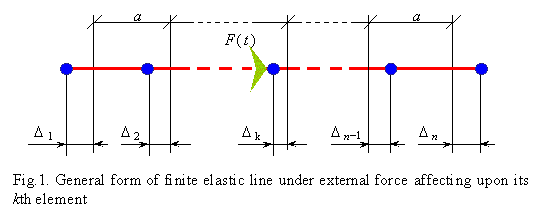

 is the external
force acting on the kth element of the line, m is the mass of the line
element, s is the constraints stiffness coefficient and
is the external
force acting on the kth element of the line, m is the mass of the line
element, s is the constraints stiffness coefficient and  i is the
momentary shift of the ith element from the state of rest.
i is the
momentary shift of the ith element from the state of rest.