
| SELF | 72 |
S.B. Karavashkin, O.N. Karavashkina |
|
|
|
With all diversity of the used methods, we can emphasise a few being basic for them all. To construct the mathematical model per se, one uses mainly two basic methods: the Lagrange method based on the energy balance, and the method of force balance on the elastic system elements. The first of them gives the scope to state the problem directly in the generalised co-ordinates for the systems having many degrees of freedom; this is advantageous in the fundamental research of complex vibration processes. The second method is more visual and simple, when constructing the particular models of elastic systems, so it is used more often in the applied calculation. Both methods give identical results, so at this stage of mathematical modelling the difficulties are rare, they arise when seeking the solutions. Analysing them, we will confine ourselves to ideal 1D elastic lines related to the subject of this paper. The conventional methods to find analytical solutions are usually based on one of three approaches to solving the problem of vibrant elastic systems:
In their turn, the problems of forced vibrations are usually based on the investigation of a homogeneous system of differential equations corresponding to free vibrations in an elastic model, due to the fact that the resonance frequencies coincide for the forced and free vibrations. So it will be efficient to begin our analysis with this type of methods. In the matrix methods, the following structure of solutions is inherent. Using the Lagrange equation of the second kind |
|
 |
(1) |
(where |
|
|
(2) |
One seeks its solution in the form |
|
|
(3) |
where Ak, |
|
|
(4) |
''This system to have a non-trivial solution, it is necessary and sufficient, its determinant to be zero: |
|
|
(5) |
[8, p.529]. ''The characteristic equation (5) is an algebraic
equation of the 2s-order with respect to |
|
|
(6) |
One can write the general solution of (2) as a real (or imaginary) part of the sum of partial solutions, i.e., as |
|
|
(7) |
where the amplitudes |
|
Contents: / 71 / 72 / 73 / 74 / 75 / 76 / 77 / 78 / 79 / 80 / 81 / 82 / 83 / 84 / 85 /


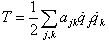 is the system kinetic energy;
  is the system potential energy; qj and qk are the
generalised co-ordinates of system) one yields the system of ordinary linear second-order
differential equations
is the system potential energy; qj and qk are the
generalised co-ordinates of system) one yields the system of ordinary linear second-order
differential equations

 and
and  are the constants that are to be
determined. Substituting (3) into (2), after an obvious reduction, one obtains an
algebraic system of a following type:
are the constants that are to be
determined. Substituting (3) into (2), after an obvious reduction, one obtains an
algebraic system of a following type:

 . After one substitutes the solution
  to
the system (4), this system will determine the relationship between the 'amplitudes' Ck:
to
the system (4), this system will determine the relationship between the 'amplitudes' Ck:
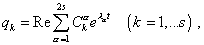
 (or rather their relationship) are determined by
(6), and solutions
(or rather their relationship) are determined by
(6), and solutions