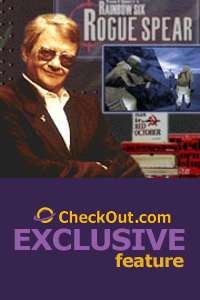
Tom Clancy on Games, Rogue Spear and Terrorism
Since his best-selling The Hunt for Red October, Tom Clancy
has been known for tales of espionage, furious action and painstakingly
detailed military realism. His Red Storm Entertainment, founded
in 1996, brings Clancy's storytelling flair and military expertise
to a new medium: videogames. In 1998, Clancy released Rainbow
Six, the story of a counterterrorist strike force, as both a
novel and a game. The game was a surprise hit with critics and players,
finally giving gamers the kind of realism fans of Clancy's writing
already knew and loved. We spoke with Clancy about Rainbow Six's
upcoming sequel, realism in videogames, and R6's surprising
success.
After so much success in books and film, why did you decide to
form Red Storm and move into videogames? Were you a game player, or
did you see it as a new medium for storytelling?
I play a few
games myself, but mostly I wanted a different way in which to tell
my stories. Coming up with concepts for computer games gives me
another avenue of creative expression. It's not just me telling the
story, it's me designing the idea for a story and letting the
players write their own ending. The net result is that the game
player can directly interact with the concepts, whether they bear my
name or not, rather than just absorb them.
Did the idea for Rainbow Six occur to you first as a
concept for a game or for a book? Will a book or movie follow Rogue
Spear, and are these characters that you intend to develop?
Actually, I got the idea for the book during brainstorming with
the guys at Red Storm. The Red Storm guys and I had a meeting back
in October 1996 in an ale house in Colonial Williamsburg, Virginia,
where we came up with the idea of hostage rescue game. As the creative
ideas began to flow in the next few months, we decided it would
be great to base a book on this team. We worked together on the
storyline; I get to have a lot of creative input without having
to do all of the work with the ones and zeros. I leave that to the
experts at Red Storm. Some of the characters were already in my
books, like Ding Chavez and John Clark. I don't discuss future works
or works in progress, so you'll just have to wait and see.
Rainbow Six's innovative design and engrossing gameplay
surprised a lot of people, and it ended up on almost every "game of
the year" short list for '98. Were you surprised by its runaway
success, or were you sure you had a hit on your hands?
When
the first mission of Rainbow Six was actually coming together
we really started to realize that we might have a hit on our hands,
but hadn't really expected the runaway success. To date we have sold
through over 700,000 copies worldwide! The main achievement of the
original Rainbow Six game has been to establish a brand that
we're now taking into the console market. I expect that Rainbow
Six will be equally successful on those new platforms.
How important is realism in Red Storm's games? Do you think
people who play your games and read your books are looking more
for pure entertainment, or realistic portrayals of situations that
could actually happen?
I think a little of both, but the most
important thing for any game is that it is fun to play. That's
really what we're trying to achieve.
How did the Rogue Spear development team incorporate
realism into the game? Did they interview real counterterrorist
operatives to design missions and the feel of the game?
The
team had already gone through the experience of working with real
counterterrorist operatives on Rainbow Six, and used that
experience and the advice of special forces teams, but they did seek
some additional advice for Rogue Spear as well.
Although fictional, Rainbow Six and R6: Rogue
Spear deal with a terrorist threat that is frighteningly real.
How do you think the world's governments can protect themselves
against terrorism and exterminate the threat?
To truly feel
like we're fighting terrorism, we need as much intelligence and
infiltration as possible into known rivals of democracy. Once that
information is collected, a sincere commitment must be made to
thwart their effects through unified/joint military resolve.
The news is full of computer simulations of one kind or
another being used to train new soldiers and to run test scenarios
of real-life conflicts. Do you think Rogue Spear could be
used as a training tool or simulator?
Yes and no. There are
parts of Rogue Spear based on real-life conflicts, but the
important thing for us was that the game should be fun to play. With
that in mind, not everything is realistic. We did want to stress the
importance of rescuing hostages, of minimizing the loss of life, and
hopefully get that across to gameplayers everywhere.
What are the most significant differences between Rainbow
Six and Rogue Spear?
There are far too many to
mention! We completely redid the artificial intelligence, reworked
the graphics renderer, and enhanced everything else. Fans of the
Rainbow Six game will be pleasantly surprised by the dramatic
improvements, and new players will really enjoy it.
What's next for Red Storm? Are further Rainbow Six
games in the works or on the drawing board? Red Storm's recent
projects have brought your signature realism to the first-person
shooter and real-time strategy genres; what other types of games do
you foresee exploring in future?
I don't discuss works in
progress, but I will say that you'll be pleased with what's coming
up in the near future from Red Storm Entertainment.
|