So
you want to go camping, but you aren't sure what to pack for your trip. We
got you covered.
Preparation
is essential for any outdoor adventure. Having the necessary
supplies and equipment can make a difference in your overall
enjoyment and experience.
If you
are new to camping, the first thing you should do is become familiar
with the basic camping gear that you will need.
One way
is to go camping with a seasoned camper. You can quickly learn from them.
Basically, you need
a shelter, which could be a tent, cabin, or RV, and you
need a bed, which could be a combination of sleeping bags and pads,
cots, air mattresses, and comforters, and you
need to eat, which may or may not require cooking utensils.
If
you need to shop for gear, go to Wal-Mart! They
have all your basics at good prices
Or
Visit
Our Fundamentals of Camping Store
Buy
choosing an item for purchase from our website, your purchase is
actually being made through Amazon.com. Amazon is the most reputable
online company around. Amazon has the lowest prices, prompt delivery
(many orders ship in 1 to 3 days). You always get Amazon's 30 day
return policy for a full refund.
When
My Wife and I started camping, we didn't have much more than a tent,
sleeping bags, one cooler and an old hurricane lamp.
As
far as equipment goes, it would depend on what level of comfort you want. It
also depends on how often you will be camping, to see if it is worth
buying all that I am going to mention.
Accept
the idea that for your first trips you will be under-equipped. Consider
them learning trips. Bring
a notebook to write down all the things you forgot or wish you had
thought of. Even
after 10 years of camping we still do this.
Equipment
Rentals
There
are a number of sporting goods stores that will rent camping gear to
you for a couple of days or more. Check with your local stores
to see if they offer this. For campers just starting out, this
is an ideal way to get your "feet wet" without spending a
lot of money. You can also decide if certain gear like a tent
or sleeping bag is right for you before you purchase it AND if you
ask the manager, he/she will most likely apply a portion of the
rental fee you paid towards the purchase of the equipment.
You
can also Google "camping equipment rentals"
First
of all, you're going to need Shelter and Bedding Essentials:
Many
families have their school age children sleep in separate tents.
(Our
3 older boys each hadtheir
own dome tent.)
Buy
at least a "couple people
bigger" than your family size.
Regarding
size, you will want to keep in mind where you will be camping.
Not
all campsites are created equal.
Your
tent size may require a bigger campsite!
If
buying a tent with an attached screen house, keep in mind that
attached screen houses with a built in floor; when it rains, this
floored-screen house holds water like a swimming pool!
Dome
or cabin - it's really a personal preference.
Many
tents come with the inexpensive easily bendable aluminum kind.
Be
sure to invest in some of the plastic
yellow or orange
ones.
You
will have much better luck anchoring the tarp that covers your tent
to these stakes than the aluminum ones.
Ground
Cloth
Extend
the life of your tent with the added protection of a ground cloth
(ground
cover, tarp, tent footprint).
Consider
using a ground cloth with your tent. This footprint tarp protects
against abrasion and acts as an added barrier to help keep moisture
out of the tent and make it more comfortable for those inside.
You
can use painters tarps (these
are thin clear plastic, and you basically get one use out of them) and
the rolls of plastic sheeting that contractors use (You
can get them at Wal Mart for about $5 per roll.)
As
a ground cloth it can be used a couple of times until holes
start to develop in it, then just throw it away, and make a new one.
They
are also great to cover your fire wood.
See Tarps below
Tarp(s)
can
be used to cover the ground under your tent prolonging the life of
your tent (just make sure the tarp you use under your tent is
slightly smaller than the floor of your tent)
can
be used over your tent to protect it from bird droppings, sparks,
tree branches, extra rain protection, and the sun.
If
using the tarp over your tent, try to get it bigger than your tent
to have an overhang by your tent door. It is wonderful not to have to
step out of your tent immediately into the rain. This keeps the
inside of your tent drier! Some people have been known to buy an
inexpensive dining canopy just for the poles to use for the tarp over
their tent.
Pillows
and pillowcases
Some kind of sleeping mat/pad blue
foam closed cell type (Less expensive) self-inflating
mattresses You
may find a cot a nice little extra.
sheets can
feel better to lay on in humid weather than a hot sleeping bag
Wool blankets nothing
beats a wool blanket as an insulator on cool/cold nights.
Next,
Your going to need Cooking and Dining Eessentials
Take
bottled water for cooking and drinking. Bring large reusable water
bottles that can be refilled, save money, and cut waste.
Also
bring a separate water container for non-potable water that can be
used for chores like washing dishes and cleanup.
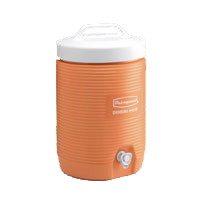
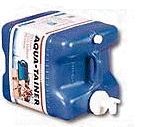
Five
gallon water container
One
with a spicket for drinking is nice.
A
square shaped one will pack easier in your car than a round one.
The
more - the better!
One
for drinking, one for cooking, one for hands and dishes and messes
and one for Kool Aid (or such) for kids and ME!
Freeze
gallons of water ahead of time.
By
freezing gallons of water ahead of time, you will have cold water to
drink for days and ice for your cooler.
Food
Simply
take what you like to eat and will need to prepare a breakfast,
lunch and dinner for each days of your camping trip.
Bring
plenty of snacks for enjoying while hanging around the campground.
Freeze
meals ahead of time. In the weeks prior to your camping trip, make a
little extra of some main courses and freeze the leftovers. When
placed in your cooler, the frozen entrees can take the place of ice
for the first few days. Once they have defrosted, simply heat and serve.
Take
frozen vegetables. Bags of frozen vegetables can also take the place
of ice in your cooler. Once defrosted, they will keep their shape and
texture for a few days in the cooler. A small pan of boiling water is
an easy way to prepare them once defrosted.
Take
along sweet potatoes, squashes and baking potatoes. All of
these vegetables do not need refrigeration and are quite easy to
prepare. With the addition of some onions and a cast iron skillet,
these core vegetables can take on a wide variety of flavors.
Take
lots of fruit. Apples, oranges, pineapples, bananas and cantaloupe
travel well. A sharp knife provides all the tools you need to prepare them.
Stove
Campfires
don't make very practical stoves or ovens.
Sure,
some foods taste good and are fun to cook over the campfire,
however
without appropriate utensils and a proper fire, the food will not
cook correctly and you'll likely wind up with blackened cookware.
As
there may be a grill at the campground, it's not practical for
preparing all your meals on unless you are going to make an entire
day of cooking.
A
two-burner, propane variety campstove with a wind screen is
preferred and makes it easy to boil water and prepare dishes quickly
and efficiently.
There's
something about outdoor cooking that makes food taste better. No
special preparations are required, but a few camping food essentials
will make the task easier.
A
chuck box, also called a patrol box or grub box, is a device used by
campers for storing the many items associated with a camp kitchen.
When packed up, it looks like a large box and traditionally contains
kitchen items such as cooking pots, pans, plates, utensils, and
cleaning items. The box will unpack (usually with a fold down front
and sides) to reveal its contents in specifically designed
compartments, shelves, drawers and racks.
There
are several models commercially available, but many campers choose
to build their own to suit their personal camping checklist. Some
campers use plastic storage containers or crates in lieu of custom
built chuck boxes.
The
primary advantage of having a chuck box is that it is easier to go
camping quickly, because these numerous kitchen items are always
packed and ready. However, some chuck boxes are also designed to
provide work surfaces and utility features, providing the significant
benefit of additional kitchen table space
rubber
mallet with a hook on the other end for pulling up stakes
Small
broom to sweep out your tent
Small
rug for outside your tent door This
is important because it really cuts down on the dirt that would
otherwise end up in your tent!
Clothes
line and clothes pins
Camp
box
This
is similar to a Chuck Box, yet it is for
all your other camping needs, ooposed to Kitchen Accessories.
If
you camp or plan to camp more than once a year,
a
camp box is the best thing you will ever invest in.
The
idea behind the camp box is to place the most common and essential
stuff in one pre-packed place. A camp box can be anything you
choose. I have seen everything from plastic tubs to lockable
toolboxes used effectively for stowing your most crucial camp gear.
The
trick is to pack as much as you can without creating a box that
weighs more than you can move. If the box becomes overly large,
don't worry. Over time you'll figure out what you need to leave
at home and what to include. But when it comes time to pack, the most
common gear is already boxed up and ready to go.
Of
course, a list ensures you'll never forget anything - if
that's possible. Making
a list is probably the hardest thing to do. Most people forget
and some don't bother to take the time it requires. But once
the list is complete, you'll have serious peace of mind. To develop a
good list you have to start with a base of things you normally
bring. Then each time you go camping bring along the list and
update it. Removing things that go unused, but adding stuff you forgot. Eventually
the list will contain absolutely everything you want to bring.
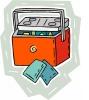
We
take three. All
different colors. Then
you'll
know which one is the "beverage" cooler, which
one is the "food" cooler and which
one is for "condiments"
(eggs, cheese, mustard, ketchup, etc).
A
metal cooler would be heavier, but in the long run you won't need as
much ice.
We
buy the loose cubed kind, because I think it is easier to fit the
food in the cooler. Many people love the big block of ice.
You
decide what will be right for your needs.
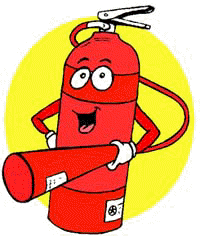
Fire
extinguisher!
All
vehicles and boats should have one. Not a bad idea to have one just
for camping.
For
families with young children, this next item falls in the "Basic
equipment" category, in our opinion.
It
takes a tremendous amount of stress off of the weekend;
however
parental supervision is still required.
A
Baby Gate to
go around the fire pit
NICE
TO HAVE ALONG THINGS
Folding
step ladder good
for some height when tying tarps to the trees
Rake
Kott
grill (grate) Don't
count on having a dependable grate over your fire pit. If your fire
pit has a grate it may be small or bent up. The Kott grill is
actually just a flat grate that takes up less car space than even a
small kettle style grill.
Maul This
comes in very handy for splitting the big chunks of wood many
Campground firewood vendors sell.
Various
length bungee cords (You
can never
have too many of these!)
Bungee
loops
Guy
line adapters These
are like short little bungees with only one hook. These are used in
conjunction with the ropes you use on your tarps.
A
great advantage to using these to attach your tarp to the stakes is
that in a wind you are less likely to pop the grommets from your
tarp. The bungees provide your tarp with move "give" in
stressful situations than just a rope does.
Dining
canopy or screen house
TIP:
Buy enough plastic drop cloths in the paint department of Wal Mart/K
Mart to go around the sides you want covered of your screen house.
Clothespin them to the seam where the screen meets the ceiling. This
also keeps you warmer when it's chilly in the fall/spring. A bit of
an inconvenience, but hey, it works!
Lawn
chairs
Citronella
candles If
you're camping in mosquito territory, you may want to bring some.
Duct
tape spare
batteries of whatever size you use spare
mantles funnel
for filling Coleman fuel lanterns multipliers Swiss
Army knife compass adjustable
wrench pliers nylon
repair tape spare
lantern generator camping
scissors extra
rope liquid
puncture preventative and repair kit spare
fluorescent tubes Sportsman's
goop A
"must" for repairing those leaks you discovered in last
nights rain! seam
sealer 3/8"
Grommet kit
WHY
BOUNCE Fabric Softner Sheets?
All
this time you've just been putting Bounce in the dryer!
TRY
THIS!
Put
a sheet of Bounce in yourpocket to keep yellow-jackets and bees away
It
will chase ants away when you lay a sheet near them.
It
also repels mice.
It
repels mosquitoes. Tie a sheet of Bounce through a belt loop
Prevent
musty suitcases and dufflebags. Place an individual sheet of Bounce
inside empty luggage before storing
Put
a Bounce sheet in your sleeping bag and tent before folding and
storing them. It will keep them smelling fresh.
Clean
baked-on foods from a cooking pan. Put a sheet in a pan, fill with
water, let sit overnight, and sponge clean. The anti-static agent
apparently weakens the bond between the food and the pan.
Deodorize
shoes or sneakers. Place a sheet of Bounce in your shoes or sneakers overnight
shower
kit
Tupperware
Box, etc. "toiletry"
type items
toothbrushes toothpaste dental
floss shampoo/conditioner soap q
tips deodorant razor/shaving
cream mirror the
mirror you find in the camping section of Wallmart or wherehaveya -
it has a handy little hook for hanging it.
Besides
toiletries you won't want to forget any
prescription medication family members need to take!
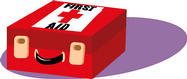
FIRST
AID KIT
Buying A First Aid Kit: Which company kit is best?
Purchasing a commercially packaged kit from either of
the following four companies, is as close as any to putting a doctor
in your pack:
Atwater Carey (800/359-1646)
Adventure Medical Kits (800/324-3517)
Outdoor Research (800/421-2421)
Sawyer (800/356-7811)
Other commercially packaged kits cannot hold a candle
to any of these four.
If you are having trouble finding any of the above
kits in your local stores, or wish to obtain specialty first aid gear
to refill your kit, then look no further than Chinook Medical
Gear-the best, one-stop, mail-order shopping source. You can get
their catalogue by calling 800/766-1365.
Practice
assembling and using your new stove, lantern and tent in your backyard.
You
might even do a "backyard overnighter" with the kids for practice.
Cook
up a dinner of camping style food, tell some campfire tales and tuck
the kids in their bags in the tent for the night.
You'll
be glad you did a test run.
It's
always better to get your act together in the comfort of your own
backyard than to arrive at a campsite tired, hungry and clueless
about how to make camp.
You
may want to even try setting it up in the dark in your backyard to
get the hang of it.
You
NEVER know!!!!
Simply clicking on the image
above will open your default E-mail Writer and have a pre-determined
subject line. You can simply send this
E-mail with nothing to write and I will be alerted with the Page that
has a broken link. However it would be nice if
some input from you of exactly which link is broke. Thank You!!!!
DISCLAIMER:
PLEASE READ - By printing, downloading, or using any info from
this site, you agree to our full terms. Review the full terms by clicking
here. Below is a summary of some of
the terms. If you do not agree to the full terms, do not use the
information. All information on this web site is provided as a free
service. Under no conditions does it constitute professional advice.
No representations are made as to the completeness, accuracy,
comprehensiveness or otherwise of the information provided. This site
is considered publishers of this material, not authors. Information
may have errors or be outdated. Some information is from historical
sources or represents opinions of the author. It is for research
purposes only. The information is "AS IS", "WITH
ALL FAULTS". User assumes all risk of use, damage, or injury.
You agree that we have no liability for any damages. We are not
liable for any consequential, incidental, indirect, or special
damages. You indemnify us for claims caused by you.





 Tent
Poles
Tent
Poles
 Sleeping
Bags
Sleeping
Bags