|
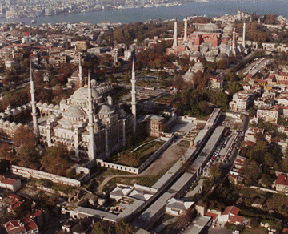
Climate It is not possible to put into one type the climate of region where Istanbul is completely located. The city has different climate conditions from many areas of inhabitance because of its geographical location and physical geography. Three types of climate is dominant in Istanbul throughout the year. These are north and south entering climates and mild climate. The climates dependent on west and east directional winds are trivial. The most frequent of the three is the climate observed when northern winds are dominant. There are four phases according to the seasons; cold, hot, and two transitional phases: One of which is long and the other is short… By the Numbers: Surface Area : 5.512 km² Population : 10.041.477(according to year 2000 census) Population Density (person/km²) : 1.822 Number of Mosques : 2.562 Number of Churches : 40 Number of Synagogues : 16 Number of Motor Vehicles : 1.152.817 Number of Primary Schools : 1.488 Number of Secondary Schools : 611 Number of Universities : 20 Number of Hospitals : 196 Number of Chemists : 3.852 Visitor Entries : 1.725.175 Tourist Enterprising Licensed Accommodation Facilities : 254 Tourist Enterprising Licensed Entertaining Facilities : 349 Contribution to the budget : 6.454.947 billion TL. Share in Turkish Gross National Product : 23 percent Share in Collected Deposits of Turkey : 35 percent Geographical Location Istanbul… The main reason of Istanbul’s being a very popular city for which wars are made, lives are lost is its geographical location… Let’s review this location first: In its south stretches Marmara Sea and in its north is Black Sea. Its west part is in Europe and east part is in Asia. The important waterline dividing Istanbul into two is the Bosphorus… The only alternative to reach the Aegean Sea and the Meditteranean Sea, therefore to open sea is to use Istanbul and the the Bosphorus… Istanbul is both the nearest Asian city to Europe and the nearest European city to Asia. What adds to Istanbul’s significance is its being a port city and all trade paths’ passing through the city for thousands of years… Another important feature of Istanbul is that it has a highly sheltered structure. Especially the center which is presently called as the “historical peninsula”, which was made capital city by both Byzantine and Ottoman Empires and its being located on a hill surrounded by three seas made it almost impossible to be conquered… Indeed, Haliç had the quality of being an unparalleled harbour sheltering navy fleets. Istanbul, still geographically perfect! Although thousands of years have passed, Istanbul still maintains its geographical importance. Today Istanbul is a huge metropolis connecting continents, cultures, religions and being home to eleven million people; and one of the greatest business and cultural center of the region… PHOTOS Aqueducts History Churches |
Istanbul Photos
|
| Istanbul | Alexandria | Crete | Home |
|---|