China

Travel in China is fun. The driving isn't as chaotic as Egypt or Turkey, but it is comparable to New York all the time. The Chinese also have lanes that are devoted to bike traffic. Makes sense when you think about it, but I was shocked and amused to see it. But then Vietnam has been called the Land of Bicycles, why should China be so much different?
The trains and planes don't seem too much different then their European counterparts. Relying more on practicality then looks.
China doesn't always offer a lot of luxury, but there wasn't much to complain about. The one luxury there was, was the hotels. I don't know if China has anything less then a 5 star hotel for tourists.
When I travel I usually go upper mid-range, but theere was no mid about these hotels. They were nice. The lack of English TV stations was the only thing missing, but I was in China. Can't have everything, though I did watch a lot of CNN.
The food was absolutely amazing. I am not a food lover either. To me meals are optional. Ranging between 1-3 a day. But in China I fell in love with food. I have considered moving there for no other reason then the food. It really is that good.
The dumplings are great, but the noodles are like sex for your mouth. I know you are probably thinking we have Chinese food here how different can it be? The only similarity is that they look the same. That is where the similarities begin and end. I have heard Japanese noodles are on par with the Chinese. In my humble opinion they don't come close. Japanese noodles are kind of slimy. If you like that (which I don't) maybe you'd prefer Japanese, but I whole heartily endorse the Chinese over their island neighbors.
The ancient buildings are quite pleasing to the eye. The new ones look like something out of a European movie filmed in the 70s. You will see a lot of temples. I learned a lot about Tibetan Budism. After a while they begin to blur, which is a shame because I am sure each temple has its own unique character. But being a stupid Westerner I didn't see it. Their temples are filled with beautiful statues. Many of which are over 20 feet tall. There is even a temple which is carved out of the side of a mountain. I'm not a big one of religion, but I do appreciate art. So I enjoyed visiting the temples for that reason. And considering that the Chinese still participate in a Communist government they are very tolerant about religion.
I am a little dissapointed with the lack of ruins and artifacts from the Three Kingdoms period. That is actually why I went there. To see where my heros fought and died. I read the book Romance of the Three Kingdoms. The remains of the Three Kingdoms period is farmland, with a little sign saying this is where the old city was. The shrine for Guan Yu's head was interesting though. I got to touch a replica of Black Dragon, his sword!
Overall the people were friendly, but they don't speak English as much as European countries do. You need a tour guide if you don't speak Chinese. There will be, what we termed the gauntlet, vendors lined up before the sites. But they take no for an answer. The Great Wall had the most. There were people on the wall selling things. Some of them were very nice about it though. They are almost as interested in talking with you as selling something. They like to practice their English. No doubt with that profession you live and die with the use of the English language. But I didn't get the feeling of being attacked when they approached me, like I did in Egypt. Also be prepared to go to a lot of friendship stores. These are gift shops that have different specialties (jewelry,clothing, etc...). They are very, very nice, but they are expensive. And I got one of the tour-guides to admit he got a 10% comission from what was bought. Not all of them operate like that, but Randy did (they all have English names as well as Chinese ones).
Overall I can't say there is any other country that I am as impressed with as China. Maybe Vietnam, but I lived there. If you are looking for a place to vacation go to China.
Beijing
Beijing is the capital of the people's Republic of China. The municipality is under direct administration of China's Central Government. The city is the center of politics, culture, and international exchanges, as well as one of the largest metropolises of industry, finance and trade.
Beijing is a world-famous city for its long history and splendid culture. According to archaeological discoveries, more than seven hundred thousand years ago, there were primitive people (Beijing Ren) in this area. The written records show that in 350 BC, it was occupied and made the capital of Ji. Later in its history it got other names such as Zhuojun during the Sui Dynasty (581-618), Youzhou during the Tang Dynasty (618-907), Nanjing and Yanjing during the Five Dynasties and the Liao Dynasty (907-1125), Zhongdu during the Jin Period (1115-1234), Dadu during the Yuan Dynasty (1271-1368), Beiping and Beijing during the Ming Dynasty (1368-1644), Beijing during the Qing Dynasty (1644-1911), Beiping again under the control of Nationalist Party (1912-1949) and it finally was named Beijing after the People's Republic of China was founded in 1949.
In the year 1272, Beijing became the Capital of a unified country for the first time in the Yuan Dynasty (1206-1368), which was written in the Travels of Marco Polo.
In fact, Beijing has been the Capital of Jin, Yuan, Ming, Qing and Republic of China and today it still is the center of national politics, economics, culture, transportation and tourism.
Now Beijing is undergoing big changes and heading for modernization as ancient civilization meets with modern achievements of the whole world, creating youthful vigor and energy.
Beijing lies in the continental monsoon region in the warm temperature zone and its climate represents as hot and rainy in summer and cold and dry in winter.
The four seasons in Beijing are distinct. It is dry, windy and sandy in spring and hot and rainy in summer. Autumn is the best season in a year when the sky is blue; the air is crisp, mild and humid. However, winter is cold and dry with little snow. The average temperature throughout a year is 11.7¡æ. The average temperatures of the hottest month, July and the coldest month January range from 27¡æ and -4.6¡æ. The shorter seasons, spring (usually from February to April) and autumn (usually from August to October) are better seasons for visiting Beijing when it is sunny and warm with few tourists crowding in the attractions.
If you come to Beijing in spring, you could wear a thin sweater, a pair of sweat pants, and a coat. But sometimes it may be a good idea to bring a warm cap because it is windy and sandy during this period though it is not cold. In summer the temperature could reach as high as 30C. When you go out, you could take an umbrella along with you if it doesn't bother you much, because a downpour may come unexpectedly at evenings from July to August. Autumn is the most beautiful season, but after October you may feel the constant changes of the weather and you may encounter light rains at any moment. So it is better to bring some heavy clothes with you. In winter, you need a heavy woolen sweater, and a long wind coat or a down jacket. Generally there will be two or three heavy snowfalls each winter, so it is always wise for you to have anti-skidding shoes with you when you come. Lastly, don't wear light-color clothes in winter.
Bilingual weather information can be obtained if you dial 121 in Beijing.
Beijing had been the Capital of four Dynasties before the founding of PRC. Its Great Wall, splendid palaces, beautiful gardens, old temples, a considerable variety of exhibitions and museums and former residences of celebrities show its glorious history and civilization.
Today more than two hundred and sixty places of interest have been opened to the public with new ones under building and planning. Besides these places of interest, the natural scenery of Beijing's suburbs also attracts great many visitors with its charms, hills, lakes, hot springs, karst caves and so forth.
In 1986 sixteen famous scenic spots of Beijing were picked from forty spots and were named "the Sixteen Sights of Beijing". They are Tiananmen Square, Forbidden City, Badaling Great Wall, Beihai Park, Summer Palace, Temple of Heaven, Fragrant Hill, Shidu Scenic Spot, Relics of Primitive at Zhoukoudian, Longqing Gorge, Big Bell Temple, White Dragon Pond, Ming Tombs, Lugou Bridge, Mutianyu Great Wall and Grand View Garden.
The Capital Airport, the largest and most advanced one in China, has more than twenty international airlines connecting countries in Asia, Africa, America, Europe and Oceania. It has over thirty airlines connecting about eighty big cities within the country. Meanwhile, it is the center of highway-net and communication.
There are more than two hundred star hotels in the city supplying more than fifty two thousand rooms. There are about three hundred travel agencies around here.
Beijing is not only a world-famous city for its tourism but also a good medium for you to know more about China, a time-honored country, and the Chinese, a diligent and wise nation.
Forbidden City
There is a world famous architecture in the center of Beijing. It has thousands of splendid rooms and magnificent towers.
It is the Forbidden City - the largest, best-preserved, mass group of palaces in China.
In the past, it was named the Forbidden City. After PRC was established, it was renamed the Palace Museum (Gugong Bowuyuan). You will regret if you come to Beijing and didn't visit the Forbidden City.
Why is the Forbidden City so enchanting? First of all you should know its history. It used to be the palace of Ming and Qing Dynasties. Altogether 24 emperors lived here. Construction of the Forbidden City started in the fourth year of the reign of Emperor Yongle (1406) of Ming Dynasty and was completed 14 years later.
This rectangle-shaped palace is 960 meters long from south to north, 753 meter wide from west to east. It occupies an area of 720,000 square meters, among which the total floor space is 155,000 square meters.
Counting the space enclosed by four pillars as a "room", there are more than 9900 rooms in nearly 900 buildings. Tradition has it that there are altogether 9999.5 rooms in the Forbidden City, only half room less than the Heavenly Palace, which belongs to the Jade Emperor in the heaven. So it is said that the Forbidden City is the largest palace in the world.
Entering the Forbidden City through Wu Gate (Wumen), you will find a square. This is the first square in the Forbidden City. A belt-shaped artificial river runs through the square from west to east. It is the Golden Water River.
On the river there are five marble-made bridges, the middle one of which could only be used by the emperor. Civil and military officials passed from the left side, and members of imperial families passed from the right side. Different people used different bridges, which could not be confused.
Walking forward, you will come across the Gate of Supreme Harmony (Taihemen). Two bronze-cast lions stand in front of the gate. The one on the right is male, under which there is a copper ball, symbolizing power. The one on the left is female, under which a little lion is lying. The statue stands for intimacy and maternal love. Watching carefully, you will find something special - there are 13 rolls of hair on the head of lions, signifying the supremacy of the imperial family.
the Gate of Supreme Harmony is the front gate of the three outer halls. The floor was made of "gold bricks" and the interior roof of the gate was painted with golden dragons and colorful phoenix.
The hall opposite to the Gate of Supreme Harmony is the Hall of Supreme Harmony (Taihedian). There is a square between the hall and the gate, the Square of Supreme Harmony (Taihedian Guangchang), occupying an area of 30,000 square meters.
What is unusual is that there is neither trees nor grass on the square. It is so vast and so quiet that it makes people feel solemn and respectful.
In the middle of the square is a straight road, which was used only by the emperor. Both sides of the road were paved with bricks. Allegedly, there are 15 layers of bricks spreading disorderly, and they were built to avoid that someone would dig the ground and enter the hall.
Passing through the square, you will see the Hall of Supreme Harmony. "Supreme Harmony" was quoted from a famous Chinese religious book "Zhouyi". According to "Zhouyi", supreme harmony means all things in the universe are harmonious and satisfactory.
There are 18 big copper stoves on each layer of the terrace on the square. Tradition has it that they represented 18 provinces at that time. Combustion sandalwoods were burnt in the stoves on each grand ceremony. On the terrace in front of the hall are a copper tortoises and cranes symbolizing longevity. To the east of the terrace is a sundial. It was used as timer in the past. To the west is a grain-measure, symbolizing that the imperial power was fair. Grand ceremonies were held here.
At the center of the Hall of Supreme Harmony is the throne which stands on a sumeru dais (it originated from Buddhist seat, later it was used as the dais in the high-level architectures in China.). In the front of dais and both sides are wooden steps. On the dais is a golden chair carved with dragons. It was the dragon-chair of the emperor.
Around the throne stand two bronze cranes, elephant, tripods, incense burners and so on. On the elephant stands a precious bottle holding five cereals (rice, millet, sorghum, wheat and beans). It is symbolic of peace and bumper harvests of the five cereals.
Behind the Hall of Supreme Harmony is the Hall of Central Harmony (Zhonghedian), the second hall in the Forbidden City. "Central Harmony" was quoted from an ancient Chinese book "Liji Zhongyong". It means that everything should be accomplished impartially and properly. The Hall of Central Harmony is in the middle of the three halls and the smallest one. It was the rest place for Emperor on his way to the Hall of Supreme Harmony.
The last of the three main halls in the outer court is Hall of Preserved Harmony (Baohedian). "Preserved Harmony" means that the consciousness of the members of the imperial family is clear and unconfused so that the emperor could be healthy and the country be peaceful.
In Ming Dynasty when the crown prince was conferred and the empress was appointed, the emperor would be here to receive congratulations from officials. In the Qing Dynasty, imperial banquets were given here to entertain princes of vassal states on the eve of lunar New Year.
Since the Forbidden City is too large, it is impossible to visit all rooms. The above mentioned is only the main part of the palace. After visiting the three halls, visitors can choose three routes according to your own interest and schedule.
The first route is to visit the three rear palaces. The second is to visit the six palaces in the west. The third is to visit treasure houses in the east.
The last scenic spot is the Imperial Garden. Occupying an area of 120,000 square meters, it holds more than 20 architectures in various styles. While viewing the rare "imperial garden in Chinese palace", you will be distinctively enchanted by the exotic flowers, rare herbs, pavilions and towers in the garden.
According to some people, visiting the Forbidden City is a test of eyesight and foot. It is worthy of the name "City in City". The structure is a unique combination of artistic tastes, mechanics, architecture, and craftsmanship. Those people who had visited here said that the most attractive things in the Forbidden City were the Hall of Supreme Harmony (Taihedian) and the dragon seat in the hall.
If you want to fully appreciate this ancient palace, you will have to spend more than half of the day. If you only intend to visit it as quickly as possible, you will also need at least two hours.
Tiananmen Square
Tiananmen Square (Tian'anmen Square, Tian An Men Square) is located on the Chang'an Street in Beijing.
Built in Ming Dynasty (1386 ~ 1644A.D.), Tiananmen Gate was initially named Chengtianmen Gate, which meant "getting power from God, receiving instructions from Heaven". Chengtianmen Gate was destroyed in the flames of war in the Ming Dynasty.
After being rebuilt in 1651, it was renamed Tiananmen Gate. The world-famous Tiananmen Square is to the south of Tian'anmen Gate.
Tian'anmen Square, the largest of its kind in the world, covers an area of 400,000 square meters. It has the capacity of holding a mass assembly of one million people. It is 4 times larger than the second largest square in the world - Saint Marco Square in Italy.
At the center of the square is the Monument to the People's Heroes. In the southern part of the square is the Memorial Hall of Chairman Mao Zedong. In the southern end of the square is the South Front Gate, with the Great Hall of the People on the west, the Museum of Chinese History and the Museum of the Chinese Revolution on the east. Tian'anmen Square is often a place where large ceremonies are held.
Witnessing through wars and fires, Tiananmen Square went through many important historical events in China. On May 4, 1911, the epoch-making "May 4 Movement" broke out here.
On October 1, 1949, Chairman Mao Zedong solemnly proclaimed the founding of the People's Republic of China from the tower of Tiananmen Gate. Most recently on June 4, 1989, the "Tian'anmen Square Students Movement" was also a event marks the history of China.
Because of its special location, historical significance and high reputation, Tian'anmen Square has become one of the most-frequently-visited squares in the world. If you plan to visit Beijing some day, you are bound to come here - Tiananmen Square is the largest of its kind in the world and bounded with history.
In the north of Tiananmen Square, a well-known square in the world, there is a terrace called "Tian'anmen Gate" (Tiananmen Gate, Tian An Men Gate). This 33.7-meters-high terrace has been standing in Tian'anmen Square for more than 500 years.
White marble used as the foundation of Tian'anmen Gate, on which stands a 10-meter-high red terrace, the terrace were made out of huge bricks, each brick weighing 43 kilograms.
Because the figures "9" and "5" are the symbolic of the supremacy of the emperors, the terrace hall were built with nine rooms facing west and five others facing south.
On October 1, 1949, Chairman Mao Zedong ascended Tian'anmen Gate to proclaim the founding of the People's Republic of China. Since then, Tian'anmen Gate has become an important place for parade and mass assembly in China.
The remodeling of Tian'anmen Gate was opened to the public on January 1, 1988. Only in a few years, millions of people have visited Tiananmen Gate. In the tourist season, the number of tourists each day can reach more than 10,000.
Like emperors in ancient China, you can also ascend Tian'anmen Gate and overlook the vast Tiananmen Square. You can imagine the historical scene that hundreds of civil and military officials are standing side by side on Tiananmen Square.
Tian'anmen Gate was first built in the reign of Emperor Yongle in the Ming Dynasty (1417A.D.). It was initially named "Chengtianmen Gate", which meant "accepting full authority from God". It was the front entrance of the Forbidden City.
Chengtianmen Gate was not so grand at that time, nothing more than a horizontal tablet inscribed with "Chengtianmen" and a three-level wooden arch. This arch was destroyed in a fire in 1451 and was rebuilt in 1465, and destroyed again in flames of war in the last years of the Ming Dynasty (1368A.D. ~ 1644A.D.). It was not rebuilt until the reign of Shunzhi in the Qing Dynasty (1651A.D.) when it was constructed into the present looks and renamed to "Tiananmen Gate".
At the time, Tian'anmen Gate is extremely sacred, representing "Imperial Authority", the highest power of all. In feudal dynasties, not only imperial edicts were issued here, grand ceremonies were also held here. The Stage of Issuing Imperial Edict was set up in the middle of Tian'anmen Gate.
When an imperial edict was issued, hundreds of civil and military officials kneeled by the south of Gold Water Bridge. The imperial edict was placed on to a wooden phoenix, "Golden Phoenix", and received by officials of rites with a cloud shape wooden tray. Later the edict would be copied on to yellow paper by officials of rites and issued throughout the country.
This ceremony was called "Golden Phoenix Issuing Edict". Whenever new emperors ascended the throne or the empresses granted the title, the imperial edicts must be announced from Tian'anmen Gate, only after the announcement could the edicts be made known to the public.
In addition, Tian'anmen Gate was the gateway for emperors where he took his major visitation each season. Each year near the winter, emperors would go to Temple of Heaven and offer his pray there; in the summer, he would be at northern suburb of Beijing to worship the Earth.
In springtime, he routinely made a prayer for harvest of rice in the first lunar month or went hunting in the second lunar month. When emperors went out for inspection, they must offer sacrifices to the road; when senior generals went to battle, emperors would hold a farewell ceremony at the gate in person.
This gate was also the place where emperors would call in the first three winners of the annual national examinations after the result were announced. He would meet them in person, which was a great honor to the winners.
Tian'anmen was also a place for holding "Autumn Judgement" and "Judgement by Court". In the Ming and Qing Dynasties, court officials would submit to emperors the registers containing the names of prisoners who were sentenced to death from each province. In the middle of eighth lunar month, emperors would make the final sentencing. This was called "Autumn Judgement" or "Sentence in Autumn".
Temple of Heaven
The Temple of Heaven is the largest historic synagogue of China, located in the south of Beijing and has existed for more than 500 years.
It was the place where every emperor of Ming and Qing Dynasty (1386~1911A.D.) offer sacrifices to Heaven and a place for emperors to worship.
The Temple of Heaven was built in 1420, the same year as the Forbidden City. The Temple of Heaven covers an area of 2,700,000 square meters and has two altars, an altar on the inside and one on the outside.
The north wall of the Temple of Heaven exists in a circular shape while the other three walls are in square shape, together it represents "harmony of Heaven and Earth".
The inner altar is the main building of the Temple of Heaven. The Circular Altar and The Imperial Vault of Heaven stand on the north of the inner altar, while The Hall of Prayer and The Huang Gan Hall facing south. There is a 360 meters long corridor connecting the two together.
The Hall of Prayer is a 38 meters high, colorful, splendid, round hall. The eaves of the hall were built with blue color glazed tiles. Because the sky is blue, so the color blue was used to resemble heaven.
Twenty-eight huge pillars supported the hall, four of which are of 19.2 meters high. In the center of the hall, there is a huge round marble carved with dragons and phoenixes, matching the design of curling dragons on the ceiling.
The Imperial Vault of Heaven is another important building. It was formerly the place for housing the memorial tablets of "God in Heaven", with the height of 19 meters and 15.6 meters wide. Built with bricks and woods like the Hall of Prayer, it is smaller than the Prayer Hall.
It comes with a single eave, lie with blue tiles and gold color ceiling. There are also white marbles railings around the hall. Seeing from a distance, the Imperial Vault of Heaven is like a giant blue umbrella with gold tip.
There is a curving wall surrounding the Imperial Vault of Heaven, which called the Echo Wall. The inner portion of Echo Wall is very smooth and clean, so that sound could be bounced and transmitted. If there are two persons setting a part, one on each end, friend on the other end of the wall can hear your gentle whispers quite clearly. You will surely be interested in trying it and have fun of it.
Another important structure of The Temple of Heaven is The Circular Altar, which is a three levels stone altar. Each level has white marble railing. This Altar presents the design of geometric figure showing the ingenious architectural designs. The number of bricks used, slats on the altar, the steps and the fences are all "nine" or are "multiply of nine", symbolizing "Nine Divisions of Heaven", which is the center of heaven where God lives.
It is because the Temple of Heaven is where emperors worship and offer sacrifices, therefore, the components used in the temple are unique, and each has its own implication. If you look carefully you will understand that the designer was trying to bring out his original thought through this temple. It is to show the harmony between heaven and earth, God and mankind.
Because of its particular design, The Scientific, Educational, and Cultural Organization of United Nation inscribe the Temple of Heaven into the world heritage list. The Temple of Heaven is not only a famous scenic spot but is also well-known as an object to architects and people who show interests in architectural design.
As famous as the Forbidden City and the Summer Palace, the Temple of Heaven is a "must" to visit for every tourist coming to Beijing.
Yuan Ming Yuan
The Yuanmingyuan Park (Yuan Ming Yuan) is located in the northeast part of Beijing. It is a masterpiece of royal gardens in China and is worldly known as a famous scenic spot.
The construction of the park buildings started in the 18th year of Emperor Kangxi in Qing Dynasty (1709A.D.), went through six emperors and finally finished building of Yuanmingyuan Park, Chang Chun Garden, and Wan Chun Garden, after more than 150 years. These three gardens are often referred to as a joint name: The Yuanmingyuan Park.
The word "Yuanming" in Chinese means round and bright. The implication of the word here is: "roundness is moderate while brightness will cover the whole nation". It is the doctrine of Confucianism, and indicates that Emperor Kangxi was a brilliant leader who will bring happy life to people.
The Yuanmingyuan Park covers a total area of 350 acres and the architecture area of 160, 000 square meters, 10,000 square meters larger than the Forbidden City. Inside the Yuanmingyuan Park, bridges are everywhere, about 100 bridges. Scenic spots are all over, with more than 100 beautiful sights. Buildings with carved beams and painted rafters, pavilions, studios are in various shapes and in different sizes, which made out of splendid materials.
The boundary of all three gardens are about 10 kilometers. The total length of walls of Yuanmingyuan is about 20, 000 square meters, which is honored as the most splendid garden among all gardens of China.
There are about 200 manmade mountains in the park with professionally designed cliffs, stones, and deep valleys by horticulturists. There are also large sections of ponds, the Grand Tai Lake, the winding streams and rivers. Some ponds are connected and some are independent. The water area occupies half area of the Yuanmingyuan Park.
Multifarious architects are scattered in the special designed mountains and lakes, as beautiful as paintings. Many spots of the Yuanmingyuan Park imitate famous mountains and lakes or well-known gardens in South China. Curios and art works are numerous, which is like an art museum with all the gardens and collections in the world.
Since it was built, Emperor Qianlong praised it as "the place where God of heaven lives", and the sights which ancient emperors had toured could not be better than the Yuanmingyuann Park. In the history of Chinese horticulture and world gardening, the Yuanmingyuan Park is a bright and dazzling pearl, it is a garden without a match in the world.
"If immortals were human beings, then the Yuanmingyuan Park would be a heaven garden" Said an English clergyman when accompanying the united British and French army. Astonished by splendid scenery and he sang high praise for the Yuanmingyuan Park. It was not long after the clergyman said so, did the united British and French army burnt this imperial garden, as beautiful as the garden in heaven, for three days and nights, to complete ruins.
This world class masterpiece garden, The Yuanmingyuan Park was then turned from a beauty into a deserted place full of wild grasses. Today, if you walk and stand in the ruins of the Yuanmingyuan Park, you will be deep in sorrow, mourning her great, brilliant history.
It is because there is an unredeemed and cruel history about the Yuanmingyuan Park, today, more and more tourists from all over the world come here to pay a visit. No matter what kind of feeling you have visiting the Yuanmingyuan Park, pondering the past, cherishing the memory in mind, or with curiosity, it is quite special and different from visiting other scenery.
Fragrant Hills Park
The Fragrant Hill Park is located at the hillside of West Mountain. It is a famous park in Beijing with beautiful scenery and long history.
The Fragrant Hills Park is particularly popular for its late autumn scene when all the leaves of 90, 000 maple trees on the hill turn blazing red after the first frost and the scene is unforgettable.
The Fragrant Hill is like natural colorful brocade with green pines, persimmon trees. Since the ancient times, there are many poems related to the blazing red leaves on Fragrant Hill. The most famous poem is as following:
"The frost leaves on Fragrant Hill owns more color than the flowers in February."
Therefore, Fragrant Hills Park becomes more and more popular and is one of the famous scenic spots in Beijing.
Inside the park, you could see Luminous Temple (Zhaomiao), a Tibetan-style Monastery, which was set up in 1780. The Octagonal Glazed Tile Pagoda stands beside the temple. There are 8 bells hanging over 8 eaves, which make nice sounds. Turning north to the Chamber of Reviewing the Mind built in Ming Dynasty (1368-1644), you come to Biyun Temple.
On the way to the temple, you will firstly visit Yuhua Villa, the major building in Fragrant Hills Park. Here, you could overlook the fantastic scenery around the hill. Especially when the sun sets, it presents a magnificent picture of the red sunset and the blazing red maples all around the hill.
As a matter of fact, the Fragrant Hills Park doesn't only present its beauty in late autumn. In other 3 seasons, you could also see the fantastic scenery at the Fragrant Hill. When spring comes, trees turn green and every creature becomes active.
In summer, flowers, both famous and unnamed, are in blossom. It also presents a beautiful picture in winter. Furthermore, Emperor Qianlong, Qing Dynasty, once paid a visit to Fragrant Hill and wrote down in Chinese characters: "Beauty of Fragrant Hill in Winter".
"Fragrant Hill in Winter" is one of the top 8 scenic spots of Beijing.
Bei Hai Park
Located at the center of Beijing, the Beihai Park was built in the Northern Liao Dynasty (907A.D. ~ 1125A.D.). It occupies an area of 680,000 square meters, half of which is the lake area. It had been the imperial garden for a long time. Now it is the oldest and best-preserved imperial garden in China.
The landscape in Beihai Park consists of three main parts. Tuancheng City is the major scenic spot in the south. Yong'an Temple, White Pagoda and Yuexin Hall are the main scenes in the middle. Wulong Pavilion, Xiaoxitian, and Jingxin Hall are the main scenes in the north.
When you step into the south entrance of the park and look as far as your can, you will find verdant trees and splendid palaces on Qionghua Islet. The islet is located in the south of Taiye Pond. Yong'an Temple, Falun Hall and Zhengjue Hall are the major scenic spots in the south of the park. Connected with the bank in the southeast by a stone bridge, It shines jointly with Jingshan Hill and Forbidden City.
A stone tablet written by Emperor Qianlong in Qing Dynasty (1644A.D. ~ 1911A.D.), erects in the depth of the woods. The buildings and the corridors on the hill are reflected in the water, which forms a beautiful landscape. There are more halls and towers in the west side of the park. One of the halls houses the precious inscription which was made during the reign of Qianglong (1736 ~ 1796A.D.) in Qing Dynasty.
The 36-meter-high White Pagoda in Yong'an Temple was built in 1651. It is a symbolic architecture in Beihai Park. When you stand on top of the White Pagoda Hill, you can clearly see City of Beijing. From here you can easily identify the Forbidden City. Smooth lake and weaving boats in the north and Xishan Hill in the west, such scenery can surely make you forget all worries and heighten your spirit.
The Beihai Park is a former imperial park. It's one of the most beautiful places in Beijing. Beside the beautiful scenery, you can also find various cultural relics and unique architectures. The ancient park is not only a favorite place of the old and the young but also a place of interest for tourists from home and abroad.
The construction of the Beihai Park originated from an age-old legend. Tradition has it that there were three fairy mountains (Mt. Penglai, Mt. Yingzhou, and Mt. Fangzhang), on which immortals lived. Ever since Chinese first Emperor, nearly every emperor in different dynasties had the dream of being immortal. Later, Emperor Hanwu in Han Dynasty (206B.C.to 220A.D.) ordered to dig a vast pond in the north of Chang'an City and named it "Taiyechi Pond". On the pond, three artificial hills were heaped, which were named after the three immortal mountains mentioned above. Since then, emperors in each dynasty were fond of constructing their imperial gardens into the style of "Three Hills in A Pond".
The Beihai Park is such a case. Beihai stands for Taiyechi Pond, Qionghua Islet for Penglai Mountain, Tuancheng City, and Xishan Terrace in the water for Yingzhou Mountain and Fangzhang Mountain. There are many traces of praying to immortals in the park, such as Lugong Cave, Xianren Temple, and Tongxianchenglu Tray.
The pagoda was constructed on a brick-made sumern base, on which stands a terrace of three levels. Under the pagoda some Buddhist articles were kept, such as niche, altar, and so on. The White Pagoda is a Lama Pagoda. It was destroyed by earthquake in 1679 and 1731 and rebuilt twice.
Great Hall of the People
The Great Hall of the People is located to the west of Tian'anmen Square, Beijing.
The Great Hall is the place where national conferences are held. The Standing Committee of the People's Congress of China (SCPCC) is located here as well.
The Great Hall is similar to the Capital Hill of United States, where many important national affairs are discussed. Currently, the Great Hall is also the place to hold important conferences and some large international events.
It is not at all exaggerating if you call the Great Hall magnificent. It covers an area of 171, 800 square meters, with 320 meters in length by 206.5 meters in width. The central part of The Great Hall is higher, with the highest part in 40.5 meters, while the two sides are a little lower and.
At the eaves of the main gate, there hangs a national emblem of People's Republic of China. Twelve 25-meters-high pillars set on two-meters-high marble foundation, which is really solemn and modern.
The Great Hall consists of three sections. The central of Great Hall is the "ten thousand people hall" with volume of 90, 000 cube meters.
The northern section is the banquet hall with an area of 7,000 square meters. It can hold 5, 000 people having banquet simultaneously.
The south part is office building of Standing Committee of People's Congress of China.
There are also halls named after the provinces and autonomous regions. Thirty-two provinces together with two autonomous regions each own its hall in the Great Hall. Each hall has its unique characteristics of the province. Besides, there is an auditorium containing 600 seats.
Built in September 1959, the construction of Great Hall of People took only 10 months in total although it is a mass construction, which is unprecedented in the architect history.
Now, some of the sections of the hall is open to the tourists. If you've been to the Capital Hill in U.S. or Parliament in other countries, it will be interesting to compare these congress halls with The Great Hall of the People.
Chairman Mao's Mausoleum
The Chairman Mao's Mausoleum stands in the south of the Tian'anmen Square, between the Monument to the People's Heroes and the Zhengyang Gate. The Memorial Hall is to memorize the founder and first Chairman of the People's Republic of China. It provides people with a place to show their respects to Chairman Mao.
The Chairman Mao's Mausoleum laid its foundation on November 14, 1976, immediately after his death, and was completed on May 14, 1977.
The Memorial Hall is a square building with light yellow walls and with tumbler roof. The yard of Memorial Hall has the length of 260 meters from south to north and width of 220 meters from west to east. The commemoration hall is located in the central of the yard.
The foundation is built by claret granite with 105.5 meters long each side and 4 meters high, which makes the hall quite stable. The stairs of north and south sides both have 2 stripes of white marble on which are carved the garland composed of sunflowers, evergreen, pine branch and winter sweets.
The wall is covered with light yellow granite, which makes the hall very bright and solemn.
Entering from the north gate of the hall, you will see a white marble statue of Chairman Mao of more than 3 meters high. There hangs the huge velvet fresco of "motherland of China" behind the statue. When you go south, through the golden wooden gate, you will come to the respecting hall. There places the brilliant flowers, the coffin platform made by black granite lies in the flowers.
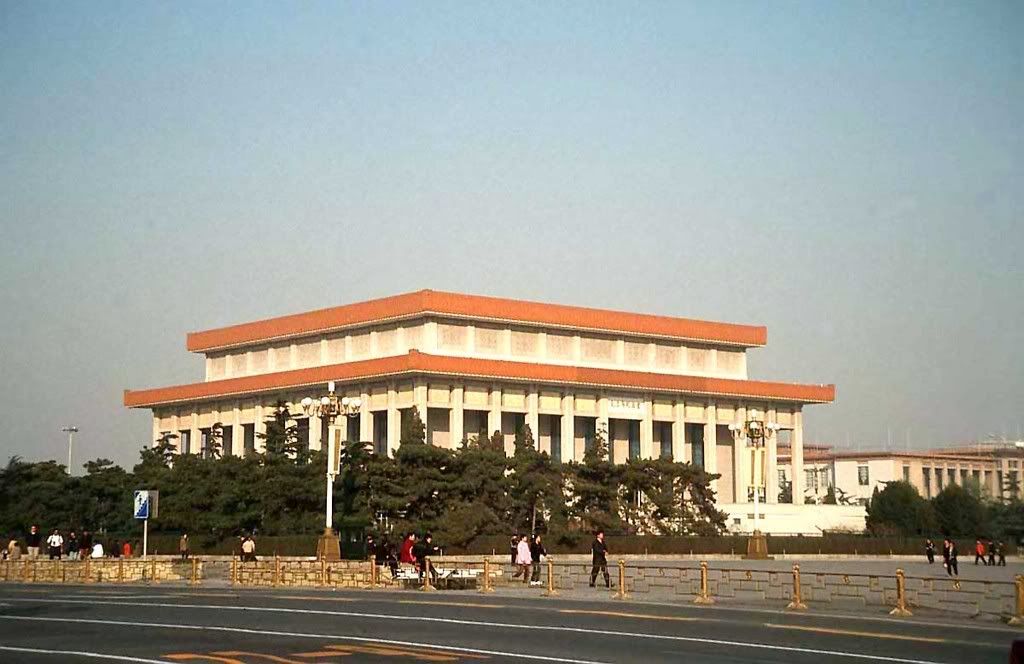 Around the coffin platform are the party emblem, the army emblem, the nation emblem, and a brief account of Chairman Mao (1893 - 1976). There carries the scattering crystal coffin on the coffin platform.
Inside the coffin lies the body of Chairman Mao, on the coffin covers the bright red party flag. After you get out of the respecting hall, you will enter the south hall. There is carved Chairman Mao's calligraphy: a poem of "Man Jiang Hong and comrade Guo Moruo" on the white marble wall.
Chairman Mao is the founder of the People's Republic of China and he is one of the essential characters in the modern history of China. Until now, almost ten million people have come to the Chairman Mao's Mausoleum, people from all over the world have visited and paid their respects to one of the greatest politicians in China.
Hutongs in Beijing
"Hutong" is formally a Mongolian term that means small lanes. A folklore expert once says that the culture of the old Beijing is actually the culture of lanes because there are more than 7,000 lanes in Beijing. Each Hutong has its historical anecdotes and symbolizes the history of lifestyle of Beijingnese. Now, we will talk about a large variety of lanes in Beijing and see if we can all appreciate the charming culture of small lanes.
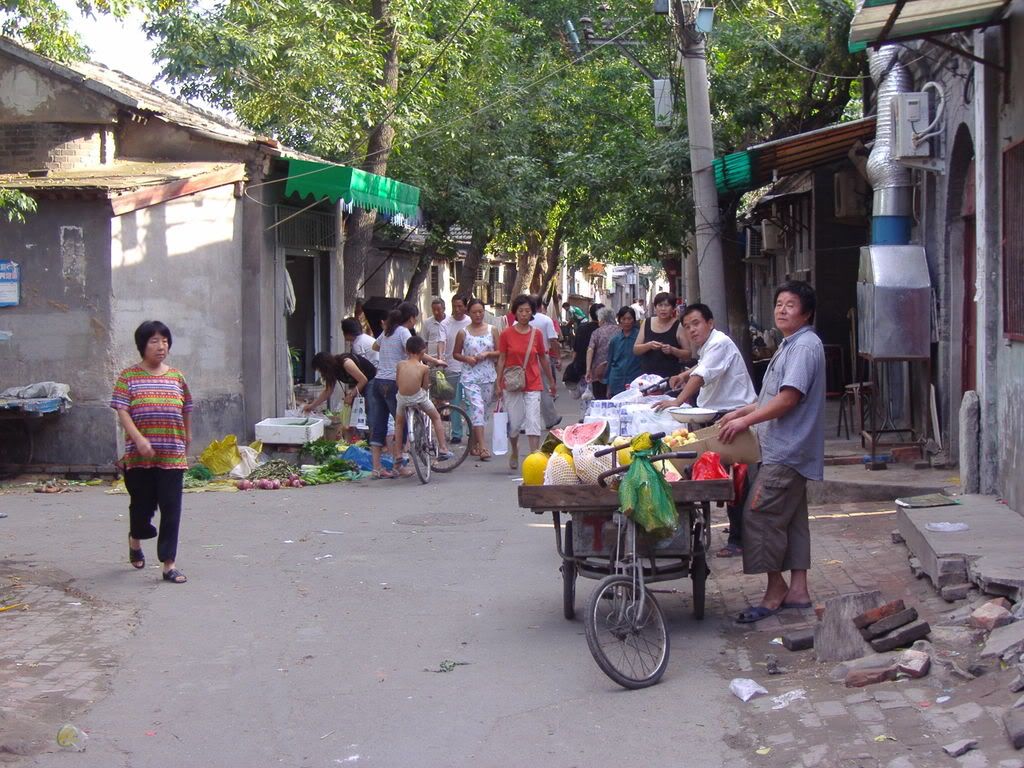 In the past, the city of Beijing was composed of many large and small sized Siheyuans (a combination of houses around a courtyard) face to face, back to back, side by side. Each line of a Siheyuan should leave a vacant path therefore people can go in and out easily, and the path is called Hutong (lane).
The lanes appeared early in the Yuan Dynasty (1271-1368AD). Many lanes got the names early in the Yuan Dynasty, which are used till now. In the past, the planning of houses in the capital was very strict, and it was the rule to build courtyards in straight lines. Due to this reason, there is slang in Beijing:
"Like carrying the bamboo poles in lanes, do it in a straight way".
Lanes spread through out the City of Beijing. The names of lanes are like an encyclopedia, which not only reflect the historical development of the city, but also represent the social customs. People today can feel the wisdom and creativity of ancient people from the way they named those lanes. Some lanes was named after famous figures, such as Prime-Minister Lane.
Some lanes were named after markets or goods, such as Goldfish Lane. Some given the name after the local dialect, for example, Enigma Pot Lane. Some lanes which had the coarse names now changes to more elegant ones, for example, Donkey Market Lane, now it changes into Protocol Lane.
Hutong in Beijing have various styles and different sizes. The narrowest Hutong is Cash Exchange Market Lane, whose narrowest part is only 40 centimeters wide. It is difficult for a man with large belly to go through this narrow lane. The most twisting and deepest, zigzag lane is in the area around Beixin Bridge. It has more than 20 turns. Nowadays, this long twisting lane was divide into five lanes. At Qian Men Gate, there is a zigzag lane where you will find 13 windings.
The lanes have gone through the changes for hundreds of years and symbolized the lifestyle of the older Beijingnese. Today lanes still occupy most of the areas of downtown and accommodate one-third of the population of Beijing. Most residents in the city still maintain the tradition lifestyle. You can climb to the Drum Tower and overlook the old downtown and lanes of all directions. You can then go to the Houhai District, where you can pay a visit to the South and North Guangfang Lane, the large and small Gold Lion Lane, and the Back and Forth Well Lane.
You can also go into one of the courtyard, and have a chat with the residents to learn more about their life. Going down Liuying Street, you will reach Prince Gongqin's Mansion, known as "The Northern Grandview Garden" compared to the one in the ancient novel "The Red Chamber Dream". You can also visit the Imperial Garden if you have time.
Lanes and modern skyscrapers combined together form two different styles in Beijing. The outside world changes rapidly everyday while the worlds in the lanes still keeps the traditional living styles and its own pace. After coming back from the Hutong tour, many tourists commented it as a "past beauty".
Antique Street
At He Ping Gate of Beijing, there is a famous Antique Street, which has a large variety of stores on ancient literature, antiques and curies, stone inscriptions, calligraphy and paintings, the four treasures of the study (writing brush, ink stick, ink slab, and paper), seal cutting, western and eastern instruments. This antique street is also called "The Glass Factory" in Chinese from ancient times to the present because it was once the location of a glass factory in the Qing Dynasty (1644 ~ 1911A.D).
The Antique Street of Beijing is not only an antique selling center, but also the most famous traditional cultural street of Beijing, which attracts the tourists from all over the world to go for a sight-seeing and purchase antiques everyday.
There are altogether 100 stores on each side of the street. They have stores of calligraphy and paintings with Rongbao Studio and Baogu Studio as the representatives. Yungu Studio and Cuizheng Studio represent the stores of ceramics and stones, while Lanxun Pavilion and Songyun Pavilion represent the stores of ancient books. Lehai Carriage, Guyi Studio and Suiya Studio represent the stores of silk boxes. Cultural antiques and works of art are too much to mention.
At present, there still stand ancient pavilions and towers of the Qing Dynasty on both sides of the street, which is a perfect match with the calligraphy, paintings and the four treasures of the study and curios in the stores. The Antique Street of Beijing is the place where you can find various kinds of ancient relics of China.
When you pay a visit to the Antique Street, better prepare some changes. Please do not forget to bargain when you feel like buying something.
Laoshe Teahouse
Laoshe Teahouse is a unique place in Beijing showing the entertainments of old Beijing people in old times.
The Laoshe Teahouse was named after the famous writer - Mr. Laoshe.
"Remembering Past Times" is the management thought of the teahouse and "Reappearance of Traditional Folk Craft" is its style, so here has already been an ideal place in Beijing for foreigners to come as a guest and know about Chinese culture today.
Everyday visitors from various places around the world who like Chinese ancient cultures and arts come here to appreciate brilliant programs such as traditional opera, cross talk, two-man comic show and story-telling in Beijing dialect with drum accompaniment... By watching these, they can explore Chinese folk arts and amorous feelings.
Visitors from various places who go to the teahouse include important people like President Mr. Bush of United States, former United States Secretary of State Dr. Kissinger, Singapore Senior Minister Li Kuan Yew, and so on.
In such liveliness and noisy limited space with deafening sound of drums, everyone has a kettle of good tea, companied with several tasteful Beijing snacks, watching hard performances on the stage attentively. Is it the Chinese tastes of old times that foreigners are looking for?
What special attraction makes this little teahouse full of guests everyday, very lively and attracts many, many visitors from home and aboard to come here? Hope when you visit Beijing next time, go to the Laoshe Teahouse so you can feel and find the answers.
Summer Palace
Summer Palace lies in the northwestern outskirts of Beijing, about 10 kilometers to Beijing City. It is up to now the best preserved and the largest imperial garden in China.
It used to be an imperial palace for short stay away from the capital. In 1750, Emperor Qianlong had it renovated and named it Qingyiyuan (Garden of Clear Ripples).
In 1860, an Anglo-French joint force destroyed the garden. In 1888, Empress Dowager Cixi misappropriated navy budget of 30,000,000 taels (about 74.5 tons) of silver to rebuild it and renamed it Summer Palace.
Occupying an area of 290 hectares, the Summer Palace has not only a lake but a hill as well. Kunming Lake, which covers about three-fourths of the total area of the garden, is the major scenic spot in Summer Palace.
Many views were constructed near the lake. Nanhu Islet, an island in the lake, is connected to the bank by a bridge - Seventeen-Arch Bridge. Compared to the noisy surroundings, it is rather quiet and peaceful.
To the west of Kunming Lake is West Causeway, on which six bridges were exquisitely constructed. They were in imitation of Su Causeway in the West Lake in Hangzhou, Zhejiang Province. Xiequyuan (Garden of Harmonious Interests) was also in imitation of Jichangyuan (Pleasure Garden) in Wuxi, Jiangsu Province.
The main reason to build Summer Palace was to put spring-everlasting Kunming City and beautiful scenes in south China into the garden and so the Empress Dowager can enjoy the picturesque scenery in Beijing.
In the middle of Summer Palace, you will come across a mass group of buildings along an axis leading downhill. They are Zhihuihai (Sea of Wisdom), Dehuidian (Hall of Moral Brilliance), and Paiyunmen (Cloud Dispelling Gate).
The splendid 41-meter-high Foxiangge (Tower of Buddhist Incense) was built on a 20-meter-high terrace, which was made of stone. This huge building was burnt by Anglo-French joint force. In 1891, Empress Dowager spent 780,000 taels of silver (about 2 tons) to have it restored. It was the largest project in Summer Palace. Foxiangge commands a full view of the scenery in scores for miles.
While talking about the Summer Palace, almost everybody who has been there would say that the Long Gallery is the most impressive scene. The gallery is 728 meters long and has 273 rooms. In 1992, it proved that it is the longest of its kind in the world, and so it was added to the Genis World Record.
It is in the south of Wanshoushan (Longevity Hill) and in the north of Kunming Lake. Walking in the gallery, you can enjoy viewing the beautiful lake as well as the hill. Each beam in the gallery is colorfully painted. They are very enchanting.
Leshoutang (Hall of Joyful Longevity) was the residence of the Empress Dowager. The furnishings in the hall are the same as before. In the courtyard, planted several magnolias, they were the favorites of the Empress Dowager Cixi. Now they are very tall and the fragrant of their white blossom are still coming out every year. Every summer the perfume of the blossom floats in the courtyard and keeps companying with the huge stone named Qingzhiyou.
A marble boat in Kunming Lake, known as Boat for Pure Banquets, was build in the 20th year of the reign of Emperor Qianglong (1755AD). There used to be a traditional style cabin tower on the boat. It was destroyed by Anglo-French joint force. In the 19th year of the reign of Emperor Guangxu (1893 AD) it was renovated into western style. Two wheels were added to decorate the boat, and it was renamed Boat for Pure Banquets.
East Palace Gate is the main gate of the Summer Palace. Entering this gate, you will see the Hall of Benevolent Longevity (Renshoudian) where the Empress Dowager conducted state affairs. To the north of Renshoudian is the Garden of Moral Harmony (Deheyuan), where the imperial family watched operas. The grand building looks like a theater.
The view in the front hill of the Summer Palace is magnificent, while the view in the back hill is peaceful. The rear of the hill presents an exquisitely constructed bridge and flowing water. Only when you spend more than half of a day can you fully appreciate the scenery in the world-famous imperial garden, and experience two feelings while visiting the front of the hill and the rear of the hill.
Ming Tombs
The Ming Tombs and the Sacred Tomb Avenue lie at the foot of the Tianshou Mountains in Changping County of Beijing.
Sacred Tomb Avenue is the broad way leading to the Thirteen Ming Tombs.
Dingling (Ding Tomb) is a huge underground tomb among the thirteen tombs.
Usually visitors who finish touring the Badaling Great Wall in Beijing will choose the Thirteen Ming Tombs as their next destination.
The beginning of the Sacred Tomb Avenue is the "Stone Memorial Archway" at the south of the Tombs Zone. The archway was build in the 19th year of Jiajing in the Ming Dynasty (1540 AD). The 14 meters high and 28.7 meters wide Stone Memorial Archway has 5 gates and 6 stone columns.
It is the biggest and earliest extant stone archway in China. Both sides of the stone column under the archway were carving with elegant relief: eight pairs of lions playing with a ball and sixteen vivid flying dragons. Behind the stone archway is the Great Palace gate. It is the front gate of the tomb zone.
Go ahead, you will find various stone statues of people and beasts on both sides of the way. The stone statures are invaluable. It includes 4 lions, 4 Xie, 4 camels, 4 elephants, 4 Qilin and 4 horses, in pairs with one standing and another kneeling down. Four civil officials, 4 military officials and 4 meritorious officials follow them. It adds up to 18 pairs, 36 statues. They stand face to face on the flank of the Sacred Tomb Avenue with imposing feature.
At the end of the stone statues is the Lingxing Gate, normally called Dragon and Phoenix Gate. Because people called the emperor's death "funeral of heaven", so it also means the heaven gate. The gate has three paths, every gate separated by dwarf walls.
Those gates were carved with stone-made fire pearl, so people nearby call it firing memorial archway. Go along the Sacred Tomb Avenue, you will reach the Thirteen Ming Tombs. It got the name from the thirteen tombs of emperor in Ming Dynasty.
Dingling is the first excavated imperial tombs and the largest tomb among them, so it becomes an important scenic spot in thirteen tombs today.
Dingling is the tomb of Emperor Shenzong Zhuyijun (the 13th Ming emperor and the longest Ming ruler), and his two empresses, Xiaoduan and Xiaojing. Emperor Shenzong began to build the underground palace in the 12th year of his rule (1584A.D.), when he was only 22 years old. It took 6 years to complete the construction.
Being the most exquisite tomb in the thirteen tombs, it cost 8,000,000 tales of silver. When the tomb was first completed, Emperor Shenzong hold a grand ceremony to celebrate the completion of his tomb.
The underground palace lies 27 meters below the surface and has 5 halls: an antechamber, central hall, rear hall and left and right annexes. The rear hall is the largest hall and it was 31.1 meters in length, 9.1 meters in width, 9.5meters in height.
The construction above the ground of Dingling is unique too. There is well preserved Minglou (Bright Tower), in front of which set up Dingling Unearthed Relics Display Room. It displays all the valuable excavated unearthed relics and treasures, which belong to Emperor Shenzong and his two empresses. All these deserve a good enjoyment.
The Thirteen Tombs is the tombs of Ming Emperors, Dingling is the most famous architecture. It was an underground palace with typical imperial construction style. Dingling, the tomb lies below 27meters from the surface, was the only one that been excavated in all the thirteen tombs.
Three thousand articles of relics and treasures that adding up to 26 boxes were taken out from the tomb. Those treasures will bring feast on your eyes and you can have a clear understanding on why those emperors in the Ming and Qing Dynasty built tombs in such large scales.
Put on soft soles when you visit Dingling because you will have to climb up and down the stairs. Because the palace is under ground, it's quite warm in winter and cool in summer, best is to prepare a coat to avoid catching cold when you visit it in summer.
Great Wall
There is a well-known Chinese saying written on the Great Wall, "He Who Has Not Climbed the Great Wall Is Not a Real Man". It is a scenic spot with a lot of tourists.
Badaling Great Wall lies in Yanqing County in Beijing and stands on the ridge of infinite steep mountains. There are two high peaks, generally called the south high peak and the north high peak. The highest point is about 1,000 meters above sea level.
The base of the wall was made of granite and lump of soil and the top was paved with square bricks.
The great wall averages 7.8 meters in height and is 6.5 meters wide at the base and 5.7 meters at the top. The width is enough for five horses to go side by side.
On both sides of the road there are dwarf walls called "parapet wall". The 1.7-meter-high "crenel wall" is the outer wall. On its top, there are battlements for patrolling and watching. Below the battlements are peepholes, used for firing at the enemy. At intervals along the inner wall are arched entrances with stone stairways leading to the top of the wall.
Every other 300 to 500 meters, there are fortresses. There are two kinds of fortresses. One is two-storied fortress called fighting tower. The ground floor was used for living, storing weapons and the top floor was used for watching and shooting. Another kind is fighting terrace or enemy terrace, which was used for patrolling and fighting.
Many piers or castles, which also called smoke pier or beacon tower, were set up on the higher part and important fort along the Great Wall.
In ancient time, soldiers made smoke in daytime and fire at night if they found the enemies. The soldier that saw the fire in another beacon tower faraway would ignite fire immediately and the next beacon tower would do the same. The message could be transmitted in a short while to the command post. It was one of the means for communication in the ancient times.
The Great Wall has a history of more than 2,000 years. As early as the Warring States Period, in order to self-protect, rival kingdoms built walls around their territories. This is the earliest Great Wall.
When Qin Shihuang, the first emperor in Chinese history, unified the whole country in 221B.C, he ordered to build another new wall on the base of the original walls of the Countries Qin, Zhao, and Yan in effort to guard against the invasion of the northern nomadic tribes.
Subsequent dynasties continued to strengthen and extend the wall. Most part of the existent wall were build in Ming Dynasty (1386~1644A.D.).
Looking from the space, you will find a construction. This is the Great Wall in China.
It is an indisputable fact that the Great Wall of China is the longest defense wall in the world. From the aspects of culture and history, the wall is an ancient masterpiece that you can fully enjoy.
Getting to the Wall was the first challenge. I hired a car and driver with the help of the hotel concierge to take me and a friend to Badaling. Although there was a decent highway, it was filled with lopsided trucks and other hard to describe vehicles filled to bursting with cabbages, pigs, ducks, etc.
Chinese drivers often equate good driving with fast driving, and our guy was no exception. While my friend sat frozen with fear reciting her children's names as a Mantra, I scrambled in my English/Mandarin dictionary for the characters that meant "Slow down. I will pay extra." I finally found the equivalent and motioned wildly to the driver to pull over. He took the book and looked intensely at the characters I had highlighted. What happened next confirmed my worst fears. He reached in his pocket and took out a large, powerful magnifying glass so that he could see!!! (If you go, think about taking a big safe tank or a tour bus.)
After an hour and a half eternity we arrived at the base of the Wall. My friend looked at me and said "Oh, you know, it's OK. You go on up. I think I'll just take a few pictures from here." I would hear none of this, so I steered her toward the little stalls outside the entrance that sell Great Wall souvenirs and other goods so that she could outfit herself with warmer layers. At first, when she inquired about buying pants, she was told there were none. After a few minutes, however, someone came out of a back room carrying a pair of (still warm) pants. She swallowed her pride, plunked down her Yuans, and pulled them on.
Outside, I was being accosted by a mob of scarf sellers who were intent on making a sale. They all but strangled me to reach their goal. They extracted the yuan, and left me with a silver grey plaid scarf, their choice. If this happens to you, my best advice is to immediately surrender to their will.
Armed with layers of warmth, we paid the entrance fee and began the climb to the top of the Badaling section of the wall. No one ever says this, but here it is. This wall is really a staircase, the biggest one ever. A steep staircase.
In the winter, there are patches of ice. Beware! The wind, blowing off the Gobi desert, whipped our faces with tiny particles of sharp sand. We clung to the sides of the wall and crept along as we were able. To our utter humiliation, MANY elderly Chinese with walking sticks and canes were skippety hopping past us. One actually stopped, pushed back the scarf I had wrapped around my face, just to see what manner of feeble creature lay within.
As we approached the top of the section, I called out to my traveling companion to film my ascent to the top. She obliged, but we later realized upon viewing the tape that her vision must have been quite compromised by the whipping sand, as she actually filmed just my posterior ascending the wall.
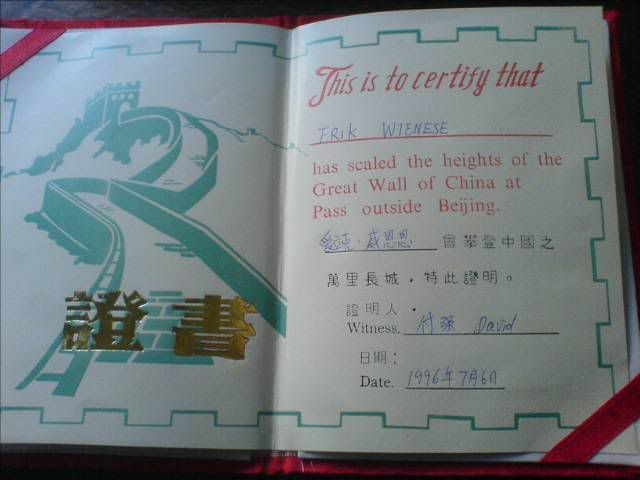
Apart from the sense of history, the splendid views, and the serene beauty of the landscape, I found several over the top great things to buy and do. If you manage to make it to the top of the section, you will be eligible to buy an elaborate certificate with your notarized signature that declares you "A Lucky Hero" for having made the climb. Also, you can purchase cast iron replicas of the Great Wall in three different sizes.
These weighty must haves will add pounds to your luggage, but may in fact provide some traction for the icy descent, should you travel in winter as we did. Back at the hotel, we put them in our carry ons and practiced walking with a light step.
I've saved the best for last! There is a small platform that is reached by a small alley and a door at about the halfway point up the wall. You can sit astride a sleepy camel or a prancing steed and pose for a polaroid with the Great Wall as a backdrop. In my nightmares, the camel won, hands down. He was warm and toasty like a down filled sofa. It was hard to leave him and make the climb back down!
The Great Wall visit provided us with adventure, thrills and laughs! It's a spectacular place, one of the seven wonders of the world, and the only structure on earth visible from space. Don't think of visiting Beijing without planning a trip to the Great Wall. Dress for the weather, and expect the weather to be more extreme up there than in Beijing. Take your time. Take lots of pictures. And give my best to that fluffy old camel!
Chinese Fengshui Feng Shui
Fengshui, or Feng Shui, a special Chinese tradition in architecture, usually links the whole process from site selection, designing, construction and interior and exterior decorating in ancient times.
Feng means wind and shui is water.
Fengshui combines the trinity of the Heaven, the Earth and humans, and seeks harmony between selected site, orienting, natural doctrine and human fate. It repulses human destruction of nature and stresses cohabitation with the environment, which is regarded as perfect and occult.
In China, a fengshui practitioner, or a diviner, usually applies theories as Yingyang, Sixiang, Wuxing and Bagua, based on the principle of the Heaven and the Earth in harmony, to select an optimum place for burial site or accommodation.
Qi, deemed as the basic element of the physical world in ancient Chinese philosophy, is the essence of Fengshui. The art of fengshui advocates there is a certain field, sort of like magnetic field, termed as Qi field. An auspicious Qi field is what Fengshui practitioners seek while an evil one is what they strive to avoid.
There are five elements - long (dragon), xue (cave), sha (sand), shui (water) and xiang (orientation). They are used to avoid evil Qi and gain auspicious Qi. In order to keep Qi of the Heaven and the Earth in harmony in the construction of a new structure, earth vein should not be spoiled. The best orientation is a building with its face facing a river or a lake in the south and back against a hill in the north.
Most ancient cities in China were built under guidance of Fengshui, which was the main principle used to select locations based on their environmental surroundings. Fengshui helps to plan placement of structures of significance and confirm the location of city central axis. Usually the central axis of a city, or certain other architectural complex, ought to face certain peak of mountains nearby to make the city magnificent and solemn.
For example, the Imperial Palace in Beijing was placed on the very center of the city, and its central axis points at Jingshan Mountain which was called Guard Mountain of the Palace.
Fengshui practitioners also emphasize pagodas and their site location since pagodas are believed capable of protecting residents around them.
Although there are still many people who believe it, many people now doubt this theory.
Shanghai
The Bund
The Bund got its name from a desolate beach outside the old Shanghai City. If you have never been to the Bund, then you have never been to Shanghai. The Bund symbolizes Shanghai and Bund is an epitome of Shanghai's history.
Tracing back, from the Opium War broke out in 1840 to the 1930's, many foreign businesses snatched the prime area in Shanghai, to establish concessions, banks, headquarters, consul houses and so on. Hence, Shanghai, a small seaside town one hundred years ago, became the largest city in Asia. It also earned the reputation of "The Oriental Wall Street". Even today, visitors can still feel the prosperity of the old Shanghai, when looking at those old buildings.
The east side of the Bund is right next to the Huangpu River. To the west of the Bund, there are group of 52 buildings standing in various styles, Gothic, Baroque, Rome, Renaissance, Classic and the combination of Eastern and Western style. Although these buildings were completed at different time and were in different styles, the main elements of these buildings were fairly unified and the overall outline is well coordinated.
Walking on the Zhongshan East Road, you will experience a kind of vigorous, forceful and solemn momentum. Some say actually that the Bund is like "an exhibition of buildings".
If the building zone on the Bund were a gallery, the rest of the Bund would be a showroom. When the sun rises in the east, the Bund is a place where people do exercises. In daytime, this building complex, blended with the beautiful scenery of the Huangpu River and the Pudong area, this scenic spot is tourists' favorate. When evening comes, city lights coats the Bund with brilliant colors, which makes the Bund particularly beautiful. Old buildings by the river echo with the new scenic spots the Oriental Pearl TV Tower and the Jinmao mansion, that this spectacular scenery often amazes many tourists.
The Dongfeng Restaurant was a famous meeting place for British. This building was a typical old British style classic structure, it has in total six levels. There were two watch towers on top, interior was magnificently decorated. There was a spacious bar on the ground floor, a 110.7-feet-long bar counter, longest of its kind in Asia at that time, which made this bar extremely popular. You can imagine the scene that the richest businessmen gathered here for social engagement.
The No. 12 of the Bund is also No. 12 of the Zhongshan Road East. The former famous Huifeng Bank was located here. Constructed in 1923, this square-shaped five-storage building, come with a round roof, in the style of ancient Greek, and a hemisphere-shaped top. The steel-framed building were exquisitely decorated. The building were equipped with the specially decorated reception halls. The British builder took great pride in this marvelous building. They rated this structure as "from east of the Suez Canal to Baling Strait in the west, this is the most exquisite building".
Adjacent to the Huifeng Bank building is the Customs Building of Shanghai. It was built in 1927. The classic building in the style of the 19th century is rare in the world. The huge clock on the building could had been seen from all sides. The melodious sound of the clock could been heard from several miles away. Its time synchronizes with Beijing Time perfectly.
The two buildings at the end of Nanjing Road East belong to the well-known Peace Hotel, built in 1906, and initially named Huizhong Hotel. In the style of European Renaissance, it is the oldest hotel in Shanghai. The building looks solemn, elegant, and unique from distance. It really is an architectural masterpiece.
The Shaxun Mansion was built in 1928. This steeled-framed "A" shape building is in typical Chicago Architectural style. The famous 19-meter-high pyramid on the top of the building are made from oblique tile, which was made of purple copper. The owner of Shaxun Mansion used it to show off his wealth. Various ornaments and furniture from nine different countries were used to decorate the mansion. It became a post where adventurers from all over the world gathered. It was also travelers' first choice to spend their night. Those who had stayed here said that its atmosphere and liveliness were unforgettable.
Yu Yuan Garden
Yu Garden (Yuyuan Garden, Yu Yuan Garden) is a famous old southern garden, located at Anren Street in Shanghai's Old City, covering an area of over 20,000 square meters.
Construction began in the Ming dynasty, giving the garden more than 500 years of history, and is one of the best-preserved large old-style private gardens in Shanghai.
Yu Garden was built in 1577 during the Jiajing reign of the Ming dynasty, and is a mansion-style private garden. It was built by Pan Yunduan, a former treasurer of Sichuan Province during the Ming dynasty.
He built the garden to please his parents in their old age and so named it "Yu Garden Garden", meaning "pleasing garden" in ancient Chinese. This old garden was once renowned as the finest in the southeast, and remains to this day one of the most famous gardens south of the Yangtze River.
Entering the gates, the first building you encounter is the Three-Corn Ear Hall. Looking up you can read a plaque inscribed, "Mountains and Forests in the City", reflecting the surroundings as a setting of tranquility amidst the bustling city.
Crossing the Yangshan Hall ("Hall for Viewing the Mountain") you see the grand rockery rising majestically from beyond a pond. The famous landscape architect Zhang Nanyang, using over 2,000 tons of rocks brought all the way from Wukang, Zhejiang Province, constructed this large rockery.
It is roughly 20 meters high and was once the highest point in Shanghai, taking on the name "Pavilion for Viewing the River". Although you can no longer see the Huangpu River from the top, you can nevertheless get a spectacular bird's eye view of the garden's beautiful scenery.
Another interesting aspect of the garden is that it contains a garden within a garden, the Inner Garden. The Yu Garden Inner Garden was built in the 48th year of the reign of Kangxi of the Qing dynasty (1709).
It has a total area of only 1,333 square meters, but possesses a complete and exquisite collection of pavilions, pagodas, pools and rockeries. It even boasts its own theater - the Quyuan - once called the finest stage south of the river. It is relatively rare for a private garden to have its own theater and is well worth a visit.
In front of the Yuhua Hall in the inner garden, there are three rockeries, the middle of which is known as ‘Yulinglong. It is 3.3 meters tall and is dappled with 72 holes. If you pour a basin of water from the top, the water will flow out from all the holes like water gushing from a well; if you place a stick of incense at the base, you can see the smoke gently rising from every hole.
On the top the characters "Yuhua" are inscribed, which mean "exquisite jade stone". It now has over 400 years of history. The adjacent Yuhua Hall was specially constructed by the garden's owners to admire this beautiful stone.
The walls of Yu Garden are adorned with an undulating dragon dividing the garden into different areas, yet maintaining a harmonious unity - the variety of scenic areas is one of the garden's greatest characteristics. The garden has 48 different scenic attractions including the Grand Rockery, Chamber of Ten Thousand Flowers, Spring Pavilion, Scenery Gathering Pavilion, "Yulinglong", and Gathering the Moon Pavilion.
The Society of Small Swords used the Spring Pavilion as a meeting place to plan an uprising against the French colonialists and the Qing government. Inside the pavilion a number of items such as weapons, documents, and self-minted coins are displayed.
There are also many other scenic spots, such as the Happy Fish Waterside Pavilion, Hall of Mildness, Hall of Beauty, Inner Garden, Nine Curve Bridge, Lotus Flower Pond and Huxin Pavilion.
This beautiful and elegant garden, representing the architectural styles of the Ming and Qing dynasties, is known for its uneven towers, pavilions, and its delicate and secluded beauty. Visitors experience the overall harmony of the gardens by first paying attention to the smaller details, before taking in the whole.
This true masterpiece of ancient Chinese landscape architecture has become a popular attraction for visitors from both home and abroad, and has been designated as a Protected State Relic.
