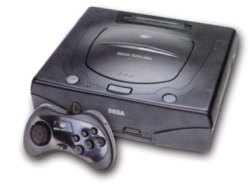
The Sega Saturn was originally going to be the ultimate 2D console with 3D capabilities being a possibility. Sega's Virtua Fighter arcade game had become very popular and gamers hoped that Sega would have 3D capabilities in their new console so that Virua Fighter could be ported for play on it. However, in November 1993, Sony announced their entry into the console market with the PlayStation under development.
After seeing the specifications of the PlayStation, Sega decided to increase the processing power for 32-bit 3D games so as to compete with Sony's console, which was due for release at the same time as the Saturn - November 1994). Even though this had to be achieved in under 1 year, it was successfully achieved.
The Sega Saturn was officially released in Japan on November 22nd 1994 for 44 800 Yen. Over 250 000 consoles were ready for sale, all of which sold in 2 days. Sony's PlayStation was released a week later on 2nd December but over the first six months of release, Saturn still outsold the PlayStation. Unfortunately, this would not last long. Lack of software for the Saturn due to production delays meant that the PlayStation soon took over.
The Sega Saturn's unexpected US debut was at 1995's E3 Trade Show on May 11th 1995 for US$399. The official release was planned for 2nd September but Sega wanted to release their console first to beat the PlayStation. Also at E3, Sony announced their console which was due for release later in the year for US$299, $100 less than the Sega Saturn. This was bad news for Sega.
The people who bought the Saturn were only able to purchase Virtua Fighter upon release. Between 11th May and 2nd September, only one or two more games were released for the Saturn. Game developers could not finish their games in time for the early release of the Saturn. Within the first year of release, though, Nintendo, Sony and Sega each had about 33% share in the video game market. But the PlayStation soon took over after the release of Final Fantasy VII.
Many argue that the PlayStation is superior to the Saturn. While the PlayStation supported several hardware features that the Saturn didn't, the Saturn is capable of handling more polygons and has a larger texture memory. The Saturn is also the best 2D console ever released. While it is considered a 3D console, it was also made to support 2D games (like you would see on 8-bit and 16-bit consoles) and the 2D games released show Saturn's excellent sprite-handling abilities. This is because Sega used technology from their 2D arcade boards as well as their 3D boards.
The Saturn, like other Sega consoles, had the potential to be bigger than what it was, but due to problems with the console itself and the way it was marketed. Saturn was supported in the US until 1998 and in Japan until 1999.
Specifications:
- CPU: 2 x 32-Bit RISC SH2 at 28.6 MHz, 32-Bit RISC SH1 at 20 MHz. 25MIPS
- Memory: 16 Mbit Work RAM, 4 Mbit Audio RAM, 256 Kbit Backup RAM, 12 Mbit Video RAM, 4 Mbit CD Buffer RAM, 4 Mbit IPL ROM.
- Sound: 16-Bit CISC 68EC000 (11.3 MHz), PCM & FM sound sources, 32 channels, 16-Bit Sampling, Sampling rate 44.1 KHz max, Audio DSP
- Graphics: 16.77 Million Colours Sprite Enlargement, Reduction, Rotation, Transformation
- CG Capability: Polygon Specialized Hardware Texture Mapping, Flat Shading, Gouraud Shading, Wire Frame
-Scroll: 5 Screens (Scaling, rotating, enlargement, reduction)
- CD Drive: Intelligent 2x. Data Transfer Rate (DMA to RAM), 150 KB/sec. (Normal), 300 KB/sec. (Double speed), Maximum Capacity - 660 Megabytes, Audio CD play with reactive display, CD+G compatible, CD+EG compatible, CD Single compatible, Photo CD compatible, Video CD compatible and Ebook compatible
- 2D Graphical Capabilities: VDP1 processor handling sprites, polygons and geometry VDP2, processor handling backgrounds, 5 simultaneous planes with two rotation planes, 32,000 colours from 24-bit palette