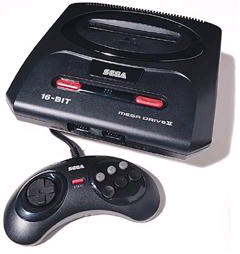
Due to the fact that Nintendo occupied 95% of the market share in America and 92% in Japan, Sega had little or no option but to try a new method of outdoing it’s competitors.
In 1988, Sega finally released a 16-bit console, calling it the “Mega Drive”, or the “Genesis” in America. Sega also made their console backwards compatible with the Sega Master System with an add-on device later named the Power Base Converter.
When first released in Japan, the Mega Drive made very little impact, however, when released to America in early 1989, Sega announced their console was the first true 16-bit system, at a cost of $190. The Genesis as it was known in America, was recognised for its arcade quality graphics and superiority to the Nintendo Entertainment System (NES) and amazed gamers because of its capabilities.
Having realized that Sega was stealing the marketplace with the Mega Drive, Nintendo got back to work on creating their very own 16-bit console, and they did releasing the Super Famicom (or Super NES). The 16-bit war had begun.
Soon after, gamers began to grow tired of the Mega Drive having realized that many of the games were repetitive and that Sega failed to have what’s known as a “killer app” to push its system. Sega was forced to act and eventually all their wishes were granted, deciding on Sonic the Hedgehog as their mascot. Not only was Sonic the “killer app” Sega had been craving, but he also emphasized the speed of the Mega Drive, something the SNES did not have. Sales of the Mega Drive skyrocketed.
Sega later released a Mega Drive II/Genesis II console that was smaller than the original and did not include a headphones jack or volume control.
The Mega Drive was still supported up until 1998 in Europe where it outsold all other consoles, even its descendent, the Sega Saturn.
The Mega Drive/Genesis did fairly well in most places where it was released, mostly due to its arcade ports, sports games and platforms. Although it did not win the 16-bit war, it sure did shake things up for Nintendo and made its mark in console history
Specifications:
- CPU: 16-bit Motorola 68000 running at 7.61 MHz
- Co-processor: Zilog Z80 running at 4 MHz (Not Present in model MK-1631) controls PSG (Programmable Sound Generator) & FM Chips
- RAM: 64 Kbytes
- ROM: 1 Mbytes (8-Mbit)
- VRAM: 64 Kbytes (Video Ram)
- Graphics: VDP (Video Display Processor) dedicated video display processor for playfield and sprite control, 3 Planes, 2 scrolling playfields, 1 sprite plane
- Colours Available: 512
- Max. Colours on screen: 64
- CRAM: 64 x 9-kbit (Colour RAM)
- Pixel Resolution: 320 x 224, 40 x 28 text display mode
- Sound: Texas Instruments PSG (Programmable Sound Generator) TI 76489 chip, Yamaha YM -2612 FM chip
- Signal/Noise Ratio: 14dB
- Sound Channels: 6 stereo sound channels
- Sound RAM: 8 Kbytes
- 1 sidecar expansion slot
- 1 cartridge port
- 2 joystick ports
- AV port
- Backwards compatible with all Sega Master System games using converter