|
|
||||||||||||||||||||||||||||||||||||
 |
 |
 |
 |
||||||||||||||||||||||||||||||||||
 |
|||||||||||||||||||||||||||||||||||||
 |
|||||||||||||||||||||||||||||||||||||
 |
 |
 |
 |
||||||||||||||||||||||||||||||||||
 |

The star around which the Earth and the other components of the solar system revolve. It is the dominant body of the system, constituting more than 99 percent of its entire mass. The Sun is a source of an enormous amount of energy, a portion of which provides the Earth with the light and heat necessary to support life. The Sun is a sphere of luminous gas 1,392,000 km (864,950 miles) in diameter. Its mass is about 330,000 times the mass of the Earth. The Sun generates energy by nuclear fusion reactions in its core. Although its core temperature is close to 15,000,000 K, the temperature of the surface of the Sun (the photosphere) is only about 6,000 K. This is average in terms of stellar temperatures, and the Sun is an average star in every respect. Just one of 100 billion stars in the Milky Way Galaxy, it is classified as a yellow dwarf of spectral class G2 and falls in the middle of the main sequence on the Hertzsprung-Russell diagram. The Sun's apparent magnitude is -26.5, but its absolute magnitude--the brightness it would appear to have at a standard distance of 10 parsecs (32.6 light-years)--is a mere +4.6, which is near the limit of naked-eye visibility. The Sun appears extremely bright to the terrestrial observer only because it is the star nearest the Earth, lying at an average distance of 149,600,000 km (92,957,000 miles). The Sun is so massive that its constituent matter is strongly compressed by gravity. At the Sun's core, the compressed gas is at such a high temperature that nuclear-fusion reactions are triggered. The dominant energy-producing reaction at the core is the proton-proton chain. Under intense heat and pressure, protons (hydrogen nuclei) collide and combine one after the other to form stable helium nuclei. The helium nuclei are slightly less massive than the protons that combined to produce them, and this residual mass is released as energy. The Sun converts five million tons of matter into energy every second; this is a negligible proportion of its total mass. Energy is first released as gamma rays, but this form of electromagnetic radiation undergoes a considerable number of interactions with overlying material on its way to the photosphere. Several hundreds of thousands of years later, the degraded radiation emerges mainly as visible light and infrared radiation (heat). A by-product of the proton-proton reaction is neutrinos. Because these particles have neither mass nor electrical charge, they escape from the Sun at the speed of light. Recent experiments designed to detect solar neutrinos reaching the Earth, however, have found fewer than expected. This discrepancy may suggest that the Sun's core temperature is slightly cooler than 15 million K, that the exact mix of elements at the core is different from that inferred from the composition of its surface layers, or that the neutrinos interact with the solar mass and are converted into a different, undetectable form of neutrino. The Sun is the most prominent feature in our solar system. It is the largest object and contains approximately 98% of the total solar system mass. One hundred and nine Earths would be required to fit across the Sun's disk, and its interior could hold over 1.3 million Earths. The Sun's outer visible layer is called the photosphere and has a temperature of 6,000°C (11,000°F). This layer has a mottled appearance due to the turbulent eruptions of energy at the surface. Solar energy is created deep within the core of the Sun. It is here that the temperature (15,000,000° C; 27,000,000° F) and pressure (340 billion times Earth's air pressure at sea level) is so intense that nuclear reactions take place. This reaction causes four protons or hydrogen nuclei to fuse together to form one alpha particle or helium nucleus. The alpha particle is about .7 percent less massive than the four protons. The difference in mass is expelled as energy and is carried to the surface of the Sun, through a process known as convection, where it is released as light and heat. Energy generated in the Sun's core takes a million years to reach its surface. Every second 700 million tons of hydrogen are converted into helium ashes. In the process 5 million tons of pure energy is released; therefore, as time goes on the Sun is becoming lighter.
The chromosphere is above the photosphere. Solar energy passes through this region on its way out from the center of the Sun. Faculae and flares arise in the chromosphere. Faculae are bright luminous hydrogen clouds which form above regions where sunspots are about to form. Flares are bright filaments of hot gas emerging from sunspot regions. Sunspots are dark depressions on the photosphere with a typical temperature of 4,000°C (7,000°F).
The corona is the outer part of the Sun's atmosphere. It is in this region that prominences appears. Prominences are immense clouds of glowing gas that erupt from the upper chromosphere. The outer region of the corona stretches far into space and consists of particles traveling slowly away from the Sun. The corona can only be seen during total solar eclipses. (See Solar Eclipse Image). The Sun appears to have been active for 4.6 billion years and has enough fuel to go on for another five billion years or so. At the end of its life, the Sun will start to fuse helium into heavier elements and begin to swell up, ultimately growing so large that it will swallow the Earth. After a billion years as a red giant, it will suddenly collapse into a white dwarf -- the final end product of a star like ours. It may take a trillion years to cool off completely.
  Sun
Prominence Sun
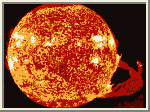
ProminenceThis image was acquired from NASA's Skylab space station on December 19, 1973. It shows one of the most spectacular solar flares ever recorded, propelled by magnetic forces, lifting off from the Sun. It spans more than 588,000 km (365,000 miles) of the solar surface. In this photograph, the solar poles are distinguished by a relative absence of supergranulation network, and a much darker tone than the central portions of the disk. 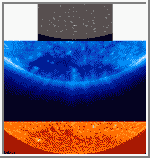 Sources
of the Solar Wind? Sources
of the Solar Wind?"Plumes" of outward flowing, hot gas in the Sun's atmosphere may be one source of the solar "wind" of charged particles. These images, taken March 7, 1996, by the Solar and Heliospheric Observatory (SOHO), show (top) magnetic fields on the sun's surface near the south solar pole; (middle) an ultraviolet image of the 1 million degree plumes from the same region; and (bottom) an ultraviolet image of the "quiet" solar atmosphere closer to the surface.  The
Unquiet Sun The
Unquiet SunThis sequence of images of the the Sun in ultraviolet light was taken by the Solar and Heliospheric Observatory (SOHO) spacecraft on February 11, 1996 from its unique vantage point at the "L1" gravity neutral point 1 million miles sunward from the Earth. An "eruptive prominence" or blob of 60,000°C gas, over 80,000 miles long, was ejected at a speed of at least 15,000 miles per hour. The gaseous blob is shown to the left in each image. These eruptions occur when a significant amount of cool dense plasma or ionized gas escapes from the normally closed, confining, low-level magnetic fields of the Sun's atmosphere to streak out into the interplanetary medium, or heliosphere. Eruptions of this sort can produce major disruptions in the near Earth environment, affecting communications, navigation systems and even power grids. 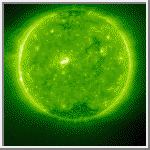 A
New Look at the Sun A
New Look at the SunThis image of 1,500,000°C gas in the Sun's thin, outer atmosphere (corona) was taken March 13, 1996 by the Extreme Ultraviolet Imaging Telescope onboard the Solar and Heliospheric Observatory (SOHO) spacecraft. Every feature in the image traces magnetic field structures. Because of the high quality instrument, more of the suttle and detail magnetic features can be seen than ever before. 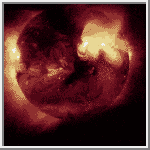 X-Ray
Image X-Ray
ImageThis is an X-ray image of the Sun obtained on February 21, 1994. The brighter regions are sources of increased X-ray emissions. 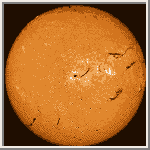 Solar
Disk in H-Alpha Solar
Disk in H-AlphaThis is an image of the Sun as seen in H-Alpha. H-Alpha is a narrow wavelength of red light that is emitted and absorbed by the element hydrogen.  Solar
Flare in H-Alpha Solar
Flare in H-AlphaThis is an image of a solar flare as seen in H-Alpha.  Solar
Magnetic Fields Solar
Magnetic FieldsThis image was acquired February 26, 1993. The dark regions are locations of positive magnetic polarity and the light regions are negative magnetic polarity. 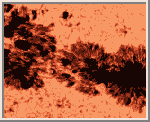 Sun
Spots Sun
SpotsThis image shows the region around a sunspot. Notice the mottled appearance. This granulation is the result of turbulent eruptions of energy at the surface.  Solar
Eclipse Solar
EclipseThis is a view of the 1977 solar eclipse.  1991
Solar Eclipse 1991
Solar EclipseThis shows the total solar eclipse of July 11, 1991 as seen from Baja California. It is a digital mosaic is derived from five individual photographs, each exposed correctly for a different radius in the solar corona. 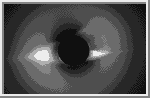 1994
Solar Eclipse 1994
Solar EclipseThe following two images were taken November 3, 1994, as observed by the High Altitude Observatory White Light Coronal camera from Chile.  Return
to Top Return
to Top © COPYRIGHT 1996-2003 DeftCOM Systems, Limited., a company for the next century.
|
 |
 |
 |
|||||||||||||||||||||||||||||||||
 |
|||||||||||||||||||||||||||||||||||||
 |
|||||||||||||||||||||||||||||||||||||
 |
|||||||||||||||||||||||||||||||||||||
 |
|||||||||||||||||||||||||||||||||||||
 |
|||||||||||||||||||||||||||||||||||||
 |
|||||||||||||||||||||||||||||||||||||