|


 This
article discusses the overall structure and composition of the solar
system and also describes its various components in some detail. Early
models of the system's origin and evolution are surveyed along with
modern theories based on detailed astronomical data. This
article discusses the overall structure and composition of the solar
system and also describes its various components in some detail. Early
models of the system's origin and evolution are surveyed along with
modern theories based on detailed astronomical data.
Our solar
system consists of an average star we call the Sun,
the planets Mercury, Venus,
Earth, Mars, Jupiter,
Saturn, Uranus, Neptune,
and Pluto. It includes: the satellites of the
planets; numerous comets, asteroids, and meteoroids; and the interplanetary
medium. The Sun is the richest source of electromagnetic energy (mostly
in the form of heat and light) in the solar system.
The Sun's nearest known stellar neighbor is a red dwarf star called
Proxima Centauri, at a distance of 4.3 light years away. The whole
solar system, together with the local stars visible on a clear night,
orbits the center of our home galaxy, a spiral disk of 200 billion
stars we call the Milky Way. The Milky Way has
two small galaxies orbiting it nearby, which are visible from the
southern hemisphere. They are called the Large Magellanic Cloud and
the Small Magellanic Cloud. The nearest large galaxy is the Andromeda
Galaxy. It is a spiral galaxy like the Milky Way but is 4 times
as massive and is 2 million light years away. Our galaxy, one of billions
of galaxies known, is traveling through intergalactic space.
The planets,
most of the satellites of the planets and the asteroids revolve around
the Sun in the same direction, in nearly circular orbits. When looking
down from above the Sun's north pole, the planets orbit in a counter-clockwise
direction. The planets orbit the Sun in or near the same plane, called
the ecliptic. Pluto is a special case in that its orbit is
the most highly inclined (18 degrees) and the most highly elliptical
of all the planets. Because of this, for part of its orbit, Pluto
is closer to the Sun than is Neptune. The
axis of rotation for most of the planets is nearly perpendicular to
the ecliptic. The exceptions are Uranus and
Pluto, which are tipped on their sides.
|
Composition
of the Solar System
|
The
Sun contains 99.85% of all the matter in the Solar System. The planets,
which condensed out of the same disk of material that formed the Sun,
contain only 0.135% of the mass of the solar system. Jupiter contains
more than twice the matter of all the other planets combined. Satellites
of the planets, comets, asteroids, meteoroids, and the interplanetary
medium constitute the remaining 0.015%. The following table is a list
of the mass distribution within our Solar System.
-
Sun: 99.85%
-
Planets: 0.135%
-
Comets: 0.01% ?
-
Satellites: 0.00005%
-
Minor Planets: 0.0000002% ?
-
Meteoroids: 0.0000001% ?
- Interplanetary
Medium: 0.0000001% ?
Nearly
all the solar system by volume appears to be an empty void. Far from
being nothingness, this vacuum of "space" comprises the
interplanetary medium. It includes various forms of energy and at
least two material components: interplanetary dust and interplanetary
gas. Interplanetary dust consists of microscopic solid particles.
Interplanetary gas is a tenuous flow of gas and charged particles,
mostly protons and electrons -- plasma -- which stream from the Sun,
called the solar wind.
The solar
wind can be measured by spacecraft, and it has a large effect on comet
tails. It also has a measurable effect on the motion of spacecraft.
The speed of the solar wind is about 400 kilometers (250 miles) per
second in the vicinity of Earth's orbit. The point at which the solar
wind meets the interstellar medium, which is the "solar"
wind from other stars, is called the heliopause. It is a boundary
theorized to be roughly circular or teardrop-shaped, marking the edge
of the Sun's influence perhaps 100 AU from the Sun. The space within
the boundary of the heliopause, containing the Sun and solar system,
is referred to as the heliosphere.
The solar
magnetic field extends outward into interplanetary space; it can be
measured on Earth and by spacecraft. The solar magnetic field is the
dominating magnetic field throughout the interplanetary regions of
the solar system, except in the immediate environment of planets which
have their own magnetic fields.
 The
Terrestrial Planets
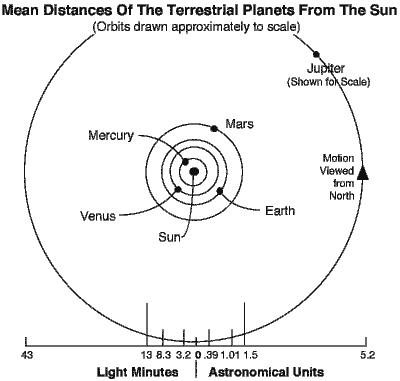
The terrestrial planets are the four innermost planets in the solar
system, Mercury, Venus,
Ealrth and Mars. They
are called terrestrial because they have a compact, rocky surface
like the Earth's. The planets, Venus, Earth, and Mars have significant
atmospheres while Mercury has almost none. The following diagram shows
the approximate distance of the terrestrial planets to the Sun.
The
Terrestrial Planets
The terrestrial planets are the four innermost planets in the solar
system, Mercury, Venus,
Ealrth and Mars. They
are called terrestrial because they have a compact, rocky surface
like the Earth's. The planets, Venus, Earth, and Mars have significant
atmospheres while Mercury has almost none. The following diagram shows
the approximate distance of the terrestrial planets to the Sun.
 The
Jovian Planets Jupiter,
Saturn, Uranus, and
Neptune are known as the Jovian (Jupiter-like)
planets, because they are all gigantic compared with Earth, and they
have a gaseous nature like Jupiter's. Jovian planets are also referred
to as the gas giants, although some or all of them might have
small solid cores. The
Jovian Planets Jupiter,
Saturn, Uranus, and
Neptune are known as the Jovian (Jupiter-like)
planets, because they are all gigantic compared with Earth, and they
have a gaseous nature like Jupiter's. Jovian planets are also referred
to as the gas giants, although some or all of them might have
small solid cores.
|
Views
of the Solar System
|
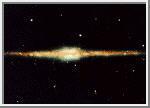 Our
Milky Way Galaxy This
image of our galaxy, the Milky Way, was taken with NASA's Cosmic Background
Explorer's (COBE) Diffuse Infrared Background Experiment (DIRBE). This
never-before-seen view shows the Milky Way from an edge-on perspective
with galactic north pole at the top, the south pole at the bottom and
galactic center at the center. The picture combines images obtained
at several near-infrared wavelengths. Stars within our galaxy are the
dominant source of light at these wavelengths. Even though our solar
system is part of the Milky Way, the view looks distant because most
light comes from population of stars that are closer to the galactic
center than our own Sun. Our
Milky Way Galaxy This
image of our galaxy, the Milky Way, was taken with NASA's Cosmic Background
Explorer's (COBE) Diffuse Infrared Background Experiment (DIRBE). This
never-before-seen view shows the Milky Way from an edge-on perspective
with galactic north pole at the top, the south pole at the bottom and
galactic center at the center. The picture combines images obtained
at several near-infrared wavelengths. Stars within our galaxy are the
dominant source of light at these wavelengths. Even though our solar
system is part of the Milky Way, the view looks distant because most
light comes from population of stars that are closer to the galactic
center than our own Sun.
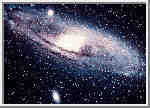 Andromeda
Galaxy, M31 The Andromeda Galaxy, M31, is
located 2.3 million light years away, making it the nearest major galaxy
to our own Milky Way. M31 dominates the small group of galaxies (of
which our own Milky Way is a member), and can be seen with the naked
eye as a spindle-shaped "cloud" the width of the full Moon.
Like the Milky Way, M31 is a giant spiral-shaped disk of stars, with
a bulbous central hub of older stars. M31 has long been known to have
a bright and extremely dense grouping of a few million stars clustered
at the very center of its spherical hub. Andromeda
Galaxy, M31 The Andromeda Galaxy, M31, is
located 2.3 million light years away, making it the nearest major galaxy
to our own Milky Way. M31 dominates the small group of galaxies (of
which our own Milky Way is a member), and can be seen with the naked
eye as a spindle-shaped "cloud" the width of the full Moon.
Like the Milky Way, M31 is a giant spiral-shaped disk of stars, with
a bulbous central hub of older stars. M31 has long been known to have
a bright and extremely dense grouping of a few million stars clustered
at the very center of its spherical hub.
 Sun
and Planets This image shows the Sun and nine planets approximately
to scale. The order of these bodies are: Sun, Mercury, Venus, Earth,
Mars, Jupiter, Saturn, Uranus, Neptune, and Pluto
Sun
and Planets This image shows the Sun and nine planets approximately
to scale. The order of these bodies are: Sun, Mercury, Venus, Earth,
Mars, Jupiter, Saturn, Uranus, Neptune, and Pluto
Terrestrial
Planets This image shows terrestrial planets Mercury, Venus, Earth
and Mars approximately to scale. The terrestrial planets are compact,
rocky and Earth-like.
Jovian
Planets This
image shows the Jovian planets Jupiter, Saturn, Uranus and Neptune approximately
to scale. The Jovian planets are named because of their gigantic Jupiter-like
appearance.
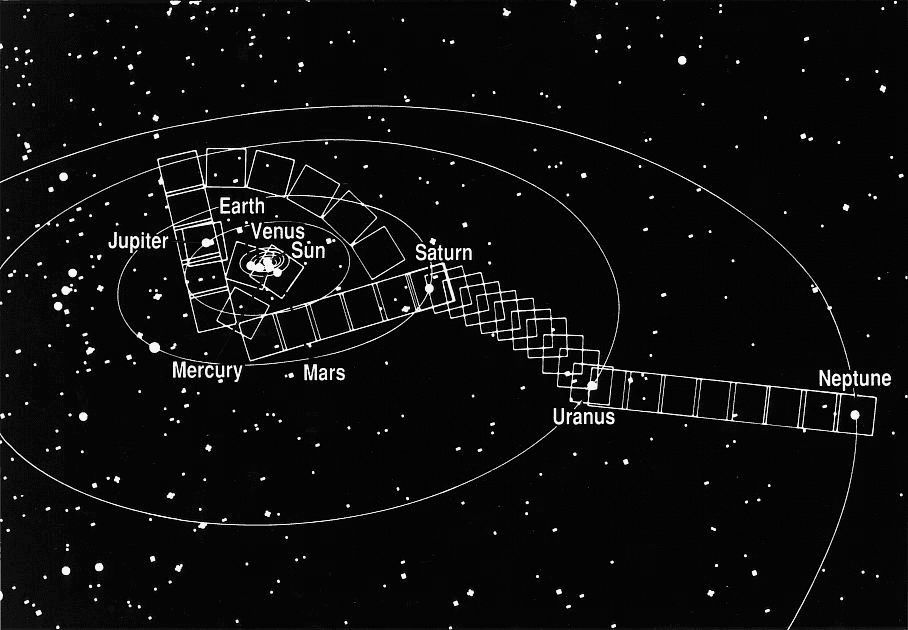
 Diagram
of Portrait FramesOn February 14, 1990, the cameras of Voyager 1
pointed back toward the Sun and took a series of
pictures of the Sun and the planets, making the first ever "portrait"
of our solar system as seen from the outside. This image is a diagram
of how the frames for the solar system portrait were taken.(GIF,
16K)(Courtesy NASA/JPL)
Diagram
of Portrait FramesOn February 14, 1990, the cameras of Voyager 1
pointed back toward the Sun and took a series of
pictures of the Sun and the planets, making the first ever "portrait"
of our solar system as seen from the outside. This image is a diagram
of how the frames for the solar system portrait were taken.(GIF,
16K)(Courtesy NASA/JPL)
 All
Frames from the Family Portrait (JPG, 33K)
This image shows the series of pictures of the Sun and the planets
taken on February 14, 1990, for the solar system family portrait as
seen from the outside. In the course of taking this mosaic consisting
of a total of 60 frames, Voyager 1made several images of the inner solar
system from a distance of approximately 6.4 billion kilometers (4 billion
miles) and about 32° above the ecliptic plane. Thirty-nine wide
angle frames link together six of the planets of our solar system in
this mosaic. Outermost Neptune is 30 times further from the Sun than
Earth. Our Sun is seen as the bright object in the center of the circle
of frames. The insets show the planets magnified many times.
All
Frames from the Family Portrait (JPG, 33K)
This image shows the series of pictures of the Sun and the planets
taken on February 14, 1990, for the solar system family portrait as
seen from the outside. In the course of taking this mosaic consisting
of a total of 60 frames, Voyager 1made several images of the inner solar
system from a distance of approximately 6.4 billion kilometers (4 billion
miles) and about 32° above the ecliptic plane. Thirty-nine wide
angle frames link together six of the planets of our solar system in
this mosaic. Outermost Neptune is 30 times further from the Sun than
Earth. Our Sun is seen as the bright object in the center of the circle
of frames. The insets show the planets magnified many times.
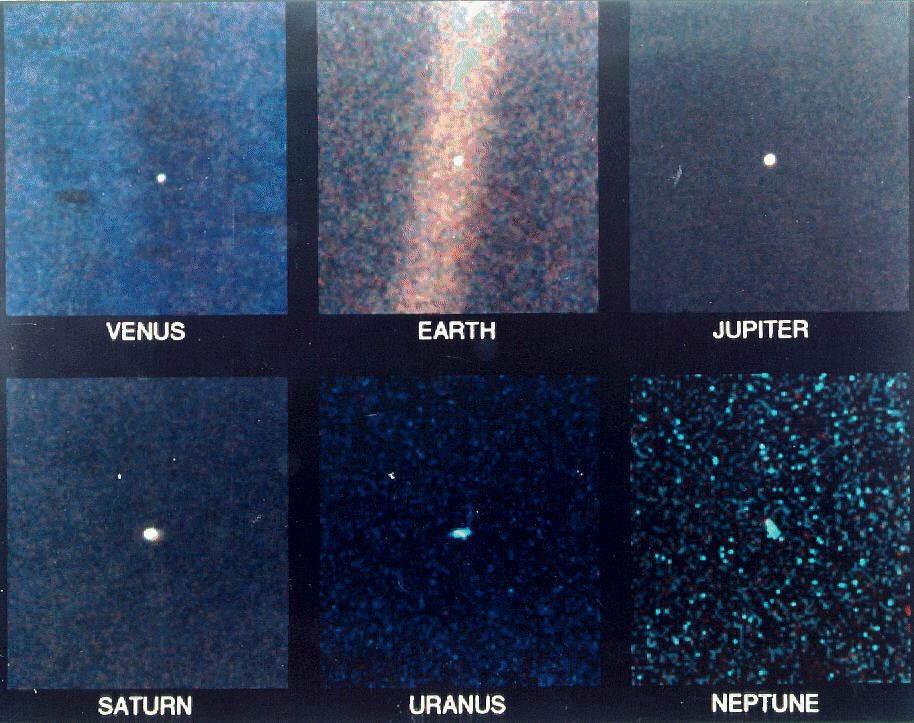
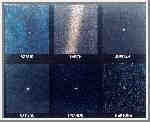 Portrait
of the Solar System(JPG, 86K)These six
narrow-angle color images were made from the first ever "portrait"
of the solar system taken by Voyager 1, which was more than 6.4 billion
kilometers (4 billion miles) from Earth and about 32° above the
ecliptic. Mercury is too close to the Sun to be seen. Mars was not detectable
by the Voyager cameras due to scattered sunlight in the optics, and
Pluto was not included in the mosaic because of its small size and distance
from the Sun. These blown-up images, left to right and top to bottom
are Venus, Earth, Jupiter, Saturn, Uranus, and Neptune. Portrait
of the Solar System(JPG, 86K)These six
narrow-angle color images were made from the first ever "portrait"
of the solar system taken by Voyager 1, which was more than 6.4 billion
kilometers (4 billion miles) from Earth and about 32° above the
ecliptic. Mercury is too close to the Sun to be seen. Mars was not detectable
by the Voyager cameras due to scattered sunlight in the optics, and
Pluto was not included in the mosaic because of its small size and distance
from the Sun. These blown-up images, left to right and top to bottom
are Venus, Earth, Jupiter, Saturn, Uranus, and Neptune.
The
following table lists statistical information for the Sun and planets:
| |
Distance
(AU)
|
Radius
(Earth's)
|
Mass
(Earth's)
|
Rotation
(Earth's)
|
#
Moons
|
Orbital
Inclination
|
Orbital
Eccentricity
|
Density
(g/cm3)
|
|
|
0
|
109
|
332,800
|
25-36*
|
9
|
---
|
---
|
1.410
|
|
|
0.39
|
0.38
|
0.05
|
58.8
|
0
|
7
|
0.2056
|
5.43
|
|
|
0.72
|
0.95
|
0.89
|
244
|
0
|
3.394
|
0.0068
|
5.25
|
|
|
1.0
|
1.00
|
1.00
|
1.00
|
1
|
0.000
|
0.0167
|
5.52
|
|
|
1.5
|
0.53
|
0.11
|
1.029
|
2
|
1.850
|
0.0934
|
3.95
|
|
|
5.2
|
11
|
318
|
0.411
|
16
|
1.308
|
0.0483
|
1.33
|
|
|
9.5
|
9
|
95
|
0.428
|
18
|
2.488
|
0.0560
|
0.69
|
|
|
19.2
|
4
|
15
|
0.748
|
15
|
0.774
|
0.0461
|
1.29
|
|
|
30.1
|
4
|
17
|
0.802
|
8
|
1.774
|
0.0097
|
1.64
|
|
|
39.5
|
0.18
|
0.002
|
0.267
|
1
|
17.15
|
0.2482
|
2.03
|
* The Sun's period
of rotation at the surface varies from approximately 25 days at the
equator to 36 days at the poles. Deep down, below the convective zone,
everything appears to rotate with a period of 27 days.
The
asteroids and comets represent remnants of the planet-building process
in the inner and outer solar system, respectively. Asteroids are rocky
bodies, ranging in size from the largest known, Ceres, with a diameter
of roughly 930 kilometres (578 miles) to the microscopic dust that is
dispersed throughout the asteroid belt. The orbits of asteroids typically
have both higher eccentricities and higher inclinations than those of
the major planets. Some asteroids travel in paths that cross the orbit
of the Earth, providing opportunities for collisions with the planet.
The rare collisions with relatively large objects (those with a radius
of more than 10 kilometres) can be devastating, as in the case of the
asteroid impact that is thought to be responsible for the Cretaceous-Tertiary
extinction. More commonly, the impacting objects are much smaller, reaching
the Earth's surface as meteorites. Observations from Earth suggest that
some asteroids are mainly metal (principally iron), others are stony,
and still others are rich in organic compounds, presumably resembling
the so-called carbonaceous chondrite meteorites. The October 1991 flyby
of the asteroid Gaspra by the Galileo spacecraft (en route to Jupiter)
revealed an irregularly shaped object pockmarked with craters, resembling
one of the small satellites of Mars.
The physical
characteristics of comets tend to be the precise opposites of asteroids.
Ice is their main constituent, predominantly in the form of frozen water,
but frozen carbon dioxide, carbon monoxide (CO), and other ices also
are present. These cosmic ice balls are laced with rock dust and a rich
variety of organic compounds, many of which are collected in tiny grains.
A typical
comet is an irregularly shaped object whose nucleus has a diameter of
a few kilometres. It spends most of its life at immense distances from
the Sun, about one-third of the way to the nearest
star. This is the realm of the Oort comet cloud, named after the Dutch
astronomer Jan Oort. The Oort cloud is actually a spherical shell that
surrounds the flat plane of the solar system that contains the planets
and asteroids. The comets in this shell are not visible from the Earth;
their existence there is presumed because of the highly elliptical orbits
(e approaching 1.0) that may be observed on their perihelion
passages (i.e., the part of their orbit nearest the Sun). As
comet nuclei are warmed through solar heating, they begin to release
the gases that form their familiar comas and tails. These comets have
orbital periods of millions of years; their orbits can be inclined in
any direction.
Based on
information obtained during the 1986 spacecraft flybys, the most famous
comet, Comet Halley, appears to exemplify what are termed short-period
comets--i.e., those that have been captured into smaller orbits
by a close encounter with Jupiter during their long journey from the
Oort cloud in toward the Sun. Comet Halley has a period of only 76 years,
as opposed to the several million years of many other cometary bodies,
and has a retrograde orbit around the Sun.
As the
comets trace out the arcs of their orbits that are closest to the Sun,
they continuously shed mass. The subliming gas dissipates into space,
but the grains of silicates and organic compounds remain to orbit the
Sun along paths very similar to those of the parent comet. When the
Earth's path around the Sun intersects one of these dust-populated orbits,
a meteor shower occurs. During such an event tens to hundreds of so-called
shooting stars are seen in the night sky each hour as the dust grains
strike the upper atmosphere of the Earth. Although many random meteors
can be observed nightly, they occur at a much higher rate during a meteor
shower. Even on an average day, the Earth accumulates approximately
400 tons of asteroidal and cometary debris.
Besides
the solid grains of such debris, the space through which the planets
travel contains protons, electrons, and ions of the abundant elements,
all streaming outward from the Sun in the form of the solar wind. Occasional
giant flares (short-lived eruptions) on the Sun's surface expel matter,
along with high-energy radiations, that contribute to this interplanetary
medium.
Exactly
where the boundary between the interplanetary medium and the interstellar
medium lies has not yet been determined, but four spacecraft have recently
passed the orbit of Pluto with velocities that will allow them to escape
from the solar system. Thus, this boundary may well be crossed in the
near future.
Return
to Top
Design
and Images
Copyright
© 2003 DeftCOM Systems Limited.
All Rights Reserved
|
|