|
Golf
By Tommy C. |
|
Taylor Made
|
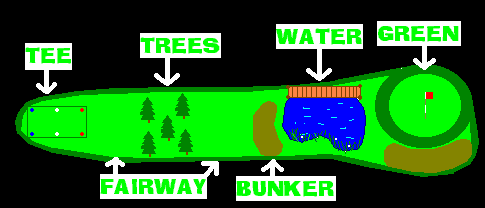
The Golf Course Golf courses have no regulation length or shape, but most courses consist of 18 holes numbered 1 to 18 ( I prefer the easy 9 ). Playing all 18 holes makes up a round of golf. Some courses have only nine holes. Each hole is played twice for a round.An 18-hole course averages somewhere around 140 acres (lot of land!) Each hole includes a tee, a fairway, a green, and often one or more hazards. See the diagram below for the layout of a typical golf course. Courses for men generally range from about 6,500 to more than 7,000 yards in length. This distance is the total length from the tees to all 18 holes. Courses are shortened for women by positioning the ladies' tee closer to the hole.
A golf course contains a mixture of par 3, par 4, and par 5 holes. A player shoots par by hitting the ball from the tee into the hole in a certain number of strokes, usually 3, 4, or 5. A typical par 3 hole measures up to 250 yards, a par 4 from 251 to 470 yards and a par 5 measures at least 471 yards. Most courses are laid out in a loop that brings the golfer back to a point near the first tee at the end of each nine holes (for lazy people like me.) The holes are arranged so that players are relatively safe from balls hit by players on another hole (which mostly never happens, so watch out for golfers like me.) Golfers shout a warning "Fore!" to alert other good golfers that a shot is about to be hit or that a ball has been hit in their direction. The Tee The Fairway The Green Play on the hole is completed when the golfer hits the ball into the hole. The number of strokes the player takes to hit the ball into the hole becomes the player's score for that hole. The player normally takes progressively shorter shots from the tee to the green. Once on the green, the golfer putts (rolls) the ball into the hole with a club called the putter. The surface of the green is usually gently sloped, and the golfer should allow for the slope when putting. Hazards
|
Wilson
|