
Hypercube

The hypercube I speak of is simply the
fourth dimension's standard "cube." When we think dimensions, we normally
think point (0d), line (1d), square (2d), cube (3d), and now, hypercube
(4d).
This site has great information of the
hypercube. Reading that would be better than reading anything that I could
ever manage Plus, mega-amount of visuals!
Hypercube (Jürgen
Köller)
While hypercubes may seem complex at
first, they're really not. They can't be considered fractals because they
do not have a fine, irregular structure. However, they are formed by a
recursive process according to the site above, and they do have some
self-similarity (cubes made up of a bunch of cubes!).
And think back to all of that fractal
dimensioning stuff, especially similarity dimensioning. Using the formula
D = logn/logr, we'll stick to a reduction factor of 2.
If we want a line twice as big, we
need 2 lines. Thus, D = log2/log2 = 1.
For a square twice as big, we need 4
little squares: D = log4/log2 = 2.
For the cube, we need 8 little cubes:
D = log8/log2 = 3.
Finally, the hypercube! We would just
assume it would be D = log16/log2 = 4, but is there a less assuming way of
figuring this out? I'm sure there is, but I know everyone doesn't want to
stare at that thing long enough to figure out how to put it together. So,
we go with a replacement number of na = 2^a (a
being the iteration of the cubes, the line is the first iteration, the
square is the second. . .)
Here's another great visual:
Hypercube (Drew Olbrich)
The first site also explains the net
of the hypercube. You know how you get a T looking strip of paper and fold
it into a kind of squished and roughly taped paper cube? This is that for
the hypercube! Salvador Dali's "Crucifixion (Corpus Hypercubus)" uses the
net of the hypercube.
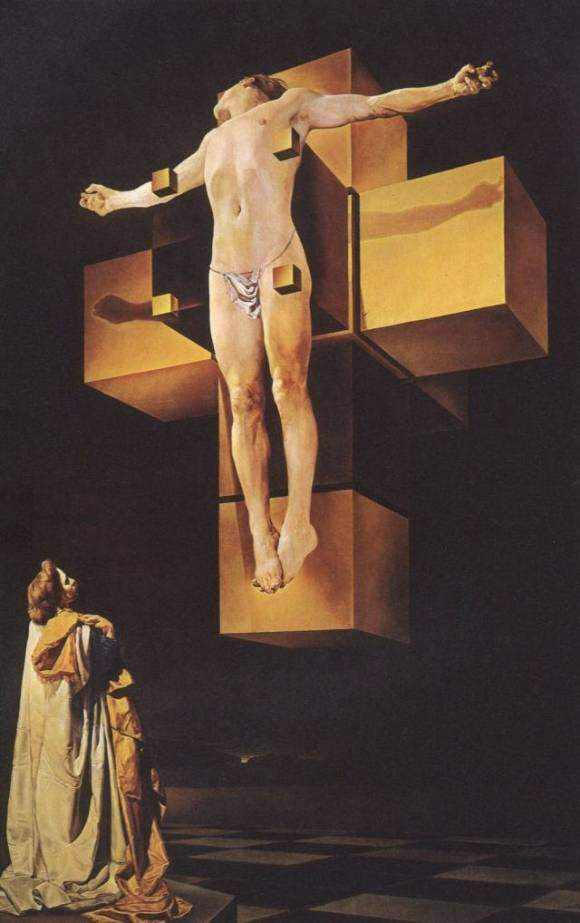
"Crucifixion"

