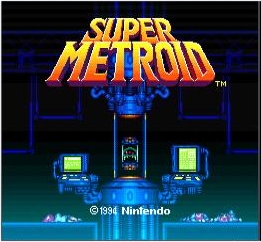
 Super Metroid
A game that seemingly pushed the very CPU within the SNES to the limits, and possibly beyond. A game that seemed to express it's actions, events, emotions, and what not with the highest of quality. A game not directly involved with the master of designing, Shigeru Miyamoto, but instead, the one who created the beloved Space hero, Samus Aran. His name is Gumpei Yokoi, and he has perfected the series he invented.
Story.
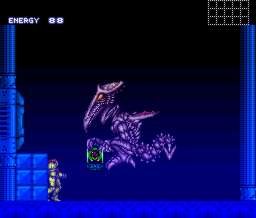
As Samus Aran, you are sent on a mission to a floating science lab were there is an emergency occurring. A mysterious creature has invaded the lab and has stolen a Metroid, and is making its escape as Samus arrives at the place. After the battle, the station is set to self-destruct and Samus must escape, even though she did not succeed in regaining the Metroid. She follows the creature by the name of Ridley to a nearby planet called Zebes, were she will go on a vast adventure in search of finding it, encountering many interesting beings, places, and objects. You will go from the surface of the planet to its very core looking for the Metroid, and you will become aquatinted with the spooky, empty sections of the planet, for example, Brinstar, a plant-like world, and Maridia, an aquatic zone. As you explore these areas, you really get the feeling that someone or something's used to live here, but apparently, nothing does anymore for unexplained reasons. And that is where this game shines, making the player feel that there was once a thriving civilization bustling about. But, as you explore it, you get the feeling something terrible happened.
Although the story is very basic and straightforward, it is not a big part of the game. As some might think or believe, a game should have an enthralling storyline to be successful. But, in the day of the 16 bit games, this wasn't an important factor. At the first of the game, it pretty much explains the story straight out. From there, it doesn't have anymore cutscenes or dialogue, but the beauty of this game is the way it presents the story by the use of the in-game action, a technique not easily grasped today in videogames. You totally understand everything that is going on even with the absence of cutscenes and text dialogue.
 Gameplay and play control.
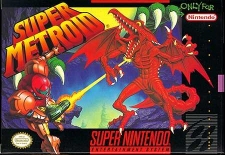
Action throughout the game is about 50/50 in action and adventuring. Half of the time, you are exploring the many secrets and passageways hidden throughout Zebes, and the other half, you are blowing away enemies and monsters with your arm cannon and other killer devices of destruction. This is a comfortable split between the 2, which appeals to a wide and varied audience. There are many secrets for you to explore, most hidden so that you could not find it by conventional means, except maybe accidental. For those you will need various items and equipment enhancements, and most definitely the cool X-ray beam, that allows you to see through walls and the like for secrets items buried within them or secret passageways to explore. The weapon upgrades you can obtain are varied, but not glamorous by no means. Although each of them have their advantages and strengths, they look mediocre and 'used', with the exception of the final enhancement you can obtain, which is a very powerful attack indeed. The sound effects for them are unique as well, which gives you the impression that this game was really 'worked' on, and not 'goofed' around with. The equipment upgrades, some new, some old, are highly effective and not a wasteful add-in scrapped together and slapped into the game. Samus' skills are really useful, too. From the Screw Attack-Space Jump combo, which allows you to bust through many walls and most enemies while jumping multiple times in thin air, to the Speed Boots, which allows Samus to perform a light speed dash that can propel her through certain walls, floors, etc., and bust straight through enemies. It also has real cool graphical effects and sounds, also.
Graphics.
Graphically, this game has it all. Detail put into this game was unheard of at the time, and it definitely proved that the SNES was not to be taken for granted. If you ever play the game, try and notice all the little details put into the game. Things such as bugs crawling around, sparks flickering about, lighting effects, the realistic drooling effects put off by the master of the game, and much, much more! Gameplay never slows down, and the colors are not of the highest quality, but are superb to say the least. Just expect to see BIG bosses and breathtaking level designs if you play it. And trust me, you'll want to play this game.
Sound.
The music, I think, is one of the best tracks for a game to date, even with the advancement of musical quality of the games of today. It matches it so perfectly, and you will never forget some of the tunes played, like the freaky music of Maridia, to the pipe organ-like last battle music, to the upbeat normal boss battle track. If you can find any MIDI tracks on the Internet of Super Metroid, I strongly suggest that you download it.
Even though this isn't a "Miyamoto game", it definitely, at first appearance, seems to be. But when you play the game, you will notice the style is different and it is from the masterminds of the Metroid team that worked on the previous ones. This game is of near perfect status, and anyone that has played this game will probably agree. I just hope that they release the sequel to this game sometime soon. And you can bet that I will be one of the first to pick it up. This game is easily worth the purchase of the SNES itself, so go out, find it, and ENJOY!!!
|