Metroid.
 In the same way that the original Mario and Zelda games laid the groundwork for their respective franchises, the original NES Metroid provided the foundation for a unique and innovative new series- the Metroid Series- nearly a genre of its own. And while few would call Metroid 1 the greatest Metroid game, it is undoubtedly the most revolutionary of the three- firmly planting the feel for the series that would be enhanced and built upon in the future.
In order to properly appreciate this game, it needs to be understood that it was different from anything else that was released at the time. It introduced a unique type of gameplay that is difficult to describe- everyone seems to have his or her own idea of what made Metroid what it is. Some point to the vast, sprawling and interconnecting caverns as the heart of the game. Others note its pacing. Others say the play control and unique weapons are the core. And yet others simply point out the entire presentation and elegance.
All those elements are probably necessary for the Metroid feel in 2D, and all were introduced in the first game. Even so, this does not equal perfection. The game simply isn’t meant for everyone, and some of the negative aspects can quickly drain away the fun. But after all, that’s part of what sequels are for- improving on the weaknesses of the original, while keeping the key elements intact (something Super Metroid did perfectly...).
 Graphics.
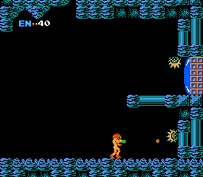
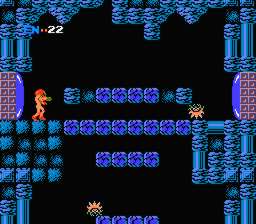
Metroid’s graphics are simplistic, as expected from an early NES game, but at the same time they show a fair amount of detail and attention to the little things. While at first glance the gamer only sees rather generic bricks and ledges in front of an always black background, as play continues a definite attention to details becomes apparent- different styles of rock hint whether they can be blown up or not, whether they are safe to walk on, etc. Certain styles quickly become associated with areas in the game- such as the bubble-like walls in Norfair. In fact, some of these themes become highly memorable, especially after seeing the return of familiar looking walls and paths in Super Metroid. However, the graphics are often the cause of one of the game’s main problems: endless repetition. The textures in Metroid remain largely the same throughout each area, but particularly in Brinstar. You’ll trek on for screen after screen, noting virtually no difference in location, other than the central texture theme, indicating you’re in Brinstar. Few other elements give you even the slightest clue as to where you are in the level. It doesn’t help that some of the screens actually repeat over again in the same area- a “classic” concept among many early NES games. All of this compounds the difficulty and adds frustration. It certainly makes the game challenging, but not necessarily in a fun way.
The highlight graphics-wise is easily the characters in the game- Samus, the three bosses, and the multitude of sci-fi enemies infesting the caverns of Zebes. Samus herself has quite a bit of animation for being in an early NES game, and some of her moves such as the Wave Beam and Spin Attack only add to the quality. Perhaps the finest graphics though are of the enemies- nearly all of the 25+ creatures attack in unique ways. Their animation stands out as well. Watching a Skree spin as it flies toward Samus makes it more entertaining to fight it.
Sound.
The music in Metroid isn’t bad for such an early game. There are actually only five or six main tracks you’ll hear throughout the course of the game, but really this isn’t any less than most early NES games. The music is generally not intrusive and it seems to fit the area- all of the music except the Brinstar track, that is. Brinstar’s tune (which you hear right when you start playing) sounds suitably heroic and adventurous in nature, but I found it simply too “peppy” to listen to it loop over and over again.
Sound effects are standard- you can hear Samus’ tapping of her boots as she runs across the corridors, and it greatly enhances the mood. Enemies make noise when they get hit and it all seems to work. The beep when Samus is low on health is annoying, but no more so than in any other game where a beep arises from a low power bar.
Story.
Samus is called upon to defeat the “Mechanical Life Vein” Mother Brain, a foe nestled deep in the heart of planet Zebes, who is using the Metroids to gain power. The story ends there, but it doesn’t really need to go on. The purpose makes sense, and there isn’t any feeling that something is missing in that aspect as you play. After all, you’re meant to feel alone and lost, deep within the caverns- with one goal always in the back of your head- destroy the Mother Brain. The two bosses you’ll encounter on your way to the Brain- Ridley and Kraid- are worth noting simply as they make a significant return in Super Metroid. In fact, nearly every standard enemy in this game returns in Super, so many players that haven’t played Metroid may enjoy going through it just to see the original versions of such memorable enemies as the Ripper, Zoomer, Holtz, and Side-Hopper.
Gameplay and play control.
Here is the core of any true videogame, and Metroid does not disappoint as far as uniqueness goes, but tedium and confusing layouts make some of the game more trouble than it’s worth. Gameplay is truly non-linear. Nearly every significant item can be picked up during your first play session, if you know where to look. The choices are all yours on what you do and when- Ridley and Kraid can be defeated in either order. You’ll progress back and forth (and up and down) through the two major areas, Brinstar and Norfair, and the smaller but much more dangerous hideouts of the two bosses. Once both bosses are felled, you’ll progress to the short final area, Tourian, home of the Mother Brain.
While this “freedom” to do what you want when you want sounds compelling, it is one of the main weaknesses of the game at the same time. Without guidance, players can get lost and frustrated very easily. Metroid II and Super Metroid proved that a game can still have a feeling of “no restrictions” at the same time as actually guiding where you go to a degree, and those games more than managed to keep the exploration feel and fun intact.
Play Control is top notch. You can pin point your shots easily, and the jumping feels just right. And you’ll be doing plenty of shooting and jumping, so that’s a very good thing. You’ll immediately notice you have amazing control over Samus while she’s in the air, and that jumping and shooting at the same time is not even remotely a problem. In addition, you’ll gain upgrades such as the High Jump, Ice Beam, and Spin Attack, which change your strategy accordingly and often allow you to reach new places and out of reach items.
It must be pointed out that many of the items are EXTREMELY difficult to find. Only a few missile packs are out in the open for easy collection- the rest are hidden very well beyond walls and traps. In fact, for most of the main items, you’ll need to blindly bomb in certain rooms to open up the correct route. This can become quite tedious, as you’ll have no clue where to bomb- some walls have certain styles to rocks that indicate they can be blown up, but the “secret” walls have no clues whatsoever and look exactly like any other portion of the level. Add to this that you don’t have a map to help track your route, and you’ve got a long, possibly boring, and monotonous journey ahead of you. Many of the items are hidden in locations that are as absurd or as difficult to reach as finding the entrances to the dungeons in The Legend of Zelda’s second quest, if not more so. Getting a map of the game, which shows locations of the key items, is highly recommended if you want to keep your sanity. And even with a map, you might get lost, and take an accidental turn into a dead-end hallway on occasion.
And there you have it.
Indeed, there are two ways of looking at this game’s negative components. You can look at it as true flaws that SHOULD have been corrected; things that simply aren’t acceptable. Or, and perhaps more appropriately, you can look at the game as an innovative plow, paving a path for the sequels to follow. Perhaps it’s not that this game is BAD; it may be that Super Metroid improved and perfected the Metroid concept so well, and in so many ways, that the original simply looks mediocre in comparison.
For example, I’ll point out an annoyance in Metroid’s play control: you can’t crouch and fire at the same time. In fact, you can’t crouch at all, without turning into the classic morphing ball. And naturally then, you’ll encounter many enemies in the game that move on the ground in front of Samus, and you simply can’t aim to attack. Your only choice is to wait for them to climb a wall, at which point you can aim directly at them. Another “problem” with the first game is you’ll be writing down long and annoying passwords. While these aspects certainly weren’t a gripe at the time, Metroid II and Super Metroid have spoiled us now, and we are used to crouching and firing, and a battery save. Going back to Metroid, we lose these aspects and the classic game simply appears primitive. But this could be viewed as a good thing- Metroid’s “flaws” make the sequels appear that much better, and give this game that sense of a true classic.
|