Social Behavior
Wolves live in packs conprising of three to thirty members. They can maintain quite a large territory, which is marked regularly. This ensures that other wolves will know that the lands are occupied. The alphas may also scent-roll to leave their scent on the ground.
Members of a pack may be so close to each other that when one member dies, the entire pack will mourn. Howling when mourning is something like a long howl with a low bark in the middle, something like a choked sob. They may not eat or play for a few days, and move around rather slumped, and slowly. More information in the posture section.
The following images are from Lioncrusher.
Submission
Postures are very important in wolf society. Every pack has its own ranking; the alphas being the leaders, and the omega the lowest ranking member of the pack. All wolves must show submission to higher ranking members; and omegas do so to all others.
In dominant posture, the wolf stands stiffly with its tail curved above its back. Ears are far forward and the wolf holds itself straight, head held high. Its tail may be wagging slightly, but stiffly, and may growl or snarl to assert its authority. The fur along the back of the wolf's neck will be raised, and it will look other wolves in the eye. Alphas or high-ranking wolves do not behave like this all the time; usually they are a little more relaxed, but generally in this posture.
Normally the wolf's tail will hang downwards, or may be raised slightly. The ears may be laid back if they are being slightly submissive, and the tail may be wagging a little as well.
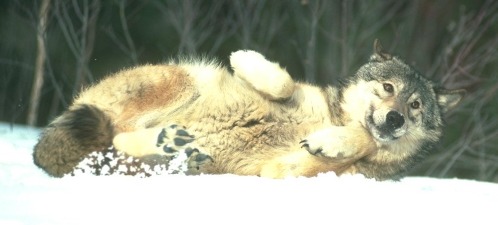
In submissive posture the wolf's tail will be between its legs, and the wolf will crouch with its ears back, or even flattened. They may lift a leg to expose some of the belly, or even roll over to expose the entire belly. Chin-licks may also be dished out to the higher-ranking wolf. All this time the wolf will try not to look directly at the other wolf. Lower ranking wolves display passive submission to almost all other pack members (Photo); higher-ranking members display active submission towards the alphas, to acknowledge them. (Photo- the grey wolf)
Body Language
When a wolf has its ears forward, teeth bared, tail bent and is in a defensive posture, it is probably a dominant wolf telling a lower ranking wolf to get away from the kill, and may also be used to scare intruders away. (Photo)
If a wolf feels threatened by another's actions, it may go into a submissive posture, but with fangs bared, trying to scare away that wolf. It may put up a fight as well. (Photo)
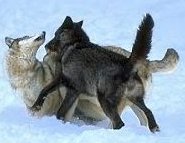
Dominant members in a pack may pin down lesser ranking members to show that they are in charge. Often done by the alphas. (Photo)
In a pack it is usually the omega who initiates play, often with a play bow, which in some ways is similar to the way a cat stretches. The tail may also be wagging. (Photo)
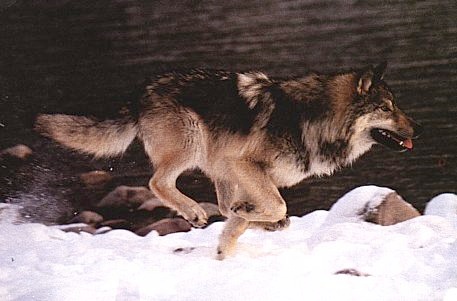
Running in fear and running in play are two distinctly different runs. In play the wolf is more relaxed, whereas in fear, the wolf's tail will be between its legs, and the back arched. (Photo- play, Photo-fear)
Wolves have mixed feelings too: in an ambivalent display, a wolf can show fear, submission, and agression all at once- the tongue sticking out of the mouth is submission, laid back ears fear, and bared teeth aggression. (Photo)
When angry, the wolf's tail sticks out straight, such that a straight line can be drawn from the shoulder area to the tail tip.
Verbal Communication
Communication takes place in many different forms. Some have been mentioned earlier in posture including ear and tail positions, but others are more vocal. Take for example the famous howl of a wolf. This does not actually occur during the full moon; this is an inaccurate presentation. Generally there is more activity on nights with a full moon as there is more light. The picturesque scene of a wolf on a cliff howling silhouetted against a full moon probably took place because of an artist who though it looked nice. O.o
Howling is normally started by one of the alphas, and then the other pack members join in. Each wolf howls at a different note, making it sound like there are a great number of wolves. Communal howling may serve to assemble the pack, communicate with other packs, tell others about the pack territory, mourn the loss of a pack member or perhaps simply for fun.
Other types of communication can bee seen when a mother whimpers to gather her pups, of the swift, sharp bark of an omega doing a play bow to entice another to chase it.
Fighting
Wolves in a pack do not fight among themselves often, and will usually just give a display to make the other give in. A fight may break out if the lower ranking wolf refuses to submit to the other. Sometimes they may fight over food, but usually not, as the higher-ranking wolves always eat first. Packs may fight with other packs, however, where boundaries meet.
Breeding
The gestation period for wolves is 63 days, or about two months. In reality the alpha pair are the only mates in a pack, as the members are actually all related, but due to the fact that it wouldn't be as fun for roleplay, gammas and betas are also allowed to breed, since most of the pack members in Mwitu Valley aren't related. No graphical mating or breeding is allowed here, so you can just start roleplaying as if the female of the two mates was pregnant, and how the parents felt about it, etc, etc. In the mating season, the pair become very affectionate towards each other, and may move away from the members of the pack for awhile. Wolves usually mate for life, unless their mate dies, and will defend each other. When the female is pregnant, as well as after the pups are born, the male will hunt and provide food for the family.
In spring a litter of about four to six pups are born in the den, though the number exactly varies according to the species/subspecies. The den or lair of the wolf may be a cave, hollow tree trunk, thicket, of a hole dug by the parents. Some pups may be stillborn, but only slightly more than half the litter survives the first month or so, and about half, or less, reach maturity. The female is extremely protective of her cubs, and for awhile may not let her mate near them as well. Other females in the pack also produce milk when the pups are born. The pups get their teeth at around three weekes and leave the den at about a month. From then until the start of their third month, they eat regurgitated meat but still require milk. In the third month they no longer drink milk, and at six months they should be able to hunt small rodents on their own. They will totally leave their parents, if they do, at a year of age.
Hunting
Pack hunts take place about once a month in Mwitu Valley. The hunters will decide the time and place the hunt will be held at, and report to the alpha to ask permission. The alpha or alphas will lead the hunt and most often do the kill; the pack members will chase the animal. Preferred prey is young or old, weak or sick; so that it will be easily brought down. Wolves chase the prey over long distances to try and tire the animal out, or have it injure itself in a fall.
Wolves hunt a variety of creatures. Individually, they would hunt rodents and birds; in a pack, deer, caribou, elk, or other equines. These animals also eat berries, surprisingly, and may resort to carrion if there is no live prey available.
After a successful kill, which happens about once in every two hunts, the alphas will eat first, then the betas, and so on in order of rank until the omega has eaten.
Others
Play is an important part of wolf's life. Wolves play with almost anything; a stick, a feather, and mostly each other. Play helps create a close-knit pack, and prepares young for hunting. An invitation to play is made by doing a play bow, and letting out a sharp bark. Wolves may chase each other, play tug-of-war, their version of 'leapfrog', and anything that's fun.
Many wolves leave their packs, sometimes in search of a mate to start a pack with, or a low-ranking wolf that was looking for a better life. 60% of young wolves leave their pack when they reach maturity.