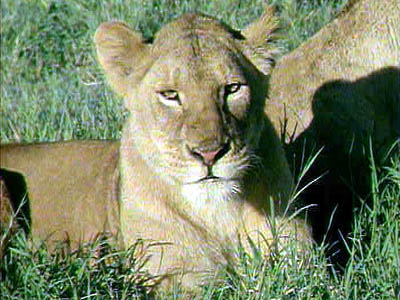
Common Name: Lion
Scientific Name: Panthera Leo
Stats
Body Length: African: 90-250 cm; Asian 113 cm
Tail: 100 cm
Shoulder Height: 120 cm
Weight: African: 120-250 kg; Asian: 130 kg
Life Span: 15-20 years
Gestation: 4 mths; 110-120 days
Litter Size: 3-4
Age they mature: Male: 5 years; Female: 2 1/2- years
Females are 40-50% smaller than males, and live longer.
Subspecies: Africa: P.l.leo, P.l.azandica, P.l.bleyenberghi, P.l.krugeri, P.l.nubica, P.l.senegalensis
Asia: P.l.persica
Common Prey: Zebra, deer, antelope, warthogs, giraffes, buffalos
Subspecies
Lions are social cats, unlike any other.
Two species of lion exist now: the african lion and the asian lion. Asian lions are smaller and have thinner manes, so that their ears are visible. They also have a flap of skin running down along their belly.
Appearance
Lions are generally a tawny color, having short fur and thicker manes. The mane, a sign of maturity and strength, darkens as the lion grows older. It may extend down along the shoulder or be partially beneath the lion's belly. It serves as protection for the male, and also helps to differenciate genders from a distance. A lioness is pretty much similar to a lion, but without the mane.
White lions do occur, but they are not albino. The light pigmentation is caused by a recessive gene. These rare white lions do not usually live long as they do not camoflage well and are usually killed when young. Lions have white chins and tail tufts, and the males also have elbow tufts. The back of their ears is black with a white circle, and is used to tell their mood.
Behaviour
Lions live in groups called prides, consisting of one to six adult lions, up to 12 adult females, and their young. Lionesses born in a pride will most likely stay in it until they die. The male must defend his pride from other lions that would want to take over it, while the females' job is to hunt to feed the pride. Territories can be very large, depending on the size of the pride.
Hunting occurs at dusk. Lions hunt in groups for large prey, and alone for smaller animals. A group of lionesses will go downwind of the herd, and another group will be opposite. These lionesses break cover and chase the prey into the other group, who will run the animal down and do the kill. They will snap the spine of smaller prey, but suffocate or sever the throat for larger animals.
After the kill is made, the males will eat first, followed by the females, in sucession of age; then the cubs. Fights occasionally happen over the meal. Lions spend up to 20 hours of the days sleeping, as much energy is used during the hunt.
When a young male matures, he is chased out of the pride. This usually happens when the lion is about 3 1/2 years old. These males will group together, forming a coalition. This ensures sucess in hunting, and forming a pride of their own. They will look out for prides in which the dominant male is old, and kill him to take control of the pride. Females will breed once every two years, at any time of the year, so the new males will kill all the cubs in the pride after they take over, so that they can mate sooner.
Cubs are born spotted with their ears and eyes closed, and open then about a week later. They begin to walk soon after. The cubs get their first set of teeth at one month old, and a few weeks later the mother will begin bringing the cub to kills to let it eat meat as well. They are weaned at four months. Prior to this, all the lionesses in the pride will give the cubs milk. More or less half of the cubs will not survive to be two years old depending on the location. Their spots will disappear as they mature, as such protective camoflage is no longer needed.
Senses & Communication
Lions have sensitive whiskers, which they use to help navigate, especially at night. These whiskers occur not only on the sides of the lion's muzzle, but also above its eyes, below its nose, and on the back of its paws. These all sense vibrations, either in the air or in the ground.
The lion's vocal communication system is quite varied; aside from roaring, they also have a variety of sounds used to express themselves. Purring also happens among lions, though as other big cats, only when exhaling. They also communicate visually. They have a well developed greeting system used to pick out lions that are not from their pride. More on communication at Lioncrusher.


