
ROLE PLAYING
BOOK REVIEWS
By David Cesarano, Jr.
This page is all about role-playing games. The systems I have played include Palladium, GURPS, d20, 2nd Edition Advanced Dungeons & Dragons, Alternity, and White Wolf. The following selections illustrate the various books I own and what I think about them. A nod must be given to Pete Overton, owner of that most excellent "Quality in Rifts" homepage, which prompted me to write up this little page that has all of my thoughts and opinions on the different books I possess.
But first, a brief description of my experiences with the four main game systems I have played (Alternity and GURPs are not included, as my exposure to them was too limited for me to build an accurate description of them.
Advanced Dungeons & Dragons 2nd Edition: This was the game system that began it all for me. I was hooked by roleplaying by the sixth grade and was captured by the imagination it took to create such fantastic worlds that seemed to leap from the pages of my favorite fantasy novels to the tabletop. I was too young to really understand the nuances of the rules, but as I grew older, like many people, I began to find the inevitable holes and problems that develop in the rules of nearly every roleplaying game system that exists. Nevertheless, AD&D was my default system until D20 emerged. My overall opinion is too heavily laden with nostalgia to give a fair account of AD&D.
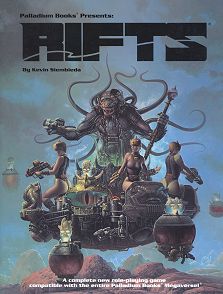 Palladium
Rifts RPG: Introduced
to me my freshman year of college, it captured my imagination instantaneously.
I had never before looked at an alternative RPG system until college, and
then I began to explore the multiple facets of possibilities that existed
beyond the scope of AD&D. Palladium has a much better skill and
proficiency system than AD&D, and while its combat system may seem
a bit more cumbersome to some first-timers, it is ultimately more realistic
(at least in the realm of hand-to-hand). Modern weapons combat, on
the other hand, is incredibly cumbersome, especially for the GM, who may
find himself juggling charts for distance, range, and character positions
much more than he would in AD&D. Magic and psionics are not even
nearly as versatile as they are in AD&D, but one must consider the
very nature of the world that is Palladium: gritty, dark and highly dangerous.
Thus, magic and psionics are less utilitarian and much more designed to
keep the player alive. All in all, I must say that Palladium is one
of my favorite systems, despite the bad rap it has been getting lately
(which, honestly, is well-deserved).
Palladium
Rifts RPG: Introduced
to me my freshman year of college, it captured my imagination instantaneously.
I had never before looked at an alternative RPG system until college, and
then I began to explore the multiple facets of possibilities that existed
beyond the scope of AD&D. Palladium has a much better skill and
proficiency system than AD&D, and while its combat system may seem
a bit more cumbersome to some first-timers, it is ultimately more realistic
(at least in the realm of hand-to-hand). Modern weapons combat, on
the other hand, is incredibly cumbersome, especially for the GM, who may
find himself juggling charts for distance, range, and character positions
much more than he would in AD&D. Magic and psionics are not even
nearly as versatile as they are in AD&D, but one must consider the
very nature of the world that is Palladium: gritty, dark and highly dangerous.
Thus, magic and psionics are less utilitarian and much more designed to
keep the player alive. All in all, I must say that Palladium is one
of my favorite systems, despite the bad rap it has been getting lately
(which, honestly, is well-deserved).
 White
Wolf: My senior year,
I finally got past my fear of larpers and discovered what is to me, the
most versatile gaming system I have ever encountered. Based upon
the D10, it is a very simple system that is surprisingly realistic (especially
combat, which is left purposely vague to keep the game from being too cumbersome,
but retaining that hard, realistic edge to it). Unlike any other
system I have heretofore encountered, White Wolf does not give a list of
rules telling the Storyteller (i.e. GM) what the players can do, but instead
gives rules that tell the reader how his character can attempt to do whatever
the hell he can come up with, without the Storyteller having to come up
with new rules on the spot or digging for 10 minutes through three different
handbooks to find the precise rule that defines exactly how to execute
what action. Their books are 75% setting,, 20% toys, and 5% rules.
This game appeals to the disaffected late Gen X youth that have become
disillusioned by the more hack-n'-slash games (like AD&D) and crave
a more intimate, dynamic, story- and role-driven game. In a nutshell,
it is a game made for and by Literature and English majors.
White
Wolf: My senior year,
I finally got past my fear of larpers and discovered what is to me, the
most versatile gaming system I have ever encountered. Based upon
the D10, it is a very simple system that is surprisingly realistic (especially
combat, which is left purposely vague to keep the game from being too cumbersome,
but retaining that hard, realistic edge to it). Unlike any other
system I have heretofore encountered, White Wolf does not give a list of
rules telling the Storyteller (i.e. GM) what the players can do, but instead
gives rules that tell the reader how his character can attempt to do whatever
the hell he can come up with, without the Storyteller having to come up
with new rules on the spot or digging for 10 minutes through three different
handbooks to find the precise rule that defines exactly how to execute
what action. Their books are 75% setting,, 20% toys, and 5% rules.
This game appeals to the disaffected late Gen X youth that have become
disillusioned by the more hack-n'-slash games (like AD&D) and crave
a more intimate, dynamic, story- and role-driven game. In a nutshell,
it is a game made for and by Literature and English majors.
 D20:
Popularized by the newly released Dungeons & Dragons 3rd Edition, D20
threatens to revolutionize the gaming market, for good or for ill.
Loosely based on the original AD&D rules, it is essentially a new system
with the same old spells and monsters, most of the same old classes, and
a few new twists. The classes are distinct, well rounded, and highly
customizable. Prestige classes, feats, and spell domains are probably
the greatest and most original ideas that Wizards has managed to put into
their gaming system. The open license ability makes this particular
universal system much more universal. Whereas White Wolf and Palladium
always had crossover potential within their own systems, D20 is an open
license, allowing different companies to make different games for the same
rules system. So now there is only one set of rules for a whole mass
of games. The result is the ability to know the rules for any number
of D20 games from simply playing one, as well as the potential to have
a Star Wars-Dune crossover (if Dune hadn't been cancelled) or a Wheel of
Time-Forgotten Realms crossover.
D20:
Popularized by the newly released Dungeons & Dragons 3rd Edition, D20
threatens to revolutionize the gaming market, for good or for ill.
Loosely based on the original AD&D rules, it is essentially a new system
with the same old spells and monsters, most of the same old classes, and
a few new twists. The classes are distinct, well rounded, and highly
customizable. Prestige classes, feats, and spell domains are probably
the greatest and most original ideas that Wizards has managed to put into
their gaming system. The open license ability makes this particular
universal system much more universal. Whereas White Wolf and Palladium
always had crossover potential within their own systems, D20 is an open
license, allowing different companies to make different games for the same
rules system. So now there is only one set of rules for a whole mass
of games. The result is the ability to know the rules for any number
of D20 games from simply playing one, as well as the potential to have
a Star Wars-Dune crossover (if Dune hadn't been cancelled) or a Wheel of
Time-Forgotten Realms crossover.
