
Introduction: I anticipated this book so highly until I finally got my grimy paws all over it, and boy was I happy when I cracked this thing open and took a peek. Up until this point, I had been on the cusp over the D20 system. I was very disappointed with the revamping of the magic system, the redefining of all of the spells (which made all the extras in the Tome of Magic, The Complete Wizard's Handbook, and other spell sources totally useless and un-canon if you will), the Assassin as a prestige class, the lack (or omission) of certain creatures from the exceptionally lean Monster Manual, and the general blah-ness of both Sword and Fist and Defenders of the Faith. These were exceptional let-downs, partially because I had been so enthused by the Player's Handbook, and everything that followed just didn't seem to make par. The Forgotten Realms Campaign Setting would make or break 3rd Edition (and thereby D20) for me.
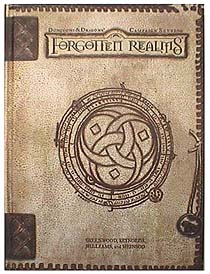
Cover: The cover looked beautiful. Like the core rulebooks, it had a very old feel to it, but unlike the others, it didn't have that glossy finish that wears away only after a hundred and fifty million fingerprint smudges mar the surface. The device on the cover was interesting; overall, it was pretty decent.
World Detail and Setting Background: The pugnatious Elminster fashions a nice introduction to the book, which gives a brief description of the feel of the Realms and is designed to hook the reader. I plowed through this part, knowing full well the basic background from the old revised boxed set from 2nd Edition. There is a rather large section on character creation and how the races and classes relate to the various areas of the Realms. Magic is fairly well detailed (much more extensively than in any other book), and various different types are illustrated in passing, especially the incredible shadow weave. The "Life in Faerun" chapter was very much like the introductory chapter to The Grand Tour of the Realms from the revised boxed set, but it did detail the various languages much better. It failed to show examples of the new alphabets, and they screwed up on the Thorass and Espruar alphabets, only giving a translation from Dethek into Roman for the different letters. In addition, they ditched Auld Wyrmish for the "3rd Edition" standard, Draconic, which I can accept, but am mildly annoyed at. I liked Auld Wyrmish very much, and I thought it added a great deal of flavor to the Realms. Nor did they list the languages of the giants (Jotun, Jotunhaug, Jotunstein, etc. from Giantcraft), nor did they list Drowic or High Drow, but since they are somewhat obscure, I'll let it slide. The "Running the Realms" chapter was very good, equivalent to the old book from the old boxed set, but they also had a comprehensive list of dungeons, which I found absolutely wonderful. The History chapter and the Geography chapter were so jam-packed with information it was incredible, and for the first time in any of their basic core setting material they described the events in the Time of Troubles. A political map of the Realms (AT LAST!!!!) was provided (something I have craved for a long time), and the descriptions of the different regions and nations within Faerun was very complete and thorough, touching every major political, magical, and divine power. The Religion section was very thorough as well, although only a few of the gods were detailed (see the free band-aid posted on the web-enhancement section of Wizards' website for the rest of the gods).
Races: The races were all there, and fairly well detailed. The overall feel, however, is changed. This time around (quite unlike the boxed set), the races are back on the upswing. Dwarves are expanding again, retaking their old homes, and the elves are leaving Evermeet (what the hell???). They totally did away with the negative, grim outlook on the future of the Dwarves as a dying race, headed for extinction, which gave them such a fantastic (although fatalistic) and tragic battle against inevitability. Likewise, elves were retreating to Evermeet, whose king was recently assassinated. But now, all of a sudden, the Thunder Blessing has pushed Dwarven youth to retake their old ancestral homes, and the young elves who have never seen Faerun also wish to bring about a rebirth of Elven society and Elven kingdoms in the Realms. To me this is just some bullshit ploy to try to put yet another band-aid on something that was too dark and too tragic (and hence, too constrasting) to the "NEW" outlook of the Forgotten Realms. They are appealing to all of the young kids who are too unimaginative to try 2nd Edition, but got pulled in by the cool art and new movie of 3rd Edition. The genasi and the aasimar were a great addition, but the damn bastards revealed where the hell tieflings come from, something that was kept secret in the 2nd Edition Planescape boxed set. So now, every plot line that every tiefling's DM had held back for that ultimate plot twist was just ruined. The new rules for "Powerful Races" were indeed good for balancing the abilities of races that seem ahead of others, but in practice, it can get really cumbersome when the party's 3rd level sorcerer can stand up to more punishment than the 1st level Drow cleric. It could use a little tuning.
Classes: Nothing new. Everything is the same. The monk is munchkin, and shouldn't belong in the Forgotten Realms (EVER!), but that is another argument. As for the Prestige Classes, they were overall excellent. The Guild Thief, Purple Dragon Knight, Hathran, Harper Scout, Runecaster, Red Wizard, and War Wizard were all well developed and fit their niches perfectly, especially since they have existed since 1st Edition Forgotten Realms (just not as Prestige Classes), and hence, they were my absolute favorites.
Feats: The whole regional feat system was a fantastic development, which encourages and helps players to tailor characters to their origins. Definitely a great innovation. Also, I must comment on the use of feats for the mastery of alternate forms of magic, such as the Shadow Weave and Rune Magic, which is a welcome and versatile development on Wizards' part. This really helped to flesh the Realms out even further.
Magic: All of the domains and spells I had hoped for and more. They were relatively faithful in their translations of the newer spells from the older ones. Many of the domains and spells were definitely needed to represent the diversity in the divine portfolios.
Overall: All-together,
this book was the best buy I think I have ever made for the D20 system.
Although it was a bit pricy, the art work was incredible (but that isn't
incredibly important to me, although it makes the book nice to look at)
and the amount of information that they packed into the book was incredible
(although they could have saved me the printer paper and just put the extra
8 or 9 pages with the rest of the gods in the damn book just for completeness'
sake). This book proved to me that Dungeons & Dragons 3rd Edition
had some merit, and it managed to soften me up to the system as a whole,
making me much more objective of it and approving of its versatility and
open-endedness now that I had seen it in action.
