Errrkkk.... You Saw me... Hi...
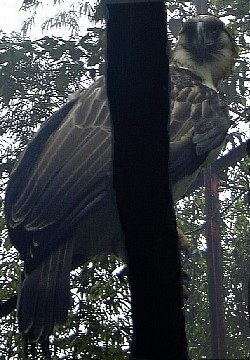
Name: Yuffie
Age:3
Place of Origin: Davao
Likes to Eat: Small Animals
Status: Endangered
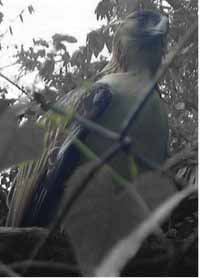
The Philippine Eagle (Pithecophaga jefferyi) is one of the rarest, largest and most powerful birds in the world. This bird of prey or raptor belongs to the family Accipitridae.
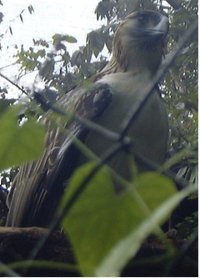 It was first called the Monkey-eating Eagle upon discovery in 1896, based on reports from natives saying that it preyed only on monkeys. Results of study on feeding ecology later revealed, however, that they also prey on other animals such as colugo, civets, large snakes, monitor lizards, and even large birds like hornbills. Because of this and the fact that the same name applied to the African Crowned Hawk-eagle and the South American Harpy Eagle, a presidential proclamation was passed to change its name to Philippine Eagle.
The Philippine Eagle could be found in rainforests of four major Philippine islands - Luzon, Samar, Leyte and Mindanao.
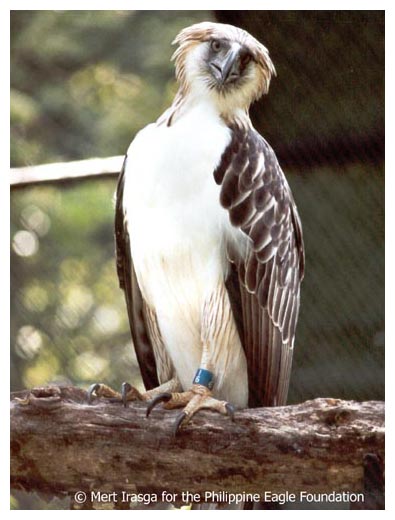
This eagle's head is adorned with long brown feathers that give it the appearance of a lion's mane. The upperside of the Philippine Eagle is brown, the underside white. This bird is 1 meter in height, up to 7 kg in weight, and has a wingspan of 2 meters. This makes the Philippine Eagle one of the world's tallest eagles, and has the largest surface area in its wings among all the species of eagles. The life expectancy for the Philippine Eagle is around 30-60 years.
 Like most other eagles the Philippine Eagle is monogamous. The couple remains together for a lifetime. The nest is normally built on an emergent dipterocarp, about 30 m above the ground. The female lays one egg. The parents will care for the egg and the young for twenty months, so they may breed only every other year.
Charles Lindbergh, best known for crossing the Atlantic in 1927, was fascinated by this eagle. As a representative of the World Wildlife Fund (WWF) he travelled to the Philippines several times between 1969 and 1972, where he helped persuade the government to protect the eagle.
The Philippine Eagle is now known as the National Bird of the Philippines. This helped increase awareness of the bird and its plight.
The eagle has slowly dwindled in numbers over the decades. With only an estimated 500 pairs left, the Philippine Eagle may soon no longer be found in the wild, unless direct intervention is taken. The Philippine Eagle Foundation (PEF) is one such organization dedicated to the protection and conservation, not only of the Philippine Eagle but its forest habitat as well. In fact, PEF has been successfully breeding Philippine Eagles in captivity for over a decade now and they have also conducted the first experimental release of a captive-bred eagle to the wild. Continuous research on behavior, ecology and population dynamics is also being done by PEF.