|
|
| Slide 3: Chronic Granulocytic Leukemia | |
| Blood
Pathologies
WBC
|
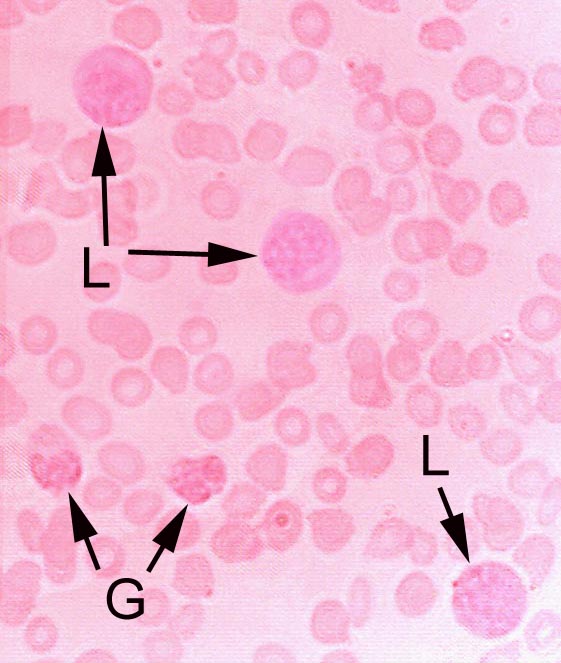
Chronic Granulocytic Leukemia is also known as Chronic Myelogenous Leukemia (CML) and is a neoplastic disease characterized by abnormal, excessive, unrestrained overgrowth of granulocytes (G) in the bone marrow. CML is associated with a chromosome abnormality (Philadelphia’s chromosome) that is either acquired or induced. This may also affect the agranulocytes (L, lymphocytes). CML develops very gradually as the abnormal lymphocytes multiply slowly, but in a poorly regulated manner. The lymphocytes also live much longer and accumulate in the body. The number of lymphocytes in the blood often rises to be 20-40 times the normal level. The cells appear to be normal but do not function as normal cells. Granulocytes (G) are usually sparsely seen in normal blood. There is generally one granulocyte for every 1,000 erythrocytes. However, in CML as shown above, there is an abundance of granulocytic white blood cells. Lymphocytes (L) are seen even more rarely in normal blood; generally having one lymphocyte for every 40,000 erythrocytes. But as seen above in CML, there is also an abundance of these white blood cells.
|