|
In Word 97 Doc Format with Pictures: isuintroductionpictures.doc
pleasing to the human taste buds. One
might require exactly a tablespoon of sugar, a teaspoon of salt,
a pinch of pepper, and perhaps a bucket of take-out fast food
to complete the recipe. The same principle applies to chemistry,
where all chemical reactions require a proper ratio of ingredients
(or elements) to yield the desired results. However, in chemistry,
there is no tablespoon, or teaspoon, or a pinch, or even a bucket
to measure with. Therefore, what methods can chemists use to
measure the quantity of an element within a compound or mixture?
Instead of being able to use our kitchen's standard of measurement,
chemists have invented many concepts to quantitize amounts of
elements, which include the units of atomic weight, moles and
molarity.
tiny particles known as atoms. Postulates
made by scientists such as Joseph John Thomson, Ernest Rutherford,
and James Chadwick have deduced that every atom is made of three
main parts: negatively charged electrons (which can be removed
to produce electrical currents), a positively charged particle
known as a proton, and a neutral particle known as the neutron.
The protons and neutrons exist at the center of the atom, known
as the nucleus.(1) Although nuclei are 10-4 times smaller than
the entire atom itself, it contains nearly the entire mass of
the atom. Each proton and neutron weighs just above 1 atomic
mass unit, or 1 amu, while electrons weigh just above 0 amu.(2)
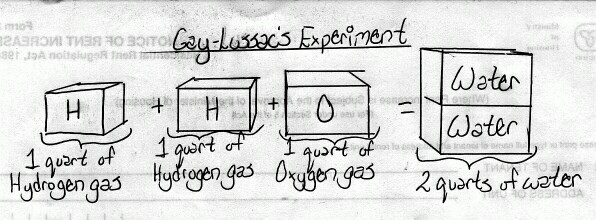
problem with his one of his postulates. John Dalton claimed that elements existed as single atoms in nature. However, when Joseph Louis Gay-Lussac, a fellow chemist of John Dalton's era, combined two quarts of elemental hydrogen with just one quart of oxygen, the reaction yielded just two quarts of hydrogen oxide.(3) According to the laws of constant mass and composition, this could not be possible. Atoms could not be created nor destroyed, therefore two quarts of one gas plus one quart of another gas should produce three quarts of the product.
Avogadro, postulated that hydrogen and
oxygen did not exist as single atoms, but rather as pairs of
hydrogen atoms and pairs of oxygen atoms. Therefore, during the
reaction process, the combined oxygen atoms would split apart,
each attaching to an H2 compound. Amedeo Avogadro soon created
his law: equal volumes of all gases under the same conditions
of temperature and pressure contain the same number of molecules.(1)
This number of molecules is measured in Avogadro's concept of
moles.
matter what the volume, pressure, or
temperature is.(2) For instance, 1 mol (which is the abbreviation
of the mole) of a gas at 3000 K (K is the abbreviation of the
Kelvin temperature scale) contains 6.02 x 10²³ particles, while
1 mol of the same element in a solid state, at 273 K, would still
be 6.02 x 10²³ particles. Despite the atoms of the element being
compacted into a different physical state, the particles are
still all there. No particles have left the compound, and no
extra particles have entered. This set amount of particles is
known as Avogadro's number, even though it was hypothesized long
after the chemist's death. 1 mole of any gas at 101.33 kPa (kilopascals
are the standard unit of pressure) and at 273 K would occupy
a volume of nearly 22.4 L (litres are the standard unit of volume).(1)
Moles are the standard of measurement to calculate the amount
of particles within any volume. Moles are calculated by multiplying
the pressure and volume of the subject, then dividing the product
by the temperature and the universal gas constant.
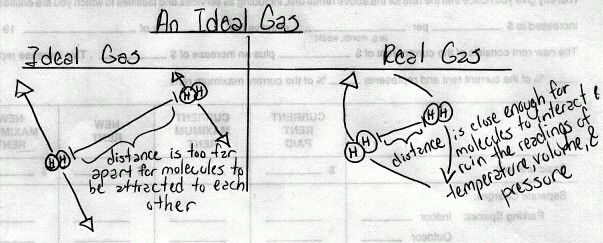
equation that provides us with the relationship between the pressure, volume, temperature, and mass of an ideal gas. An ideal gas is a gas with atoms that exist at extreme distances from each other.(1) The lack of attractive forces between atoms results in no coulombic or gravitational forces among particles, and no interactions with each other. In other words, there is no potential energy between the atoms.(3) Rather, all energy is used as kinetic energy. An ideal gas also upholds the concept that if collisions do occur between atoms, no energy is lost. Just as how the ideal machine would work, an ideal gas operates at 0% energy loss and 100% efficiency.
6.02 x 10²³ particles or things. Moles
do not deal solely with compounds and elements, but also with
any type of particle or any type of thing. It is possible to
have a mole of neutrons, a mole of protons, and even a mole of
chicken eggs. However, chemists often use moles to measure the
amount of valence electrons that react in a chemical reaction.
Valence electrons are a concept first introduced by Neil Bohr.
He postulated that electrons orbited the nucleus of an atom.
However, Bohr's theory was proven unusable for atoms more complicated
than hydrogen, but his concept of electrons arranging themselves
in energy levels around the nucleus is also postulated in the
Quantum Mechanical Atomic Theory.
energy levels known as shells.(3) Each
shell is similar to the concept of Bohr's orbits in the idea
that it encompasses the nucleus. However, instead of following
linear orbits, electrons are transferred from one spot in the
shell to another. The areas where an electron is most likely
to be found is referred to as an orbital. Valence electrons refer
to all of the electrons in the outmost shell. In chemical reactions,
electrons from the outermost orbital of the valence shell will
be used first, followed by the next outmost shell.(3) Calculations
of the amount of moles of electrons are used to identify the
amount of moles of the element in the compound or mixture.
cumbersome tool to estimate the weight
of atoms. Substances are weighed in grams and kilograms in real
life, such as when we weigh ourselves on a balance. A conversion
equation between the mole and mass was therefore required. Avogadro
continued with his research and calculated that 1 mole of hydrogen
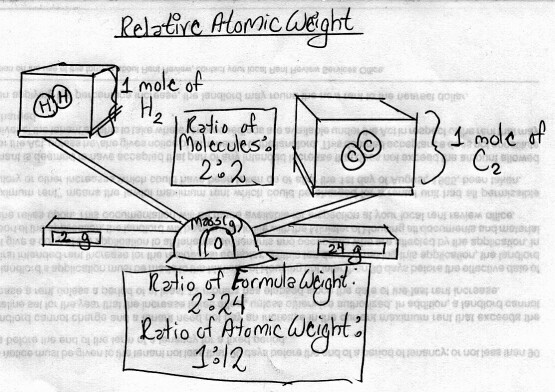
always weighed 2 grams.(1) 2 grams per mole of hydrogen is known
as the element's formula weight.
Amedeo Avogadro realized that a mole of single hydrogen atoms would weigh 1 gram. This is known as relative atomic weight. Due to the simplicity of this value, Avogadro decided to use the relative atomic weight of hydrogen (1 gram per mole) as a base to compare with all other elements on the periodic table.(2) 1 mole of Carbon-12 weighed 24 grams. Therefore, 24 grams of Carbon in ratio to 2 grams of hydrogen, after reducing to simplest form and relative atomic weight, would equal 12 grams of Carbon in ratio to 1 gram of hydrogen. In other words, the relative atomic weight of Carbon (which is postulated to exist as a diatomic molecule like hydrogen) is twelve times greater than that of hydrogen.
below the symbol of the element is it's
relative atomic weight in grams per mole.(1) However, one might
notice that if each proton and neutron weighs one atomic mass
unit (which is one gram per mole), it raises questions about
why there are decimal numbers within atomic weights. For instance,
hydrogen has one proton and no neutron, therefore, in theory
it should weigh 1 atomic mass unit. However, the periodic table
lists hydrogen as having a relative atomic weight of 1.008 amu.
This is because relative atomic weight is the average sum of
all naturally occurring isotopes (elements with varying amounts
of neutrons).(2) Hydrogen with no neutrons is by far the most
common form of the element, which is why chemists have kept the
relative atomic weight very close to 1 amu. However, two other
isotopes of the hydrogen element exist, such as deuterium (which
has a single neutron and weighs 2 amu), and the radioactive tritium
(with two neutrons and weighs 3 amu).(3)
are three of the many standards of measurement which chemists use in modern science. All three of these quantitative units are intertwined. For pure compounds, one may discover how many moles he or she has by simply dividing the weight of the substance in grams, by the formula weight of the pure compound in grams per mole (n mol = W divided by FW). This conversion process allows chemists to calculate one variable, such as the mole, if the other two variables, such as the formula weight and relative atomic weight, are measured.
a Compound are based upon the use of
formulas to calculate atomic weight, molarity, or moles when
the other variables are given. The lab experiment referred to
as Composition of a Compound utilizes the combustion of oxygen
to isolate the potassium chloride that it had bonded with. The
purpose of this experiment is to employ the process of decomposition
of matter to determine relative atomic weight, which is explained
by the kinetic molecular theory.(3) Every element has a fixed
and unique boiling point. Heating the potassium chlorate will
result in it's oxygen atoms gaining kinetic energy. Increased
temperature (kinetic energy) results in the oxygen atoms moving
at increased velocities. The increased speed weakens the attractive
bonds that held the oxygen together with potassium and chlorine
atoms, and the volume of the solution increases as the spaces
between each oxygen atom widens.(3) Eventually, the oxygen atoms
will reach their boiling point and separate from the potassium
chlorate in a gaseous state. The substance remaining in the test
tube will be potassium chloride, which will be weighed in terms
of both moles and relative atomic weight. Comparisons between
the measurements of the potassium chloride and the potassium
chlorate (which are done prior to the experiment) discloses the
amount of oxygen that was present in the mixture.
reaction will be a redox reaction. A
redox reaction is classified as any reaction where electrons
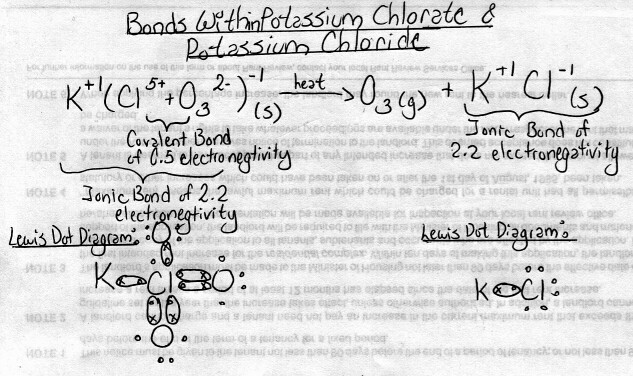
are transferred through atomic bonding.(2) The formula for the
reaction is: K+(Cl5+O32-)- (s) O3 (g) + K+Cl-(s) The reaction is redox because the product, O3, exists as an elemental gas. It is not an ion (a charged particle) because it is not dissolved in water, therefore it's charge is neither positive nor negative. Because the oxygen now has a charge of 0, but had a charge of 2- while bonded with the Potassium Chlorate.
atomic weight of an element in a compound,
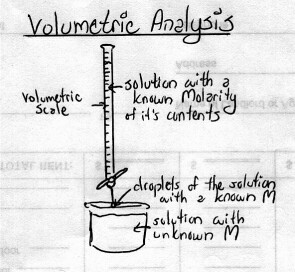
involves titration. Titration is a procedure for analyzing a
solution by adding to it another solution. Titration is an example
of volumetric analysis (which calculates the molarity and relative
atomic weights of substances by measuring the volume occupied
by the solution). Volumetric analysis involves a solution with
a known concentration and molarity (referred to as the titrate
or the titrating reagent), which combines with a solution of
unknown molarity and concentration, commonly referred to as the
analyte.(2) The process of titration continues until the equivalence
or end-point of the process is reached. This occurs when all
of the analyte's valence electrons have reacted with the titrate,
and is usually indicated by a change or standstill in colour.(3)
In the lab of Iron Determination, the titrate is a 10 mL of a
solution made up of 1 Molar of sulphuric acid and an unknown
concentration of ferrous sulphate. The analyte is a solution
consisting of 0.005 Molar of potassium permanganate.
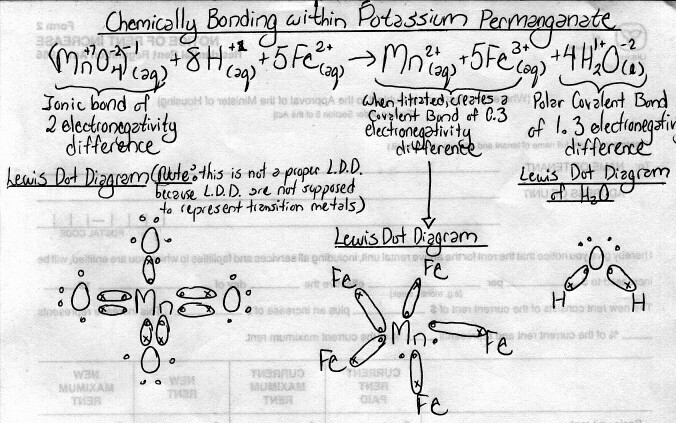
atomic weight through titration. The hypothesis for Iron Determination is that the reaction is also a redox reaction. The chemical formula is: MnO4- (aq) + 8H+ (aq) + 5Fe2+ (aq) Mn2+
(aq) + 5Fe3+ (aq) + 4H2O (l) Permanganate ions+Hydrogen ions+Ferrous ions Manganese ions+Ferric ions+ DiHydrogen Oxide This is a redox reaction because the
charge of the iron ions changed between the charge as a reactant
and the charge as a product. For instance, before the titration,
the Iron existed as Ferrous ions with a charge of 2+, but after
the titration, the Iron existed as Ferric ions with a charge
of 3+.
moles of permanganate ions that are required to completely titrate and chemically react with all of the iron atoms. The equivalence point (when there is an equal number of moles of the titrate as there are of the analyte) is indicated when the purple colour of the permanganate just begins to stay in the solution.
relative atomic weight, moles, and molarity. Composition of a Compound uses relative atomic mass to calculate the percentage of oxygen within the mixture. Iron Determination measures the molarity (the amount of moles per litre of solution) of the titrate to determine the molarity of the analyte. The molarity is converted to moles, and the moles are converted to grams and milligrams to determine the amount of iron in a iron (II) sulphate tablet. In conclusion, one might claim that Composition of a Compound is similar to weighing a bag of apples at the supermarket to determine it's price, while Iron Determination is the method in which chemists can count the number of apples. |