What is Sikhism?
The word 'Sikh' means a 'disciple.' A
Sikh is a person who believes in One God
and the teachings of the ten gurus,
enshrined in the Guru Granth Sahib, the
Sikh Holy Scripture. Additionally, a
Sikh must take Amrit, the Sikh Baptism.
Sikhism is the world's fifth largest
religion.

Hamandur
Sahib(Golden Temple), Amritsar India
A Brief History
The Sikh
religion was founded by Guru Nanak Dev
Ji, who was born in 1469 AD in the
village of Talwandi, now called "Nankana
Sahib" near Lahore, Pakistan. Right from
his childhood his keen mind would not
accept all the groundless rituals,
supersituations and dogmas which passed
for religion in those days. Guru Nanak
Dev Ji and the nine gurus, who succeeded
him, set a wonderful example of living
spiritually, while yet taking an active
and secular part in the world. The tenth
guru, Guru Gobind Singh Ji (1666-1708AD)
initiated the Sikh Baptism ceremony in
1699AD; and thus gave a distinctive
identity to the Sikhs. The first Five
aptized Sikhs were named Panj Pyare
(Five Beloved Ones), who in turn
Baptized the Guru on his request.
Shortly before passing away the Guru
ordained that Guru Granth Sahib, the
Holy Scripture would be the ultimate
spiritual authority for the Sikhs and
the temporal authority would vest in the
Khalsa Panth- the Sikh Commonwealth.
Guru Granth Sahib, the Holy Sikh
Scripture was compiled and edited by the
fifth Guru, Guru Arjun Dev Ji in 1604AD.
This is the only scripture in the world
which has been compiled by the founders
of a faith during their own lifetime.
Guru Arjun Dev Ji also built the world
famous Gurudwara- Darbar Sahib, also
known as the Golden Temple, at Amritsar
India which is the nucleus of Sikhism.
During the 18th century the Sikhs were
subjected to various suppressions and
persecutions by the authorities of the
time motivated by communal fanaticism.
They had to make supreme sacrifices to
protect and preserve their faith and
separate entity. The Mughal Empire in
India was on the verge of
disintegration. The Afghans had started
invading the country under Ahmed Shah
Abdali. The Sikhs availed of this
opportunity to establish their own
kingdom which they ultimately achieved
under Maharaja Ranjit
Singh(1780-1839AD). The Sikh Empire
lasted for half a century and was
annexed by the English in 1849AD. During
the freedom struggle of India from the
British, a large number of Sikhs kissed
the hangman's noose, faced all the
brutalities and braved the bullets and
suffered long term imprisonments in
order to liberate the country. Although
the Sikhs constitute only 3 percent of
India's Population they have made a name
for themselves in almost all walks of
life including the armed forces,
agriculture, sports, art, education,
medicine, engineering,, etc., through
sheer dint of hard work and with a
missionary dedication. Their adventurist
and enterprising nature has taken them
to almost all countries of the world.
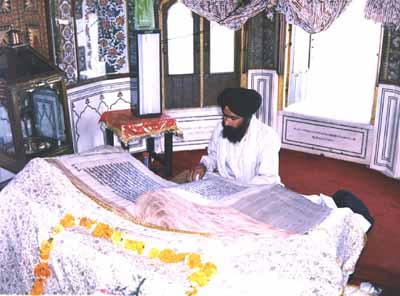
The eleventh
Guru-Sri Guru Granth Sahib
Religion and Philosophy
The Sikh religion is strictly
monotheistic, believe in one supreme
God. Absolute yet all pervading, the
Eternal, the Creator, the cause of
causes, without hate. The basic
postulate of Sikhism is that life is not
sinful in its origin, but having
emanated from a Pure source, the True
One abides in. The Sikhs do not
recognize the caste system nor do they
believe in Idol-worship, rituals,
superstitions. The religion consists of
practical living, in rendering service
to humanity and brotherly love towards
all. The Sikh Gurus did not advocate
retirement from the world in order to
attain salvation. It can be achieved by
any one who earns an honest living and
leads a normal life.
Sikh Baptism
Amrit, is
the name of the Sikh Baptism, it is a
must for every Sikh. No minimum or
maximum age is stipulated for getting
Amrit. A Sikh undertakes to uphold the
principals of its faith and Code of
Conduct as prescribed by the Gurus. Any
man or women of any nationality, race or
social standing, who adheres to the
principles of the Faith has a right to
receive baptism and join the Sikh
Commonwealth. When a Sikh takes Amrit
there are certain rules he or she must
follow. The Baptized Sikh's must wear
the five symbols or five K's. These are
the Keski or Keshas(long uncut hair
wrapped in a turban), Kangha(a comb),
Kara(a steel bracelet), Kachara(a type
of shorts), and a Kirpan(a sword). The
Kangha is kept to keep the hair neat and
tidy and a turban known as the Keski is
worn to keep the hair clean. Moreover
the turban represents the royal symbol
of the Army of God(Khalsa Phoj) to
protect the poor and down trodden in the
world. The Kirpan is used for self
protection and protection of others and
is not supposed to be used for any other
purpose. The Kachara is meant for
personal sanctity. The Kara is worn on
the right wrist to act as a visual
reminder that God is watching all of our
deeds and is binding us not to commit
any sinful acts. The rules that a Sikh
must follow after being Baptized are
known as the "Sikh Rehat Maryada," It is
the teachings of the Guru Granth Sahib,
these rules are not taking any drugs or
alcohol including tobacco. The second is
that no hair on the body can be cut. The
third is not to eat any meat including
beef, pork, eggs, and fish. The Guru
Granth Sahib notes this as, "Mercy on
living creatures is considered superior
to all pilgrimage and religious
donations." The fourth rule is not to
commit adultery. A Sikh should regard
another man's wife as his sister and
another man's daughter as his own
daughter. This also includes pre-marital
relationships.
Daily Life of a Sikh
Every
Sikh is expected to get up in the
morning before dawn. After taking a
shower and washing his hair he should
meditate on the name of God. The
following prayers are done daily:
Morning: Japji Sahib,Jaap Sahib, Ten
Swiyas, Kabiyo Baach Bainiti Choupai,
and Anand Sahib Evening: Rehras Sahib
Before Bed: Kirtan Sohila These prayers
constitute two hours of prayer daily
although more prayers can be done. A
Sikh is also required to attend the "Gurdwara"-the
Sikh temple or church.
Sikhism Websites
www.sikhiwiki.org
www.saldef.org
www.Sikhnet.com
www.Sikhs.org
|