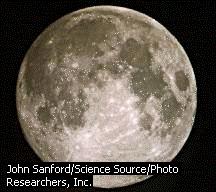
The moon is the Earth's natural satellite. It is 238,860 miles away. The moon is 2,160 miles in diameter. 81 moons would weigh the same as earth. It circles the Earth every 27.3 days. The moon has no light of it's own, it reflects the sun's light. It is moving away from earth about 1 inch per year. There is no air on the moon so the surface remains unchanged. The temperature on the sunlit side is 200 degrees farenheit, on the dark side it is -270 degrees farenheit. The dark side was not seen until 1959when the soviet spacecraft Luna 3 flew by. The craters were formed by meteoriods 3 and 4 billon years ago. The biggest crater seen from Earth is named Bailly and is 180 miles across. It is on the dark side of the moon. The darker areas called maria(seas) were made by lava 3 billon years ago. Gavity from the Earth pulls a buldge a few miles high on the moons surface. The moon also pulls a buldge on the Earth. The Earth rotates under the buldge and that makes the tides.
No one know's how the moon got here. But scientists make up theories. These theories are:
1. The moon was made in the same dust cloud as Earth.
2. The moon was passing by and got trapped in orbit
3. The Earth grew a big buldge and it spun off and became the moon.
4. A rocky body hit the Earth and knocked off the moon.

