|
Bio Readings Tarot FAQ Tarot Code of Ethics Tarot Certification Tarot Whispers Book Reviews Deck Reviews Articles Links Book List Newsletter |
author: Raven Grimassi and Stephanie Taylor
"The Well Worn Path" referred to here is one that is reflective of the roots of European Pagan spiritual tradition. It reminds us of all that have gone before us, of the voices of our ancestors. While my personal spiritual path is aeclectic shamanism, I too can hear these voices. I very much looked forward to reviewing this particular deck, as I am a great admirer of Raven Grimassi's work. His collaboration with Stephanie Taylor, Mickie Mueller, and Llewellyn Worldwide has resulted in a stunning book and deck, gently and accurately reflecting the Pagan spiritual journey, and the tools and beliefs found on this path.
The cover of the accompanying book, "Travelors Guide to the Well Worn Path", tells the story here - done in earth tone colors of brown, yellow, and silver, we see a Book of Shadows residing on a low table. Above and to the left as we face the book is a yellow candle. Above and to the right, we see a silver-white feather placed in what appears to be an ink well, which is nicely seated in a candle holder. The cover itself becomes a wonderful meditation.
The 195 page book presents a unique divination system based on Pagan beliefs and practices. This tool allows those who follow the Pagan path to take their beliefs deeply into their lives as it brings them into close contact with the voices of their ancestors. It is based on the symbolism, meaning and teachings of modern Paganism, for use as a tool of divination, in ritual work, for personal alignment, and as an aid in teaching.
One running theme is that of the cycle of seasons, the Crescent-Crowned Goddess and the Stag-Horned God. The Goddess is connected to the moon, the crossroads, the cauldren, and the hearth - receptive, supportive, nurturing aspects of life. The God is connected to the Sun, Greenman, the Wheel of the Year, the harvest, and the more aggressive aspects of life.
A second running theme is that of the passing on of vital traditions. Connected with this theme are the concepts of teacher and initiator. Through the teachings in this book, the concepts of Paganism are experienced in a very real way.
In most spiritual writings, there is what can be termed a sense of mystery (or a "mystery" theme). Included in the mystery them of Paganism are the concepts of Underworld/Otherworld, the Old Ones, initiation, the Voice of the Wind, the Summerland, reincarnation, ritual tools, the alter, and the four elements.
There is also a storyline included in this deck, involving a seeker and a figure known as the "crone of the cottage", who acts as a guide and an intermediary in interpreting each card/concept. Along the path we encounter Hecate, Goddess of the Crossroads, and the Old Ones, the first spirits known to our ancestors.
The Seeker's inward journey begins as he/she opens the book and takes their first steps. And with this - the adventure begins!
The section on how to use this deck begins by reiterating its four-fold purpose: to act as a deck of divination, as a system of teaching, as a tool for spiritual alignment, and as a means of performing solitary rituals. It is suggested that the Seeker begin by reading the alignments for each card. This is the storyline, and sets the background for the teaching. It brings out the essence of the card. The sections on teachings and meanings will familiarize the Seeker with the overall card concept and symbolism. One suggestion in this very well written section is that the Seeker "customize" the meaning of the card to reflect their own individual understanding of the symbols.
Each card is presented with a black and white scan, and sections on the cards meaning, teaching, and alignment. From the book, for the Crone:
When this card appears it addresses matters that require "contemplation and reflection". The card speaks of conserving resources, and of the wise use of energy. It also indicates counselors, advisors, teachers, and mentors.
The Crone is one of t he three major aspects of the Great Goddess. She is the quiet reserve of winter, and the accumulation of provisions to sustain life within the season of decline. The Crone possesses the wisdom of life experience, a deep understanding of the cycles of life and death. The Crone is also associated with the waning phase of the moon. The card depicts an elderly woman at her deck. She is writing her knowledge and wisdom onto the pages that will be added to her Book of Shadows. The Crone sits in her warm cottage with the things that she has collected over the years. Books sit on a shelf, alongside her pet raven that brings her messages and guards her domain. A crystal ball also sits on the shelf, and through this she sees into other worlds that await her departure from the mortal world. In the corner is her old staff, which accompanies her when she ventures out into the woods. The dried herbs that she collects from field and forest hang on the walls of her cottage, for she is the healer, potion maker, and seer. A candle is set upon the table, giving its light to the Crone. She is the keeper of the flame, one who is an initiate of the Old Ways of our ancestors. See related teachings in: Hearth, Words of the Magus, The Key, and The Crossroads.
It is a cool fall day as you cross through the woods, making your way down the well worn path. You see a cottage with a soft light in the window and smoke coming from the chimney. A woman's voice calls to you to come in and warm yourself by the fire. You enter to find an elderly woman at her writing desk. She seems unaware of you as she focuses on her recollections. You notice her black dress as it seems to shimmer. A stillness gathers around you as a deep silence. You see a movement above, and it is the raven. It turns to look at you, and lowers itself as t hough it might leap into flight. The staff in the corner of the room comes to life, and you see it is the living root of a tree. You become aware that you have entered the gateway between the mortal world and the Otherworld. Here in this one place are your past deeds, your present life, and the completion of your time in the realm of mortal kind. Where have your journeys taken you? What knowledge and wisdom do you possess? What do you leave behind you that will benefit those who follow the road you have extended on the well worn path? The spreads section of any book is always of major interest to me - to see how the author and illustrator intended their work to be used. Included in this book are spreads unique to this deck: a ten card Cauldren Spread for use in readings that cover several different areas; a six card Pentagram Spread for use with a single question or issue; and a nine card Crossroads Spread for use in making decisions or choices. All of these spreads reflect the teachings found within this book. The final chapter of this book brings it all together in a very significant fashion - taking the cards into performing solitary ritual. The authors suggest that the cards can be substituted for the material tools and other ritual items. As the authors indicate, this works well for someone with limited space, or limited resources. The first ritual (Rite of the Inward Journey) is one of dedication, or of declaring your intent to study the old ways, and place them in your life. The second ritual (The Solitary Full Moon Rite) is a basic full moon ritual, allowing the solitary practitioner to experience this energy without having to work with other people. The rituals are written out in an incisive, cohesive manner, easy to understand, and easy to follow. They are a great gift. These are the forty cards that comprise the Well Worn Path:
Wheel of the Year
The face of the cards has a 1/4" light brown border, with a white window across the bottom where the name of the card appears in black letters. The illustrations are done in muted earth tones, reflecting in a very gentle manner the intent of the card. Included with the deck is a black organdy bag to store the cards in.
In The Rede, we see the Book of Shadows opened to The Rede, with text on the left hand page, and the right hand page showing a young woman, eyes lightly bound by a flowing red ribbon. In her right hand she holds a white globe, in her left hand a black globe. Surrounding her is a vine of red roses. Some of the cards "are what they are", such as the cakes with Pentacles on them, sitting in front of a wine goblet in Cakes and Wine. They reside on a black alter cloth, in front of two candles, with a representation of a Pentagram behind them. In the Chalice, we literally see a chalice, again against a background of black cloth, with a Pentacle in the background. In Initiation, we see a male and a female figure, jointly holding a candle, standing on a path lined with trees.
The Well Worn Path is a work of grace, of humbleness, of good intent, and, above all, of honor. I felt that it fairly and accurately represented the Pagan path, and that it had as to give to someone well versed in this path as it does to someone new to the path. It is not a Pagan rendering of some other divination system, it truly IS a Pagan divination system by foundation and intent. As I am writing this, it is the day of the Autumn Equinox. This deck will indeed become part of my personal celebration and ritual tonight. It may well become part of your path also - whether you are Pagan or not.
Bonnie Cehovet
|



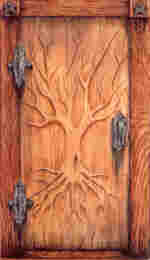 The cards themselves are 2 3/4" by 4 1/2", on quality, glossy cardstock. The backs are done in a light earth brown, portraying a closed door, with silver guards, etched with Pentacles, at the top right and left corners, silver hinges, a silver handle and a silver lock. Depicted on the door itself is a tree, with branches reaching upward, and roots flowing downward.
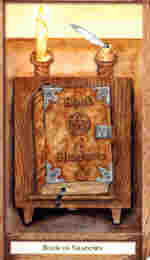 The Book of Shadows says many things in a simple manner - we see the Book of Shadows resting on a low table, with a candle above and to the left, and a feather in what appears to be an inkwell up and to the right. Silver guards at the four corners have the symbol for the Triformis Goddess, the patroness of the inner mysteries. Etched into the cover are a Pentagram with a crescent moon and a flame.
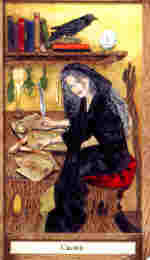 Some cards are more than they seem. In the Crone, we see an older woman, seated at a table, writing in her book. A candle provides light, while her books, and her raven, are seated on a ledge near the table. Her staff stands behind her, ready for use.
 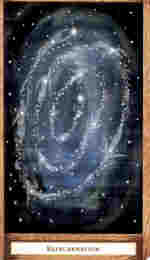 In Reincarnation, we see a spiraling energy in the night sky. Look at this card very closely - there are human "ghost forms" in that spiraling energy! In The Moon, against a background of green hills and night sky, we see a "Moon Tree", a lattice-like structure with thirteen flames surrounding it - six on each side, and one on top, representing the thirteen new or full moons of the yearly moon cycle. In the middle of the structure resides a pole, called the hekataion, one of the most ancient representations of the Goddess of the Mysteries.
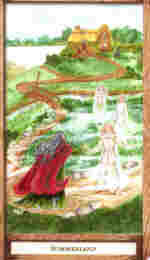 In Summerland, we see a scene that literally brought tears to my eyes. In the background, we see a home, with a path leading from it to the foreground of the picture. The house is placed next to a body of water, amongst lush green land. To the right hand side of the picture we see ghost-like figures moving forward to greet the figure on the left hand side of the picture - a female figure in a flowing red robe, hair streaming behind her, moving towards the ghost figures with her arms outstretched. This same type of them in carried into The Old Ones, which portrays three ghost-like figures, standing in a semi-circle before an alter, with large trees looming behind them.