|
Bio Readings Tarot FAQ Tarot Code of Ethics Tarot Certification Tarot Whispers Book Reviews Deck Reviews Articles Links Book List Newsletter |
author: Susan Sheppard
In The Phoenix Cards, a 28 card deck by author Susan Sheppard, gifts us with a tool that not only connects us with significant past lives, but helps to explain some of the people and places that we are drawn to in this life. She does this in a very concise, gentle manner, through the use of images and symbols representing many diverse cultures. Sheppard posits that we are drawn to certain time periods, certain physical places or certain cultures because we have experienced them in our past lives. She addresses questions like:"How much of what we were then are we now?" and "What are the lessons that still must be learned?" The place that we access this information is our subconscious, and the bridge to this information is the use of symbols. Each of the cards in this deck was extensively researched, and represents what Sheppard calls a different "psychic letter" or "spiritual symbol". They touch the places within us that, as Sheppard states, are only shadows. They touch the core of who we are, and who we can be. The cards address the place, time and culture of given peoples, as well as the cultural "personality" of a given group. In understand our past, we can better understand where the hopes and fears of this lifetime come from. The information on in that book that accompanies this deck is broken down into eight separate sections for each card. They are as follows: Symbol: Art and images that represent the culture of the card. This is where our subconscious makes the connection with a specific culture. Place: This section gives the basic area that you have lived in the past. Time: This section lists time spans when you have lived in a specific area. Sheppard notes that some of the spans are large ones, and will require research to pinpoint a more specific time. Groups: These are subdivisions (subgroups) of various cultures. Here also research to gain further information is encouraged. Language Groups: This section shows the link between cultural and ethnic groups. Appearance: This section covers the physical appearance of a group of people. Traits: This section cover the "imprints" of teachings from past lives t hat carry over into this life. Conclusion: The largest of the eight sections, the conclusion identifies past influences that have brought you to where you are, and the positive (as well as negative) aspects of personal growth connected with the card. The cards and book come in a slip out box, which is my preferred manner of presentation for book/deck sets like this. The cards themselves are 3 1/2" by 5 1/2", on non-glossy cardstock. The size makes them difficult to handle for smaller hands, and care will need to be taken when handling them, as they are not coated. The colors are very basic and intense, with the style being somewhat primitive.
There is a specific manner presented for reading these cards, called the Past Life Mandala. It is meant to help you understand the planetary energies affecting your current situation, and to pinpoint opportunities for growth and change. The positions are:
2  7 73 64 5
1. Sun: spirit, essence, vitality, personality One additional spread is given, the Five-Star Spread.
2 3 4 5
1. Sun: daily meditation There is a nicely done summary of the meaning of the Phoenix cards, as well as detailed meanings for the cards in each specific position. I found this deck insightful easy to use. If you are searching for a way to begin accessing past lives, this is an excellent tool of empowerment.
Bonnie Cehovet

|

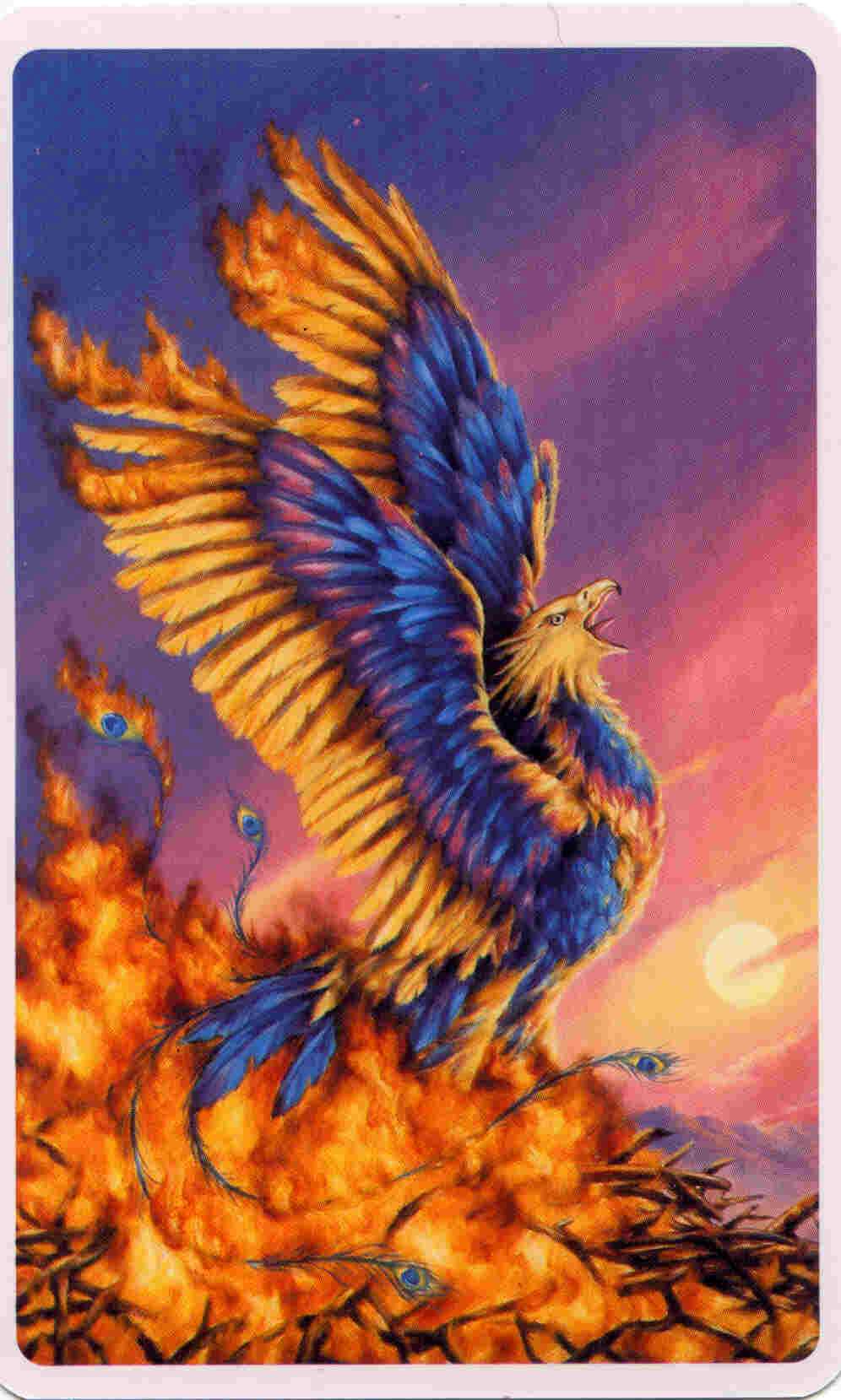 The back shows a somewhat intense presentation of a Phoenix bird, and brings to mind thoughts of the primal nature of these cards.
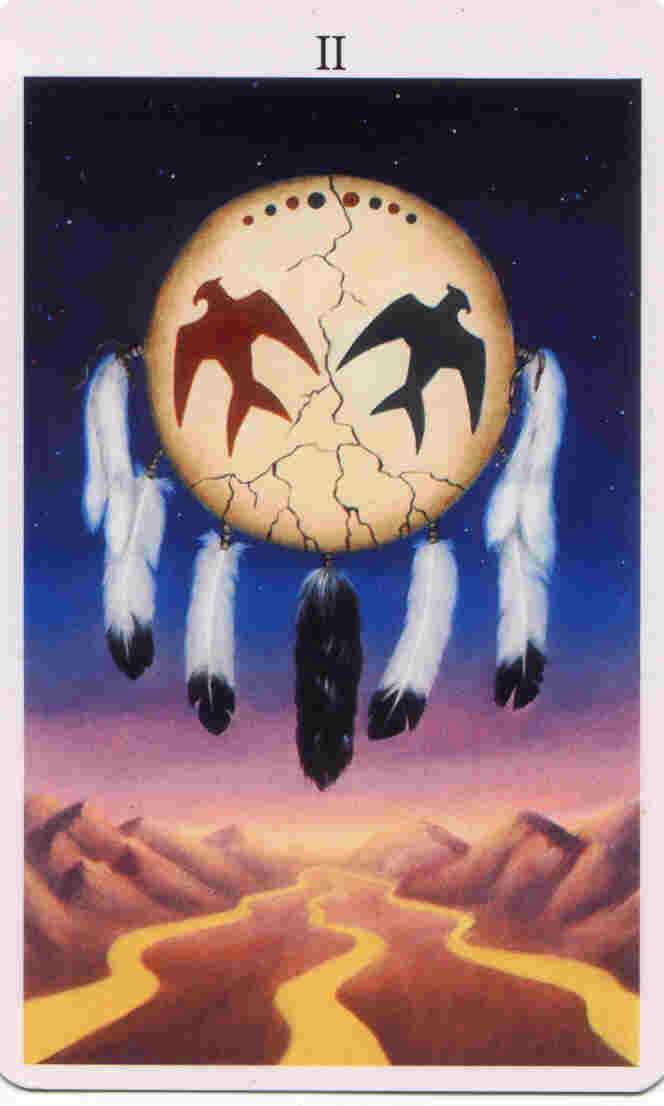 One of my favorite cards in II (Expressions of the Individual): the Prairie Plains Medicine Wheel. The Medicine Wheel itself acts as a mirror for the universe, representing the six directions (North, South, East, West, Above and Below). The Prairie Plains tribes lived primarily in the central and western parts of the United States and Canada. The timeline for this group is approximately 500 A.D. to the present. Some of the groups included here are the Cree, Comanche, Cheyenne and Paiute. Languages spoken would be Siouan speakers, Uto-Aztecan speakers, Algonquin speakers and the Athabascan speaking Apaches.The physical type is tall and dark. The traits are individualism, with a strong mystical leaning. Under conclusion, it is noted that if you are drawn to this card, you are more than likely a loner, with your own personal manner of expressing yourself. You honor nature, and see magic in all things.
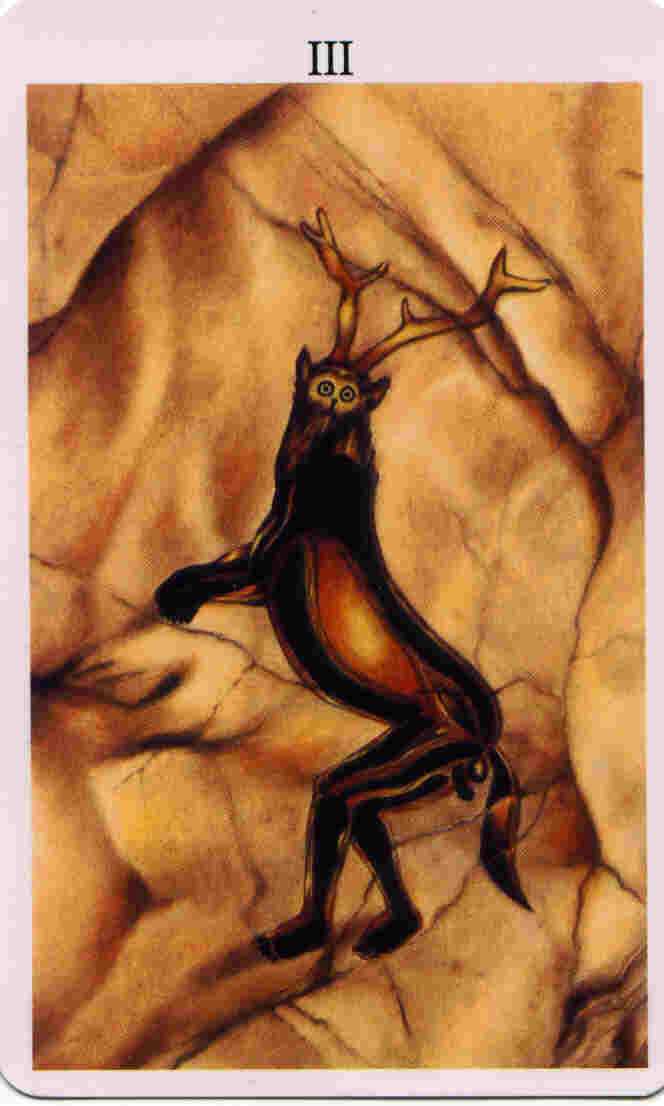 Card number III (Love of Primal Darkness): Pre-historic Sorcerer, fascinates me. A pre-historic cave design, it depicts the paws of a bear, the beard of a man, the torso of a lion and the antlers of a deer. The place is the Trois Freres Cave in the French Pyrenees. The time is approximately 13,000 to 11,000 B.C. The group is thought to be a progressive branch of Cro-Magnan man. The appearance is tall and well formed. The traits are unknown. In the conclusion, Sheppard states that if you have drawn this card, you have a kinship with ancient souls and are drawn to the occult. There is a great depth to your personality.
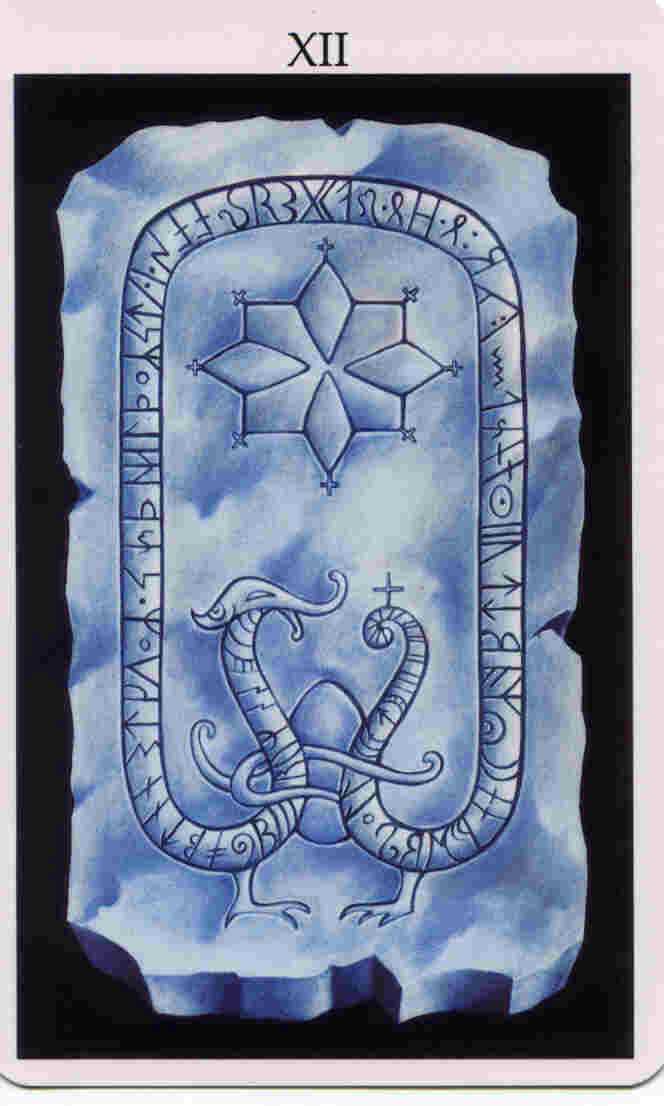 I have no clue "why" I am drawn to card XII (Love of Victory): Viking Rune Stone. It represents a Runic stone that was placed as a memorial to a Viking chieftan. The place is Norway, Sweden and Denmark. The time is approximately 793 A.D. to 1347 A.D. The group of people are the Vikings, forebearers of modern Danes, Swedes and Norwegians. The language is Germanic dialects. Tall, light haired and light complexioned. They were fierce fighters, and tended to keep to themselves. One of the conclusions to this card is that those who draw it have a hard time expressing themselves to others.