Site hosted by Angelfire.com: Build your free website today!

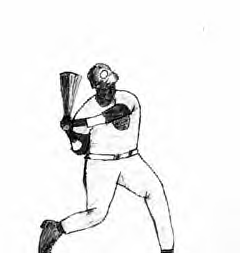
Frame #1 

Initiating the swing 

How the swing is initiated is by far the most important part of the swing. How the batter develops energy for the swing and the direction of the forces he applies to the bat at this point will determine his mechanics for the balance of the swing.


"A ballistic motion, once initiated, produces trajectories that can only be efficiently changed at its margins."


Although the above biomechanical principle may appear complicated, once grasped it makes understanding and teaching the mechanics of the baseball swing far more clear. The principle basically means the batter does not have to remember when to "pop his hips," "squeeze the trigger," or any of other batting mechanic principles. Once the hitter has properly initiated his swing, the rhythm of the ensuing mechanics are on autopilot. From the launch position to follow-through, what to do with his front toe, hips, hands, and so on, need never enter the batter's mind. Forces he applied at the start of the swing determined the sequence of the following mechanics. Now, his total concentration is on timing and getting the plane of the swing inline with the path of the ball.


When a batter initiates the swing with incorrect forces, the balance of the swing will be an exercise in compensation. The reaction of the bat to an improperly initiated swing is what causes that tense, jerky appearance.


When a player or coach uses video to review flaws in mechanics, it is imperative that he understands that the solution to a flaw will not be found in the frame that the flaw becomes apparent. The answer lies in the forces he used to initiated the swing.


  • Hips, torso and shoulders start their rotation around a stationary axis.

  • Back elbow comes down to the batter's side to accelerate the bat heads arc toward the catcher and allow the wrist of the top hand to rotate in-line with the plane of the swing.

  • The forearm (back arm) starts its rotation and lowering toward a horizontal position (completed in frame #5).

  • From this point to contact, the position of the back elbow in relation to the body will change very little (sliding forward 1 to 3 inches).

  • The quick acceleration of the hand-path is developed mainly from the rotation of the shoulders and torso.

  • Angular bat head acceleration will be the product of constantly supplying torque and rotational energy from the body through the hands.


Click the button above to go back to the web page or web site you were at before coming to this page

Click Here to go back to The Home Page of Brookside Little League

[Official Little League Rules & Regulations]   [Parents]   [Players/Kids]

Learn How to:
[Hit]  [Pitching]  [Infield]  [Outfield]  [Catcher]  [Baserunning]  [Coach]

[Baseball Humor]  [Baseball Terminology]  [Site Map]

[Sign Our Guestbook]

[Privacy Statement/Disclaimer]  [Terms]

This site is awarded the

In recognition of creativity, integrity and excellence on the Web.

You are visitor to visit this page!
Since May 7, 2002

The term "Little League" and the Little League logo are trademarks of Little League Baseball, Inc., Williamsport, Pa., extended only to local chartered leagues for purposes of  identification and publicity

Copyright © 2000 Brookside Little League, Inc. All rights reserved

Indianapolis, In

Please, drop us a line and  let us know what you think, like or dislike or would like to see on our site!

jontanderson@juno.com

Thank You ,  for visiting Brookside Little League's web Site


by
Jon Anderson
jontanderson@juno.com