Newsletter Vol.
V
DEC.-JAN. 2001-2002 |
|
 |
|
P H I L I P P I N E Television Links
|
|

|
|

|
|
FREE LINK TO BARKADAHANG PINAY
|
|

|
|
 |



Media
Noche and Noche Buena...
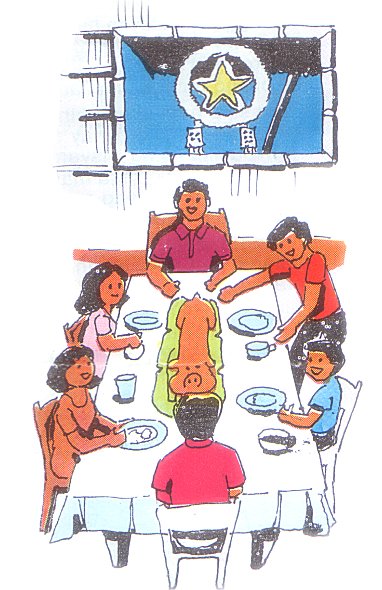 are two meals that are eaten on
Christmas, but on different days? Media Noche, which means middle of the night,
is eaten on Christmas Eve. It is served right after the misa de
aguinaldo. Noche Buena (good night), on the other hand, is
the meal eaten on the night of Christmas Day. are two meals that are eaten on
Christmas, but on different days? Media Noche, which means middle of the night,
is eaten on Christmas Eve. It is served right after the misa de
aguinaldo. Noche Buena (good night), on the other hand, is
the meal eaten on the night of Christmas Day.
THE CHRISTMAS TREE
Philippine history reveals that the first municipal Christmas tree was lighted in 1912 in the plaza of Antipolo, Rizal.
As for it's origin, it is believed that the use of the Christmas tree as a "symbol of the cross" could be traced in the worship of the Egyptian goddess Isis. The custom of lighting the Christmas tree, on the other hand, was introduced by the 16th century German religious reformer, Martin Luther.
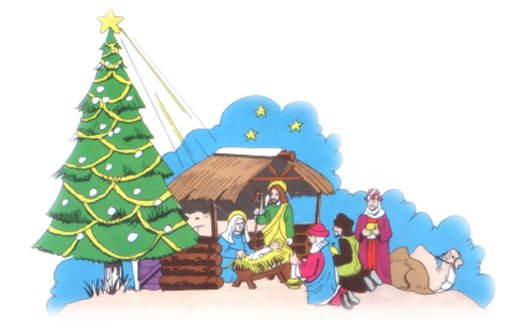 THE BELEN The custom of setting up the belen
is said to have been introduced in an Italian church by St. Francis of
Assisi in 1224 in his efforts to bring the Christmas spirit to the people.
Like all Christmas symbols, the manger is not taken as another Christmas
decoration, but is said to represent family unity and recall to man the
humility and selflessness of Christ who chose to be born in a stable with
the poor shepherds as His first visitors. THE BELEN The custom of setting up the belen
is said to have been introduced in an Italian church by St. Francis of
Assisi in 1224 in his efforts to bring the Christmas spirit to the people.
Like all Christmas symbols, the manger is not taken as another Christmas
decoration, but is said to represent family unity and recall to man the
humility and selflessness of Christ who chose to be born in a stable with
the poor shepherds as His first visitors.
THE CHRISTMAS CARD
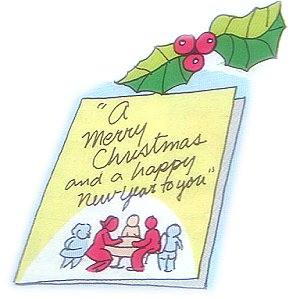
Sometime in 1843, Sir Henry Cole who was then the curator of the Victoria and Albert Museum in England, came up with the very first Christmas card.
The card was simple. The design was composed of a central panel, which showed a family party in
progress, and two side panels which showed charity being dispensed to the needy. Beneath the design were the words "A Merry Christmas and a Happy New Year to You." The message was short, simple, and straight to the point.
 CHRISTMAS CAROL AND CHRISTMAS SONG Carols
are songs of joy and mirth; songs of praise and devotion. The
subject of these songs is the Nativity, or the birth of Christ. The
word carol is actually French in origin and may have been derived from the
Greek choros (a company of singers) or from the Latin chorales (flute
player). The first Christmas carol was heard about 2000 years ago, when
angels sang "gloria in Excelsis Deo" to the awestruck
shepherds to report the birth of Jesus. On the other hand, the
earliest known carol composed by man is "Jesus Refulsit Omnium"
(Jesus, Light of All Nations), written by St. Hilary before the 13th
century. Other examples of carols are "Joy To The World",
"Silent Night", "Holy Night", and "O Come, All Ye
Faithful". Now what about Christmas songs? These are
about various Christmas symbols and traditions; they do not sing
particularly about the birth of Christ. Some well-loved Christmas
songs are "Rudolf the Red-Nosed Reindeer", "The Twelve Days
of Christmas", and " Jingle Bells". CHRISTMAS CAROL AND CHRISTMAS SONG Carols
are songs of joy and mirth; songs of praise and devotion. The
subject of these songs is the Nativity, or the birth of Christ. The
word carol is actually French in origin and may have been derived from the
Greek choros (a company of singers) or from the Latin chorales (flute
player). The first Christmas carol was heard about 2000 years ago, when
angels sang "gloria in Excelsis Deo" to the awestruck
shepherds to report the birth of Jesus. On the other hand, the
earliest known carol composed by man is "Jesus Refulsit Omnium"
(Jesus, Light of All Nations), written by St. Hilary before the 13th
century. Other examples of carols are "Joy To The World",
"Silent Night", "Holy Night", and "O Come, All Ye
Faithful". Now what about Christmas songs? These are
about various Christmas symbols and traditions; they do not sing
particularly about the birth of Christ. Some well-loved Christmas
songs are "Rudolf the Red-Nosed Reindeer", "The Twelve Days
of Christmas", and " Jingle Bells".
---------------------
*compiled
by: shirley chase MORE TRIVIA...
HOW
DID THE WORD "YULETIDE" ORIGINATE? The word
"Yuletide" originated from the word "Yule", which was
recorded In Latin writings as early as A.D. 726. At that time, the
form of the word was "guili". Both terms refer to a 12-day pagan
feast celebrated around the time of year that has come to be known as the
Christmas season.
WHY
IS "XMAS" USED AS AN ABBREVIATION OF "CHRISTMAS"? This
abbreviation for Christmas is of Greek origin. The word for Christ in
Greek is "Xristos". During the 16th century, Europeans began
using the first initial of Christ's name, "X" in place of the
word "Christ" in Christmas as a short- hand form of the word.
Although the early Christians under- stood that "X" stood for
Christ's name, later Christians who did not understand the Greek language
mistook "Xmas" as a sign of disrespect.
WHAT
IS SYMBOLIC ABOUT POINTSETTIAS? Poinsettias are native to
Mexico, and they were named after America's first ambassador to Mexico,
Joel Poinsett. He brought the plants to America in 1828. The Mexicans in
the eighteenth century thought the plants were symbolic of the Star of
Bethlehem. Thus the Poinsettia became associated with the Christmas
season. The actual flower of the poinsettia is small and yellow. But
surrounding the flower are large, bright red leaves, often mistaken for
petals.
---------------------
*contributor: edna
onoue
>>>BACK TO SAMUT-SARI<<<
Salamat po sa inyong pagdalaw
dito.
|
|
 |