


* STORY * CHARACTERS * FIRST MOVIE * NEW MOVIE * NEW CAST * GALLERY * LINKS *
"Through the eyes of "Scout," a feisty six-year-old tomboy, TO KILL A MOCKINGBIRD carries us on an odyssey through the fires of prejudice and injustice in 1932 Alabama. Presenting her tale first as a sweetly lulling reminiscence of events from her childhood, the narrator draws us near with stories of daring neighborhood exploits by she, her brother "Jem," and their friend "Dill." Peopled with a cast of eccentrics, Maycomb ("a tired and sleepy town") finds itself the venue of the trial of Tom Robinson, a young black man falsely accused of raping an ignorant white woman. Atticus Finch, Scout and Jem's widowed father and a deeply principled man, is appointed to defend Tom for whom a guilty verdict from an all-white jury is a foregone conclusion. Juxtaposed against the story of the trial is the childrens' hit and run relationship with Boo Radley, a shut-in who the children and Dill's Aunt Stephanie suspect of insanity and who no one has seen in recent history. Cigar-box treasures, found in the knot hole of a tree near the ramshackle Radley house, temper the children's judgement of Boo. "You never know someone," Atticus tells Scout, "until you step inside their skin and walk around a little." But fear keeps them at a distance until one night, in streetlight and shadows, the children confront an evil born of ignorance and blind hatred and must somehow find their way home. "
source: The Internet Movie Database
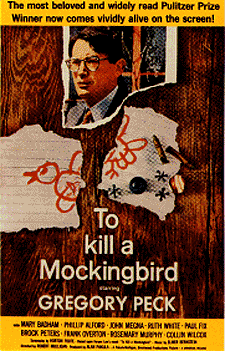
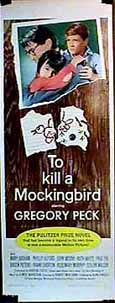
AWARDS AND NOMINATIONS
Academy
Award® Wins 1963
Best Actor - Gregory Peck ("Atticus")
Best Art Direction -
Set Decoration -
Henry Bumstead, Oliver Emert, Alexander Golitzen
Best Writing, Screenplay
Based on Material from Another Medium
- Horton Foote
Academy
Award® Nominations 1963
Best Cinematography,
Black-and-White - Russell Harlan
Best Director - Robert Mulligan
Best Music, Score -
Substantially Original - Elmer
Bernstein
Best Picture - Alan J. Pakula
Best Supporting
Actress - Mary Badham
("Scout")
American
Cinema Editors, USA
Eddie Award Nomination, 1963
Best Edited Feature
Film - Aaron Stell
Brittish
Academy Awards
BAFTA Film Award Nominations, 1964
Best Film from any
source - To Kill a Mockingbird, USA
Best Actor - Gregory Peck, USA
Cannes
Film Festival Win, 1963
Gary Cooper Award - Robert Mulligan
Golden
Globe Awards, USA Wins, 1963
Best Film Promoting
International Understanding - To Kill
a Mockingbird
Best Motion Picture
Actor - Drama - Gregory Peck
Best Motion Picture
Score - Elmer Bernstein
PGA Golden
Laurel Awards Win, 1999
PGA Hall of Fame
Motion Pictures - Alan J. Pakula
Writter's
Guild of America, USA
WGA Screen Award 1963, Win
Best Written American
Drama - Horton Foote
The Credited Cast
| Gregory Peck | .... | Atticus Finch |
| Mary Badham | .... | Jean Louise "Scout" Finch |
| Phillip Alford | .... | Jem Finch |
| John Megna | .... | Charles Baker "Dill" Harris |
| Estelle Evans | .... | Calpurnia |
| Brock Peters | .... | Tom Robinson |
| Ruth White | .... | Mrs. Dubose |
| Paul Fix | .... | Judge Taylor |
| Collin Wilcox Paxton | .... | Mayella Violet Ewell (as Collin Wilcox) |
| James Anderson | .... | Bob Ewell |
| Alice Ghostley | .... | Stephanie Crawford |
| Robert Duvall | .... | Arthur "Boo" Radley |
| William Windom | .... | Mr. Gilmer |
| Crahan Denton | .... | Walter Cunningham |
| Richard Hale | .... | Mr. Nathan Radley |
| Rosemary Murphy | .... | Miss Maudie Atkinson |
Frank Overton |
.... | Sheriff Heck Tate |
The Crew
Directed by: Robert Mulligan
Writting Credits: Harper Lee (novel), Horton Foote
Produced by: Alan J. Pakula
Original Music by: Elmer Bernstein
Cinematography by: Russel Harlan
Film Editing by: Aaron Stell
Art Direction: Henry Bumstead
Set Decoration: Oliver Emert
Costume Design by: Rosemary ODell
Makeup Management: Larry Germain, and Bud Westmore
Production Management: Earnest B. Wehmeyer
Sound Department: Corson Jowett, Waldon O. Wattson
Visual Effects: Carol Cowley
Script Supervisor: Mera Rebner
Comparison of the first film to the novel, by Kim Junio
Harper Lee’s To Kill a Mockingbird is a world-renowned and critically acclaimed novel. It is considered by many as America’s greatest piece of literary work. It holds a lot of life’s universal aspects: growing up, understanding others, prejudice, parenting and others. Although the novel is "almost perfect", as many say, the same cannot be said about its film adaption.
The movie version of To Kill a Mockingbird almost seems like a "bare-bones" guide to the novel itself. It is missing characters such as aunt Alexandra and Mr. Raymond. Calpurnia is greatly devalued in the movie as opposed to the book. The sequence of events is altered. The novel’s story is told through the course of years, but only in days or weeks in the film. Many of the events are deleted from the film and some key plot points are either missing or changed. For example: in the novel, both Scout and Jem find the "treasures" in the hollow tree from Boo Radley. In the movie, only Jem found the items. Mrs. Dubose’s lesson of courage to Jem is lost in the film as well as Calpurnia’s bringing of the children in her church. By deleting these scenes, the lessons they teach are also lost. Courage, Prejudice, and Parenting are among the important themes brought up in the book. Merging the whole novel into a short full-length film was an unwise decision. Key events, such as those mentioned, that bear significance in the overall charm, wit, and beauty of the book are lost.
There are, though, two scenes that serve as a "saving grace" for the movie. These scenes were so powerful that they almost balance out the pros and cons of the film compared to the novel. These two scenes are the "Lynch mob" scene and the "Meeting Boo Radley at Last" scene. The directors of the film saw the vision from the book, and knew how to transfer it to film.
The movie adaption of Harper Lee’s To Kill a Mockingbird does not come close to the beauty of the novel itself, but is watchable, especially if the viewer wants to spend their time criticizing with such comments as "What the…?". "That’s not how it happened!", "Where’s the part where…?". Avid fans of the book are very likely to notice that the movie moves by very quickly, and by the time it is finished, will very likely to explode into a rage of more critical comments.
The film may be one of "the greatest films of all time" (Entertainment Weekly calls it, and it won many Academy Award® s), it does not compare to the literary crowning jewel that is Harper Lee’s To Kill a Mockingbird.
© CPR (chyld
productions / records) 2000 -2001
This site was created by Kim "Chyld" Junio for Mr.
Brown's
Honor's English 10 class in Kinnick High School
at Yokousuka Naval Base, Japan.
chyld@mail.com
