
Encephalitis- an infectious disease of the human central nervous system characterized by inflammation of the brain (and its protective sac). Typical symptoms are headache, fever, and extreme lethargy (which lead eventually to coma; double vision, delirium, deafness, and facial palsy, often occur in the acute stage of the disease.) Aftereffects of encephalitis may include deafness, epilepsy, and dementia. ~1~
meningitis- inflammation or infection of the meninges (the three membranes around the brain and spinal cord).
arbovirus- bug-borne virus.
VIRUS (American outbreak)-
Experts believe it was probably brought overseas by stowaway mosquitos. It is most closely related to a strain that infected a flock of domestic geese in Israel two years ago.
When first studied under electron microscope, described as "flavi/toga-like virus, 40 nanometers in diameter" ~2~
It is a member of the Japanese encephalitis virus antigenic complex.
In the temperate zone of the world (between latitudes 23.5° and 66.5° N/S; DC's National Airport is about 38.8° N), wnv cases occur mostly in late summer or early fall, and year-round in milder climates.~8~
Unlike most arboviruses, wnv is carried by several, at least 8 species of mosquitos, including Culex pipiens (primary vector), Aedes vexans, and Anopheles. Ticks with wnv have been found in Asia and Africa. Their role in transmitting the virus was uncertain, but recently West Nile was transmitted to laboratory mice by Orthinodoros moubato tick feeding on infected mice. The virus is not directly transmitted directly between humans.
Birds bitten by infected mosquitoes are infectious for 4-8 days. The virus incubation period in humans is 5-15 days. Most people fight off the West Nile Fever Virus without getting sick. For those who do get sick, the fatality rate is not very high, about ten to fifteen percent.
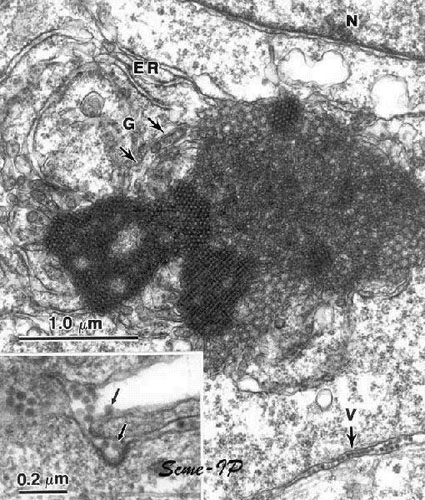

Symptoms: high fever, headache and body aches, skin rash, swollen lymph glands, neck stiffness, disorientation, convulsions, paralysis, see encephalitis.
It is not known where the U.S. virus originated, but it is most closely related genetically to strains found in the Middle East. The virus was first identified in Uganda in 1937, and is fairly common in Europe and Middle East, sometimes in Australia, "and is not a serious threat to most people.~8~"
The earliest case of human infection with wnv (in retrospective study) was identified 8/2/99.
Animal outbreak.
No one is sure exactly when birds were infected. During the first recognized outbreak of wnv in the US, infection of animals preceded the first human cases by 1-2 months.
By late June, a veterinarian at an animal clinic had examined and treated several birds that appeared to have nervous system disorders, releasing those that survived. The reports of dead birds increased. By mid-August birds were being sent to the NY State Dept. Of Environmental Conservation. The wildlife pathologist there determined that the birds were not dying from any of several common causes of bird death. By late August, several wild and caged birds had died on Bronx and Queens zoo property.
Besides [more than 63 species of] birds (mainly crows), 3 species of bats, a raccoon, eight horses and an eastern chipmunk have all tested positive for wnv.
Human outbreak
In late August, an infectious disease specialist in a community hospital in Queens noticed that the hospital had an abnormally large number of suspected cases of encephalitis and/or meningitis, and that several of the patients had developed and unusual pattern of muscle weakness. Blood and spinal fluid specimens were sent to the Center for Disease Control (CDC). On September 3, CDC announced that the samples tested positive for St. Louis Encephalitis. [St. Louis Encephalitis is mosquito-borne and causes encephalitis in people and horses.] A massive campaign was launched to prevent people from being bitten by mosquitos, and to determine the extent the extent of the SLE outbreak.
9/23/99, CDC came to the conclusion that the virus was no SLE but a virus new to the country. West Nile and Kunjin were suggested as possibilities. 9/27/99, CDC had confirmed that a "West-Nile-like" virus was responsible for both the animal and human outbreaks.
* The need for better laboratories was frequently mentioned by officials during the outbreak. There is a need for more laboratory capacity for handling as well as identifying infectious agents, particularly new and/or exotic ones. They said that at the time of the outbreak, only 2 or 3 laboratories in the whole country had reagents necessary to identify wnv. ~2~
ACTION-
9/25/00 News media broke the story as West Nile or Kunjin.
Financial
10/13/00 "The White House has declared New York to be in an official state of emergency, freeing as much as $5 million in federal funds to help pay for the state's West Nile Virus control efforts."~9~
Chemical
A spray- A barrel-sized cylinder that sits upright in the bed of a pickup truck shoots a mosquito pesticide (permethrin and the additive piperonyl butoxide) skyward as the truck drives slowly down the street.
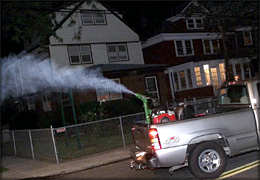
Larvicide pellets are also available, and can be placed in storm sewers.
Also see Treatment.
STATISTICS-
*The first incursion of the virus in North America caused 62 human cases of encephalitis and 7 deaths in New York. This year, there have been 18 illnesses and only one death.
*"To date, 14 infected people and 1,039 birds have been identified in New York state, and the virus seems to have become a permanent feature in the Northeast.~9~"
*A serosurvey (a blood test for West Nile antibodies was performed) conducted in Queens revealed that between 1.2 and 4.1 percent of the population in the area surveyed had been infected with wnv.
St. Louis Encephalitis
St. Louis Encephalitis is mosquito-borne and causes encephalitis in people and horses. In an average year, Florida experiences a number of cases, and outbreaks tend to occur ever 7-10 years.~10~ SLE is similar to wnv in that most people infected show no symptoms, but for those who become seriously ill, no effective anti-viral drugs are available. SLE has a higher fatality rate than wnv, ranging from 3-30% of confirmed cases.
Eastern Equine Encephalitis
EEE attacks the nervous system of people, horses, emus, sheep, and other related animals. It is transmitted by mosquitos, which transmit the disease from infected birds. Transmission of the virus by/to horses by/to people is highly unlikely. Horse mortality rate is 50-90%. Proper vaccination of horses will prevent them from contracting the disease, but there is currently no vaccination for humans. Symptoms include fever, impaired vision, irregular gait, reduced reflexes, inability to swallow, occasional convulsions, death.~10~
and a very closely related disease in Australia-
Kunjin
Mosquitos transmit 'Australian encephalitis'. Cases vary from the mild to severe and fatal. Symptoms almost always include a sudden onset of fever. Anorexia and headaches are common, and vomiting, nausea, diarrhea and dizziness may also be experienced. Brain dysfunction may be experienced after a few days with lethargy, irritability, drowsiness, confusion, convulsions and fits; neck stiffness can be expected, and both coma and death may follow. Recovery from the encephalitic syndrome to occur without residual mental or functional disability is rare.
MOSQUITOS-
9/29/00, eight species of mosquitos carried the virus. (so far, I've found Culex pipiens, aedes vexans, Cx. tarsalis, Cx. univittatus, Cx. perexiguus, anopheles. Cx. tritaeniorhynchus, Cx. vishnui, Cx. bitaeniorhynchus have been tested and are capable of carrying it.)

Culex pipiens, main transmitter. (thank you, NBII)
FLAVIVIRIDAE-
West Nile Virus is classified in the group Flaviviridae, which also includes human pathogens such as yellow fever (L. "flavi"-yellow), dengue, Japanese encephalitis, and St. Louis Encephalitis.
Flaviviruses can survive for long periods of time in hosts (like ticks and mosquitos) by replicating inside the host, without damaging the host. In vitro, replicate in many insect and mammalian cell lines. Flaviviruses produce a wide range of symptoms including fever, arthralgia (neuralgic pain in a joint or joints), rash, hemorrhagic fever, and encephalitis. The outcome depends mostly on the host-age, sex, genetic susceptibility, pre-exposure to the same or a similar agent. (Elderly people are the most susceptible, in general.)
Arboviruses
Most arboviruses are spherical, measuring 17-150 nm or more, but a few are rod-shaped, measuring 70-200 nm and all are RNA viruses.
Treatment?
In anticipation of the recurrence of wnv in the summer of 2000, and analysis was made of the effectiveness of the nucleoside analogue ribavirin (a broad-spectrum anti-viral compound that works against several RNA viruses) for wnv. High doses were found to inhibit replication and cytopathogenicity in [human] neural cells, in vitro.
Next page! Foreign cases.>>>
back to Little Thoughts page
