
|


Fujian (also called Min) is about 46,000 square miles in area (about the size of England), and much of it covered by subtropical vegetation. To the north, west and south mountains form its border, while to the east the province looks 100 miles across the straits to Taiwan. Fujian's coastline is twisted and complex. Only extending about 310 miles as the crow flies, the coastline in fact meanders in and out and around covering over 1,800 miles, and there are about 1,000 islands off its shores.
 Fuzhou, Quanzhou and Xiamen are the most important harbors in the province. The proximity to Taiwan has exerted a powerful influence on Fujian. Even before 1949, the majority of the people in Taiwan were of Fujianese extraction. The same local dialect is spoken on both sides of the straits, and active trade between the two economies has taken place even when frowned on by authorities. Relatives somehow manage to visit one another and many even cross from Taiwan to die in their motherland. Buddhism, Christianity, and Islam, have a considerable influence in Fujian. Fujian is the native place of Zhu Xi, a renowned philosopher of the Song Dynasty (960-1279), who founded the Zhuzi School of philosophy there. The well-developed and somewhat independent culture of Fujian Province has produced noted philosophers and many heroic people in history. Many contemporary revolutionaries, scientists, men of letters, artists, and architects are also from Fujian. More than eight million overseas Chinese and foreign citizens of Chinese origin come from this province. The province is divided into eight municipalities: Fuzhou, Xiamen, Zhangzhou, Quanzhou, Putian, Sanming, Nanping, and Longyan. Fuzhou is the provincial capital. Fujian is a multi-national province. In addition to the Hans, there live the She, Hui, Mongolian, Manchu, Gaoshan, and 26 other ethnic groups. Fujian's climate is subtropical maritime, with hot and sticky summers, cool and pleasant autumns and winters. Plentiful rainfall and the backdrop of hills and mountains have produced rivers short and swift. The province is rich in natural resources. More than 100 types of minerals are mined, including tungsten, iron, aluminum and copper. About 40 percent of the province is covered in forest. Only about 20 percent of Fujian's land area is suitable for agriculture, but that portion is highly fertile, in particular the area encompassing Xiamen. Fujian is known for its Wulong (oolong) Tea and narcissus. The Fujian cuisine is one of China's eight major cooking styles. Fujian or Min cooking is one of eight 'notable styles' in Chinese cuisine. As Fujian is a coastal province, emphasis is on fish and shellfish, frequently flavored with rice or grain wine. In Fuzhou, the provincial capital, the local delicacy is a type of freshwater mussel (haibang), which is found at the mouth of the Min River. Fujianese people are said to epitomize Chinese entrepreneurial skills. This is evident in the busy city markets and in the business empires built all over Southeast Asia by Fujianese emigrants. The province is the ancestral home of about one-third of the world's overseas Chinese (approximately 20 million) - a direct consequence of its coastal position and long seafaring tradition. Notable local handicrafts include stone carvings, bodiless lacquer ware, and cork patchwork. Fuzhou is the provincial capital of Fujian. Most adoptive families will spend time in Fuzhou to process documents and receive their children there. After David and I have spent a year learning beginner's Mandarin and some Chinese history, we find there is a a wealth of little known history right here in Fuzhou. Here is a short synopsis from the city where we will be guests: Fuzhou, the capital of Fujian Province, got its name because of the Fu Mountain to the north. It is the political, cultural, and economic center of the province and the largest city in Fujian, receiving much of its investment from Taiwan. The city's recorded history dates back to the third century AD, when it was known as Yechang. It is also still substantially influenced by Buddhism--altogether there are six statelisted key temples in Fuzhou, the largest number in China. The city is known for its profusion of springs and from early times has been known as the "spring city." More than 900 years ago, the people of Fuzhou planted numerous green banyan trees, which won it another name of "Banyan City." Fuzhou covers an area of 11,968 square kilometers, including 1,043 square kilometers of the urban district, with a population of over 4.8 million, of which 1.16 million live in the city proper. It governs 5 districts of Gulou, Taijiang, Cangshan, Mawei and Jin'an, as well as Fuqing City and 7 counties: Minhou, Luoyuan, Lianjiang, Changle, Pingtan, Minqing and Yongtai. There are more than 20 peoples in Fuzhou, including the main nationality, Han, and such minorities as She, Manchu, Miao, and Hui. Fuzhou produces a number of fine handicrafts, including Shoushan stone carving, Fuzhou bodiless lacquer ware, gold and silver jewelry, the four treasures of the study, fireworks, bamboo and wooden furniture, cork pictures, ivory earrings, jade sculptures, wood carvings, porcelains, paper umbrellas, paper lanterns, and horn combs. Today, over 2.5 million overseas Chinese in at least 50 countries claim to have ancestors from Fujian. Even in ancient times, when emperors emphasized policies of self-reliance, Fuzhou was a major gateway to the outside world. Every year thousands of merchants would sail for months to and from Fuzhou to trade in tea, china and silk. Fuzhou is currently re-emerging as a crucial seaport city and manufacturing center of southeast China.
Fujian is in the southeast (in green) 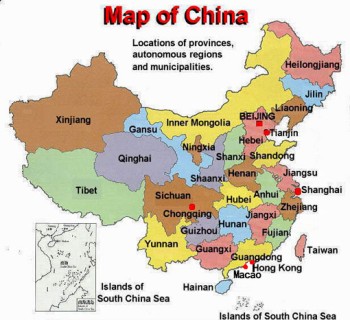
 |




