|
Explanation
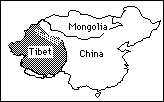
Tibet is a territory which China claims to be a historic part
of China and has occupied since 1949.
The culture and language of the Tibetans however is different
from those of China. If Tibet ever had a suzerain it was Mongolia
whose kings instituted the office of Dalai Lama and which still
follows the same religion.
Tibet, partly because of its location on a high mountain plateau
and also because of government policy, was inaccessible from
the west until the mid 20th century.
For about a century until 1949, with the proclamation of the
People's Republic, China was too weak to assert control. From
the Chinese revolution in 1911 the Central government's power
grew particularly weak as for practical purposes China broke
up into warring parts under war lords similar, but on a larger
scale, to the recent Lebanese situation.
Tibetan people on the other hand have never regarded themselves
as part of China. The most they have accepted is a feudal relation
with, in pre-modern times, a small Chinese presence. Since 1949
China has stationed troops and police, destroyed the religious
institutions and forbidden most ceremonies. Large numbers of
Chinese have been settled in Tibet, especially in the eastern
provinces and also in Lhasa.
The Dalai Lama has requested that resistance to the Chinese
be conducted non-violently, according to the Buddhist religion.
There are signs, however, that some Tibetans inside the country
are beginning to use arms.
In March and April 2008 there have been demonstrations in
Tibet protesting about the Chinese oppression of the native Tibetans.
These demonstrations have resulted in arrests and killings by
Chinese military and police. They have been emulated around the
world in the run-up to the Beijing Olympic Games to be held
in Summer 2008. Demonstrations have greeted the Olympic Flame wherever it has been exhibited (outside China itself).
|