|
|
|
|
|||
|
|
|
||
 |
|
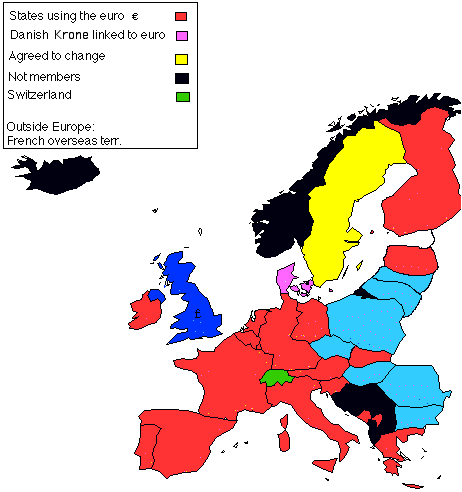
The euro has been adopted by:
Britain seems unlikely to adopt it. There are endless arguments about it, but the politicians clearly believe people would not vote for it in a referendum, after being exposed to propaganda in the right wing press owned by Rupert Murdoch and the Daily Mail (why does Murdoch, an Australian-born American citizen care?). Gordon Brown, in charge of economics since 1997 (and until May 2010 Prime Minister), clearly valued the independent action he had from a pound that is not linked to the euro. Was he right? The 2008 financial catastrophe seems to have made Britain joining totally impossible. After the fall in the value of the pound against the euro in October 2008 joining might have been more attractive - Brown may have been against joining at too high an exchange rate. But the crisis of Greece and the bankrupt banks makes a change seem far too risky. New eastern European states are supposed to adopt it, according to the terms of their accession to the EU, but are not making much progress towards doing so, except for Slovenia and Slovakia. Estonia joined 1 January 2011. Lithuania is planning to join in 2013. Iceland Advantages Travellers gain a great deal from not having to change currencies when crossing a frontier. Businesses gain from a single rate of interest throughout the common market area and from easy calculations of prices and profits in the whole area. Buyers gain from easy price comparisons in different countries. The euro is supported by such a large population that it may be becoming a Reserve Currency, held by others outside Europe, and even used for trading oil (a threat to the dominance of the US Dollar). Disadvantages Could the euro break up? The administrative problems alone would be very difficult, given that frontiers are open. It would be like Pennsylvania opting out of the US dollar. (There are rumors that at one time Luxembourg was planning to issue a separate currency from the Belgian franc, to which its franc was linked, but it is hard to believe even this relatively small operation could have succeeded.) Until Ireland and Britain joined the EU in 1973 there was a common currency zone so that the Irish pound had the same value as the British pound and circulated freely in notes and coins across the border with Northern Ireland. The two currencies were then separated and started having different values. This was a small change. Crisis? In April 2010 Greece has applied to the IMF for a loan. Germany has objected to external aid to Greece without severe cuts in the public sector budget and serious efforts to cure the fiscal deficit. One of these might be to persuade people of the need to pay taxes, as large numbers of the middle class professionals notoriously avoid paying tax. Spain and Portugal are also in trouble and have seen their government bond rating reduced. November 2010 By July 2011 Italy too comes under the question of whether its borrowings can be financed. By November 2011 The question of Greece has been urgently discussed by meetings of the heads of government of the EU and by the G20 meeting of world economic powers. It remains unclear whether Greece will leave the euro and adopt its own currency. 14 November 2011 A new "non-political" prime minister Mr Papademos has been appointed, essentially by the EU organs. He is a former deputy governor of the ECB. His purpose is to clean up Greece's economy. Can anyone make Greeks pay their taxes and stop bribing officials? A former European Commissioner Mr Mario Monti has taken over as "non-political" PM of Italy. By the end of November 2011 a discussion of "fiscal union" has been aired. This would require the members of the eurozone to harmonise their taxes, which would be set not by national governments but by the EU Council of Ministers (or rather by the Eurozone council). Greece The election in May 2012 resulted in no party having a majority, and no coalition government could be arranged. Another election was held in June 2013. The result was ambiguous. It is said that the parties in favor of the austerity measures "won", though the the anti-austerity parties could dominate if they cooperated together. A pro-austerity government was formed. If the anti-austerity parties had won, default and exit from the euro-zone seemed likely. Other currencies have broken up. In colonial times the East African Colonies: Kenya, Uganda, Tanganyika and Zanzibar, British Somaliland and South Arabia shared the East African shilling, managed by a Currency Board (which kept its reserves in pounds sterling and issued currency only according to the pounds in the reserve). These states issued their own currencies after independence, most of which rapidly inflated. They would probably have been better advised to retain a common currency, like the former French colonies in Africa which share the CFA Franc. In 2015 the common East African Shilling may be restored but the people working on it come from the European Central Bank. The proposed date for introduction keeps being postponed. Can they avoid in East Africa the problems of the eurozone? Any country leaving the euro-zone would experience far more difficulties, and might well have to leave the EU entirely. Of course certain rightwing politicians and businessmen apparently would like to see the EU itself break up. It is not clear what motivates them. Perhaps they ought to go to the first world war sites and graveyards. See the museum at Compiegne. It is to be hoped that the period of Europeans fighting each other has ended.
Historical note |
Interesting Reading David Marsh - The Euro  The Euro: The Battle for
the New Global Currency * New Edition * The Euro: The Battle for
the New Global Currency * New Edition *  The Euro: The Battle for the New Global Currency   Der Euro: Die geheime Geschichte
der neuen Weltwährung Der Euro: Die geheime Geschichte
der neuen Weltwährung Michael Lewis - Boomerang Boomerang: The Meltdown Tour  Boomerang: Travels in the New Third World  David Graeber - Debt, the first 5000 year Debt:the first 5000 years  History of debt  Schulden: Die ersten 5000 Jahre 
A history of money from the time of the Sumerians, and the need to cancel all debts every so often. |



