|
|
 |
|
|
|
|
|
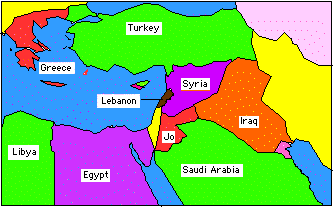
The Levant (direction where the sun rises, as viewed from Italy or Greece) is the crossroads through which cultural influences have passed from Africa (mainly Egypt) into Asia and Europe, and also in the reverse direction. (The Occident is the direction where the sun sets - hence the West). Is this the Middle East? The British Foreign Office used to classify the world into Near, Middle and Far East. In fact the Levant was traditionally the Near rather than the Middle - which was roughly Persia and India. The narrow flat land along the coast of the eastern Mediterranean has been the road through which Egyptian armies have passed to conquer the area to the north (Palestine), and also for the Hittite, Syrian or Persian armies to conquer the area to the south (Egypt). With them have come trade, culture, languages and religions. The Mediterranean linked the various cultures in trade. The Cretan culture had a trading empire throughout this area, before it was destroyed by the volcanic explosion of Thera (Santorini. The Phoenicians of Lebanon, a Semitic language group, traded throughout the Mediterranean and founded an empire in Carthage that rivalled Rome. The Greeks entered the area from southern Russia and after settling in Greece founded colonies in Italy, southern France (modern Marseille) Spain, round the Black Sea and in Asia Minor (modern Turkey). Religion Egypt stagnated and was overcome by cultures from the north who had learned to use iron weapons and horses. Persia invaded and conquered the country, after which Egypt was not an independent state again until the 20th century. But its culture and religions continued to affect others as far as Rome and Ethiopia. Hellenistic period The Arab Empire gave way to Turkish conquest and eventually Ottoman rule over the whole area of the map. The Crusades took place in the Levant - an attempt by Medieval Europeans to conquer the area from the Turkish rulers in the name of their religion. Turkish influence remained until the first world war. The presence of oil nearby has added to the importance of the area to the rest of the world. The migration of Zionist Jews to Israel has created an area of tension and instability at its heart (but it always has been). The modern situation continues to be influenced by the ancient history. Egypt is still the state with the largest population. Does its political influence reflect this? Probably not as although many Egyptians work outside their country the country itself is dependent on the United States as it can no longer feed itself. |
  David Hirst - Beware of Small States Beware of
Small States: Lebanon, Battleground of the Middle East |
| Arab world | Greece | Israel | Palestine |
| Crusades | Iran | Jordan | Saudi Arabia |
| Cyprus | Iraq | Kuwait | Syria |
| Egypt | Islamic world | Lebanon | Turkey |





