|
|
|
|
|||||
|
|
|
|
|
|
|
| The purpose of this project is to collect Water Hyacinth from the lakes and watercourses and convert it profitably to gas, solid and liquid fertiliser and thus make use of a disaster to generate employment and wealth. Initially the object is to set up a prototype business complex that can be replicated all round Lake Victoria and the other affected areas. The end result should be to set up a new industry. |
|
There are three tasks that must be done successfully. 1)
Collecting the hyacinth from the lake and delivering it to a
processing site. 2) Processing it into as many saleable products as possible. Initially these are: i) Biogas to be used to substitute for
charcoal, firewood and oil products |
|
Collecting the weed from the Lake At this point I don't know how this should be done. The main problem is Bilharzia (Schistosomiasis). There is no vaccination against this disease. Anyone who spends time allowing lake water to contact the skin is in danger of being infected by the parasites (I have had it myself.) Allover protective clothing is impractical in the hot climate. Whether there is any machinery that could collect the weed without human contact with the water is something I don't know yet. Even if there is, the cost could be too high to be covered by the earnings from biogas and the other commercial activities proposed in this project. |
|
Biogas
technology is fairly conventional now. There are two
possible methods of digesting water hyacinth. Experiment may
show which is the most suitable.
There is a technical question that still needs to be established. How much nitrogen from animal manure is needed and where it will come from. One method might be to feed some of the Hyacinth to animals - pigs have been suggested - and use the manure in the process. This implies an animal farm as part of the project, or associated with it. There may at present be animal farms with unused manure outputs. That is, I have noticed in Africa such enterprises as chicken farms do not always value and utilise their manure. They could be contacted and invited to sell it to the Project. Given the fact that Hyacinth is almost unlimited in quantity the supply of nitrogen for digesting it may be a limiting factor. It might be necessary to add inorganic nitrogen such as ammonium nitrate (see below). But human waste is a possible source. |
|
3) Selling these products. i) Selling biogas may in the first place mean setting up an "industrial estate" where users can set up their businesses near the biogas digester. These would be activities that need heat. An obvious candidate is a bakery; another is a potter or earthenware producer. Thus these businesses would rent a site within reach of the biogas digester and be supplied with gas, perhaps using a meter for payment purposes, or possibly paying a flat rate as part of the rent. In the long run, if the amounts of gas produced increase greatly, a gas distribution system might be possible to lead gas to users. Probably it is unlikely that the supply of gas could be enough for general urban domestic supply, but we must remember there are huge quantities of weed in the lake. A gas distribution system of this kind needs to be designed to professional and Natural Gas standards by an organisation like British Gas (or whatever its current name is). However, biogas would not necessarily replace all uses of charcoal and bottled gas (LPG). Charcoal and LPG are portable and are useful for such things as roadside food kiosks. ii) Selling fertiliser is a different business and is linked to Organic produce. |
|
Profitability How can these processes be made profitable? The revenue comes from sales of the various products. What can be charged for these? Only observation of the market can answer that. To some extent compost and liquid fertiliser may be a substitute for existing products, many of them imported. Organic standards Sir Albert Howard in "Farming and Gardening for Disease and Health" noted that coffee trees developed Coffee Berry Disease when the soil lacked humus. This was confirmed by Tim Hutchinson on his biogas farm at Fort Ternan in Kenya - his coffee didn't get the disease, he never sprayed but supplied plenty of fertiliser from his biogas plants. Thus a coffee farmer might be supplied these products and charged what he pays at present for spray against CBD as well as what he pays for artificial fertiliser. In return he can be enrolled in an Organic Coffee marketing scheme and receive a higher price for his coffee. (If there is no local equivalent of the Soil Association, one will have to be set up, along with a marketing organisation to sell Organic Coffee - ask Fair Trade). |
| There is a caveat here. If it is necessary to add inorganic nitrogen to the digester to make up for a shortfall in animal manure the Soil Association may refuse its certification to the product. One way round might be to add volcanic dust for trace elements. Negotiation with Organic Standards Organisations will be necessary. |
|
(Sir Albert Howard was Chief Agricultural Officer for India in the 1920s and founded the Soil Association. Another of his observations was that cattle reared on soil with good humus did not catch Foot and Mouth Disease even when in contact with infected beasts.) Thus these organic products add value to agriculture in ways other than direct sales. There would probably be enough compost from these biogas plants to convert large parts of Uganda's exports to Organic standard - a higher value product. Both the farmers and the Hyacinth processors should benefit from this added value. |
| Moreover, there will be two distinct products to sell: liquid and solid. Hutchinson gained most of his nitrogen from cows via the animal manure only digester. We shall be using any of this liquid in the hyacinth digester. The liquid output from the hyacinth digester may not have the same nitrogenous quantity as Hutchinson's liquid, and may not have the same effect on Coffee Berry Disease, for example. (Howard, got the same result from ordinary compost - he said it was the humus content that cured the CBD. Therefore the solid waste would be valuable for this, too, as it is equivalent to ordinary compost.) |
|
Quantities Profitability probably will not occur until the quantities being processed are of the order of several tonnes a day. If the project is processing one tonne of weed per day there will be an output of about 30 cubic metres of gas per day. The amount of fertiliser produced will be of a similar order - one tonne a day. Can these outputs pay for the collection? It is difficult to see how the calculation can be made before a pilot project is running. What needs to be known is: 1) Wage rates and the labour cost of collecting the weed from the lake. 2) The likely price and revenue to be received from selling gas. 3) The amount of revenue from selling fertiliser products. 4) The cost of building and operating the plant (including maintenance, depreciation and reinvestment). |
|
World Climate As the biogas produced is to some extent a replacement for oil products and is solar derived there may be some scope for financing it from any funds available to combat global warming. The gas users will be transferring from charcoal - which will assist forest conservation - and LPG which will save carbon from being added to the world's atmosphere. If Uganda and the other Lake Victoria states have quotas for carbon emissions there may be some scope for exploiting this. Climate money ought ideally to be used for capital investment rather than as a continuing subsidy (because subsidies can be cut off without warning). However, see the proposals in Climate. Each biogas producer should sell its carbon credits for hard currency. |
|
Fishing and Transport services Removal of the weed makes possible the use of the lake for transport (ferry services) and fishing. It would be appropriate for these industries to help pay for the work of clearing the weed. |
|
Management skills It must be clear that profitability is by no means assured. Management skills in controlling costs and getting the best price for all products and services will always be important, and may make the difference between success and failure. Ownership As there is not an excess profitability the best ownership might be as a cooperative of the workers, initially as a non-profit distributing trust. That is, a "conventional" owner, requiring profit will be disappointed. If he attempts to extract profit the business would probably fail. Whether a cooperative could work can only be discovered by trying it. |
|
|
|
The Water Hyacinth Project Object To collect water hyacinth from the lake surface and process it into saleable products, including biogas and fertiliser, to make use of human and animal wastes, to sell biogas to local businesses and fertiliser to local farmers, especially coffee farmers and encourage them to grow high value organic coffee and other crops. To provide paying employment and training in new skills. These
skills will be: biogas processing; compost making; marketing;
weed handling. To encourage the use of wind power for pumping and electricity. |
|
Sub-project 1 bagging plant for solid fertiliser? Employees Jobs needed will be: Research |
|
|
|
|
|
|
|
|
| diesel | 0.62p/litre | 0.72 lit | 0.4464 | 13.39 |
| kerosene | 0.50p/litre | 0.87 lit | 0.435 | 13.05 |
| petrol | 0.75p/litre | 0.8 lit | 0.6 | 18 |
| charcoal | L4.50/30kg | 1.45 kg | 0.217 | 6.53 |
| electricity | .06p/kwh | 2.2 | 0.132 | 3.56 |
|
Column 5 shows the daily value of the biogas as a substitute for other fuels, assuming one tonne of weed processed per day. Thus it is best to use the biogas to substitute for diesel, petrol and kerosene. People who are using these fuels may be able to pay the highest price. If there is electricity at a site, biogas is less likely to be a suitable substitute - providing the electricity supply is reliable and not subject to interruptions. Calculations made in 1973 show that LPG (bottled gas) is also a high price fuel, and biogas can profitably substitute for this too. Liquid fuels do have an advantage in that they can be used as portable sources, whereas biogas will be tied to a pipeline. Thus biogas might have to be sold at a slightly lower price to attract people who would value portability. The use in vehicles is possible but requires an investment in compressors and storage tanks that is probably not appropriate for this project. Compressed Natural Gas is being used for buses in some cities. What is the future of oil prices? What it would mean for biogas in Uganda is that the value of biogas can be tentatively projected to increase after world oil production peaks - if it does. Its value for the national economy increases if we enter a period of increasing oil prices because it then becomes an important counter to inflationary tendencies. However, others have pointed out the limit to oil pumping has been reported at intervals for many decades, and always the limit has been exceeded as a result of new discoveries. 2004 The world oil price has jumped following the Iraq war. Is this a permanent rise or will it fall again if more peaceful conditions occur in the Middle East? At the present price (August 2004) biogas becomes a more attractive substitute for oil products than in the recent past. |
|
Compost and Liquid fertiliser prices The British company Tropical Wholefoods buy other organic products from Uganda. These too would be potential customers. |
|
Sub-Project 2 A sub-project might be the production of the Motswedi Wind Pump. Most of the suitable sites for water hyacinth processing projects have the typical convection wind systems that make wind pumping the best source of energy for lakeside projects. This is especially true of the Rusinga area and Bukoba in Tanzania. A strong wind blows up at about 11.00 in the morning after the land surrounding the lake heats up and then blows until about sunset. The Motswedi wind pump was designed for use in Botswana where a large number have been built. Its design principles are to build it from parts available on the market using local labour. These principles could be applied to the Lake Victoria region. I suggest the designers - General Engineering Management - be asked to set up a factory to produce the Motswedi pump for use on the initial water hyacinth project and in the hoped for replica sites that will follow. As it includes a rotating shaft this wind pump can also be used to generate electricity in small quantities. |
|
Sub-project 3 Workshop/factory to build Motswedis Needs Project Manager Object One pump will be needed for the demonstration project. Every replica project will need one for the water supply to feed the biogas processors and other site needs for raw water. The Rusinga site could use water for irrigation during the dry season. Probably other sites could as well. Irrigation might be a large scale use for Motswedi pumps. The Motswedi was designed by Max Ewens, of General Engineering Management, 3 Holmwood Drive, Leeds LS6 4NF. Research 1. Adaptation for the needs of water pumping from lake level
to a storage tank - this is different from the Botswana use of
this pump, which is to raise water from boreholes. |
|
Sub-Project 4 To digest water hyacinth, consisting mainly of cellulose,
a supply of nitrogen is needed. In rural areas chicken manure,
cow and pig manure might be the best sources. In urban areas
human manure is the obvious source. Design The sub-project would be to build near the site a public toilet. An attendant should be provided who will maintain high standards of cleanliness in order to attract people to use it. As this is a source of raw material the attendant would be paid by the Biogas unit, and trained thoroughly. This should be a high prestige job. The design should prevent disease being spread and protect the workers. The facility should be inspected frequently. It should be robust to resist rough usage but be attractive enough to cause people to use it. This suggests we should be ready to build to a high standard with good quality tiles and floor. It should be simple to use. |
|
Employees Jobs needed will be: -cleaning and maintenance to a high standard Research How should the product be treated? WHO guidelines on preventing
disease spread: Cholera, Bilharzia, AIDS, parasites and so on. |
|
Sub-Project 5 To rent land as sites for users of the gas. Object Means To prepare sites suitable for buildings, perhaps of the informal sector type (mud walls) equipped with gas supply pipe, raw water and drainage, with removal of solid waste. Target businesses Bakery These are activities that need heat, at present provided by charcoal, firewood and oil products. Other businesses might be identified that will make use of the gas. |
|
Personnel Site manager Means of payment Payment will be as rent for the site. The rent to be negotiated with the renter. Should it include gas and water as a consolidated price, or should gas be paid by the amount used? This is to be discussed. Payment by the amount used might need meters for each site, which introduces a range of technology which might cost more than the advantage. The aim should be to keep the payments simple while ensuring that the activities make a profit for the Project (rent to bring in more than expenditure on servicing the site). |
|
Health and Safety The site owner (the project) shall have the right to advise and order the gas user on safe usage of the gas, to avoid explosions and fires on the site. Buildings should be inspected and the siting of burners controlled. In Uganda conditions the main provision for safety is that there must be ventilation to allow any escaped gas to pass out of the building without accumulating in the roof space (where explosions might occur). The site owner (the Project) should control the activities going on, especially the type of waste produced. That is, renters should not build up toxic wastes, should not put wastes into the Lake, nor affect the health of people on the site and outside. |
|
|
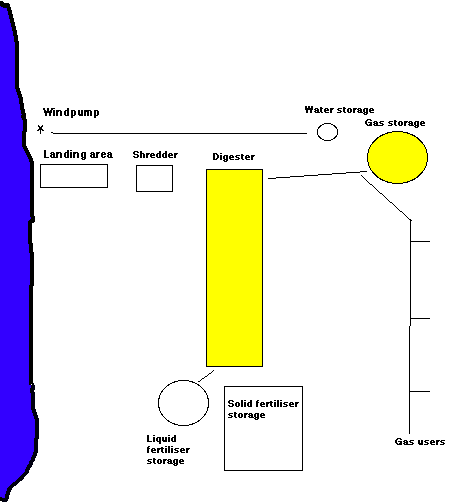
![]() |
| The site is beside the lake to receive water hyacinth delivered by boat. It also needs to be connected by road to deliver solid and liquid products to customers, and to service the industries making use of the gas. It does not necessarily need electricity or clean water supplies. Thus it might be possible to site one of these projects in a place which does not at present have modern services. Electricity can be generated on site by wind, solar and from the gas. |
|
|
|
|
(This plan was proposed in 1997 but didn't proceed, partly because Uganda went to war in Rwanda and the Congo (former Zaire))
|
|
|
|
|
|