 |
|
|
|
|
|
|
|
1. What is Biogas 2. How I have used it 3. How other people can use it. 4. Biogas and the climate problem Biogas is a mixture of carbon dioxide, water vapour and methane produced by the breakdown of organic remains in the absence of oxygen. It has been known for centuries, though not as far I know put to use until the 19th century. It burned in marshes and was thought to be spooky when it was ignited by phosphorus compounds and named such things as Will o' the Wisp. The Wikipedia article is very unsatisfactory in that it mentions Ancient Persia and China but without references.
Will o' the Wisp features in Lord of the Rings in the dead marshes, and in our folk traditions. Roger Bacon is supposed to have ignited a build up of methane in his monk's cell (according to a novel: Doctor Mirabilis) Farts and other manifestations Large dumps of organic household waste are well known to be digesting in the absence of oxygen and therefore giving off methane, sometimes causing explosions in buildings placed over the decaying mass. In many areas pipes put into these old dumps have produced useful gas. By burning the gas we can avoid the climate changing effects. Biogas is the source of a huge amount of methane in the environment, some of which has the potential to cause catastrophic harm. Deep in the oceans can be found methane hydrate formed from the slow breakdown of organic materials deep in the oceans. Pressure and temperature keep it as a sort of ice. If the temperature of the water ever rises beyond a threshold the gas may escape, causing sudden very drastic climate change. Similarly, organic breakdown has produced a great deal of frozen methane in the Tundra. As this melts in the general warming of the Arctic it is being released, speeding up the rate of climate change. Methane is a much more powerful warming gas in the atmosphere than carbon dioxide. Last Sunday (21 March 2010) in the BBC tv Solar System series the presenter showed a lake in Alaska or northern Canada which was bubbling. There is a layer of rotting vegetation on the bottom of the lake. They placed an upturned boat over the bubbles and collected the gas in them. The gas was methane. There is a lot of it about.
|
||||||||||||||||||||||||||
|
Kenya Biogas lecture In 1965 as a new graduate (History) I was recruited by the Ministry for Overseas Development. I later came to realise that this was the old Colonial Office with a new name but many of the former personnel. For example it was headed as Permanent Secretary by a former governor of Uganda Sir Andrew Cohen. Barbara Castle was the minister - a Labour firebrand from way back. Uganda had been independent since 1962. I was one of a group of students sent out to be trained as teachers at Makerere University College in Kampala under what was called the Teachers for East Africa scheme (TEA). Our role was to expand the existing secondary schools in the three territories that had been British East Africa - Kenya, Uganda and Tanganyika (Tanzania now). Before I left on the three weeks sea voyage customary in colonial days (the last group to travel in this entertaining way, at the Ministry's expense) I had glanced at a popular newspaper and took a cutting of an article about an eccentric southwestern farmer who was running his car on Chicken Manure. The article was of course jokey and slightly deprecatory but it planted in my mind an idea. He was of course making biogas - a name that was not used at that time. Harold Bate should be better known as he was a true pioneer, derided in his time of course. He didn't invent the concept of biogas. Egypt or India may be the earliest British Empire use of the technique, and of course sewage works had been using it for many years. But Bate was the first to apply it to a vehicle. He was partly prompted by the petrol rationing that occurred in 1956 at the time of the Suez Crisis - the first indication that we in Britain were vulnerable to cuts in our imports of oil, but soon forgotten until 1973 when the same happened again. Now, of course we are near to or past Peak Oil. The behaviour of the oil market in 2008 suggests we are still vulnerable to external forces, especially as we have foolishly pumped our own reserves as fast as possible and not left them until the price had risen - which has now happened. http://www.green-trust.org/2000/biofuel/batesmethane.htm What Bate's experience shows is that Necessity is a powerful motivation. Harold Bate and his Chicken powered car I also took with me a UN publication on energy for developing countries. It was a report of a 1961 Conference on New Sources of Energy and Energy Development. Although it mentioned solar and wind it did not refer to biogas - then still a rather fringe activity. |
|
|
Kenya While working in Botswana (1970-71) I had built a solar water heater to power a shower, and did some experiments with a solar concentrator for cooking - not a success. I had also ordered some of the books in the Whole Earth Catalog, including the WHO publication of Composting by Harold Gotaas. This book formed the basis of my knowledge of theory. It was on my second period in Kenya from 1972-74 that I started to work with gas. I was teaching in Musingu school in Kakamega district that had a small farm attached: some pigs, chickens and crops of a high grass for fodder - Kikuyu grass. In my garden I had banana trees. The soil of much of my garden was like that of many new houses: the top soil had been scraped off and what was left was what is called in East Africa Murram or Laterite). It is a bit like brick clay. Its main use is to surface roads.
I did go down to Kisumu and ordered a tank from an Asian tank maker. It was a round corrugated tank about five feet high, with a 1 inch tap at the bottom and a half inch tap at the top for letting gas out. 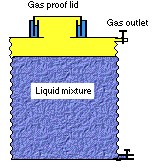 This first design had a serious fault as I did not have a gas proof lid. I had to get a new lid for it and solder it on to the original tank. Into it I put the various kinds of animal manure found in the school farm. This was a mixture of pig, cow and chicken. I can't remember where I found the bacteria to make it digest. I might have bought it from the Tunnel Company. It started to bubble but I wasn't sure whether it was producing gas. Before I had got a proper lid I tested it with a match. Yes, it was making gas and I singed my eyebrows. A bubble of flame rose up. That is something people should not do. I also ordered from the Kisumu tankmaker a gas holder. At this time I really didn't know much and so I ordered a tiny gas holder which was fairly useless. 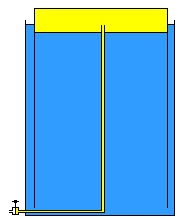 To use the gas I ordered from Tim Hutchinson a burner suitable for using as a cooker. To connect these together I had acquired agricultural plastic pipe(hard polythene) of the kind which could use ordinary water pipe fittings with special brass connectors. It was very easy to handle. So, I then had a tank producing gas, a tiny gas holder and a burner suitable for boiling water. But only for a minute or two. My next step was to order a much bigger gas holder from Kisumu, about 6 feet high and four feet in diameter. With this installed I could store the gas made in the tank. The mixed manure in the tank bubbled away until it was exhausted and I could then let it out via the tap at the bottom and spread it on the garden. I soon noticed that this liquid was a miraculous fertiliser. I had bought a Swiss Cheese plant in a metal pot. For months it failed to grow but when I put some of the liquid output on to the pot, leaves started growing at once. It had the same effect on my garden made of murram. Plants growing there became vigorous and I had excellent crops of maize. The boys in the school thought I must be using special seeds, but I assured them it was just the same maize everyone else was using.  The next stage was a tank to digest vegetable wastes. I think I had been to see Tim Hutchinson's farm at Koru by then. He sold suitable vegetation tanks and I ordered one. Into it I put the liquid from the first tank and various kinds of soft vegetation waste and more animal manure from the school farm. A good source was banana stalks after the bananas had been harvested. The banana is like a sort of grass and is not woody at all. The leaves and stalks chopped up are full of fibre and cellulose. It is the cellulose that the bacteria break down into gas, leaving behind a soft solid that can be used as humus. I also put in grass clippings from the lawn, the large leaves from pawpaw trees and some of the dried up leaves from a Kikuyu grass plantation kept to feed the cows on the farm. Musingu is quite high in Kenya. It has a climate often described as an ideal English summer. Strawberries grow all the year round. The days are pleasantly warm with a temperature in the 80s (30c) and the nights are cool, down to the 60s (15oC). This means that the material in the tanks didn't reach the ideal operating temperature for this process which is about 35oC. So the process went faster during the day and slowed a bit at night. I did try covering the vegetation tank with a plastic sheet but someone stole it in the night. Eventually I had two vegetation tanks and the original animal manure tank. These fed gas into the gasholder tank to store it. My cook used the gas for cooking. It replaced the electricity I was using previously. I also had a gas lamp of the kind used in Britain until electricity replaced gas for lighting (I remember a house in London lit by gas from the late 1940s). I used the gas lamp only on the rare occasions when the electricity wasn't working. The school was in the rural areas but was supplied by an intermediate voltage line down the road. Occasionally it was knocked out by lightning strikes but considering that there were thunderstorms nearly every day the electricity was very reliable. I had a kerosene (paraffin) fridge and a gas burner designed to replace the paraffin. During the night I used the gas, but as there wasn't enough to run it all the time I used kerosene during the day - when the windows were open and the smell dispersed. 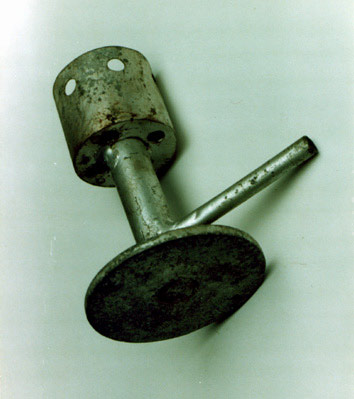 This installation wasn't really vital to my life. It was just an experiment to see what was possible. I had electricity in the house and didn't really save any money by using the gas. For cooking I used a pressure cooker. The gas substituted for electricity. I seldom needed the gas light. Gas lights have a disadvantage, especially in tropical areas. They create heat and attract flies. It's hard to say how much I spent but it was hundreds of pounds rather than thousands. The whole set-up was sent to Rusinga Island when I left Kenya in 1974. Unfortunately, it was never re-assembled and so was lost. But, when the electricity was off, I had a feeling of independence. I felt that much more strongly when I was in Nigeria a few years later. |
|
Nigeria - 1977-1980 I was at a school in Bida. Whereas Musingu in Kenya had been in a cool area, Bida was the hottest place I have ever been in. The electricity was very poor, coming from a diesel generator in town which wasn't big enough to cope with demand, especially at night. After sunset the voltage declined so that incandescent lights went dim and fluorescent lamps wouldn't start. I did experiment with a primitive inverter running off my VW car battery but that quickly ruined the battery - and batteries were expensive in Nigeria. (At that time I did not know that for storing electricity you need a deep cycle battery such as is used in forklift trucks.) My main problem was cooking. I had a cooker running on a calor gas cylinder - they were difficult to find. To refill it I needed to go to a dealer in town. Sometimes they had them; sometimes not. Also they charged a lot. One could go to the refinery in Kaduna - four hours drive away there and back - and wheedle one out of them, with difficulty at half the price. All in all cooking with calor gas wasn't that easy. So I remembered my experiments in Kenya. This time I really needed the gas. I at once realised that the temperatures in Bida were much more favourable than in Kenya. The ideal temperature for the mixture is 35oC (according to Gotaas, my book of theory). I never actually measured the temperatures but I assume that in the middle of the day it was in the high 90s (Fahrenheit ), that is above 30oC. So I started looking for suitable containers. Luckily, I found the Public Works Department had a number of oil drums which were no longer suitable for carrying oil. I also found a number of tar barrels whose diameter was slightly less than an oil drum. This combination was perfect. I already knew that water pipe fittings could be used for gas, and I had brought with me some of the fittings from Kenya. On my first Christmas in Nigeria I visited Kenya and got a supply of pipe fittings suitable for hard plastic pipe of the kind I had used in Kenya. I felt I was equipped. I knocked out the blank end of an oil drum and fitted the other end with valves. I got a piece of metal pipe and got the school workshop to put on a thread so that it would fit into the smaller outlet of the drum. I knocked out the end of the tar barrel and so I had a gasholder. All that was needed was a suitable mixture. 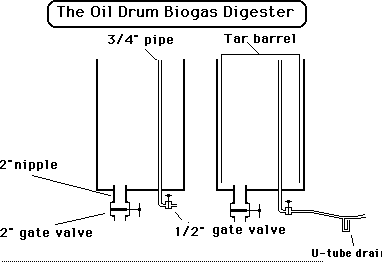 The school had some chickens and I collected a supply of chicken manure and half filled the tank, and filled the rest with water. Eventually, something happened. A gas did come off. I fitted the burner to it and tried to light it. Two things happened. The gas itself was evil smelling (my biogas in Kenya had had no smell at all). The flame produced was very thin and tended to go out. Clearly it wasn't working. I consulted the books and realised I had started too quickly. For one thing I didn't have a proper supply of bacteria, which you can get from a swamp or an already existing biogas plant. (I think I had bought the mixture in Kenya from the Tunnel company. The other problem is that the mixture was too acidic. Sourness breaks out from acidity, common with bird droppings. I needed to start with more alkaline cow or horse. The whole system produced a horrible smell. So I went down to the town's slaughterhouse. There I found a very unsanitary situation. The undigested food from the cow and goats' stomachs (paunch manure) was thrown into a swamp. If you looked at that swamp it was obvious it was bubbling. Bingo. I dipped my Nido tin into the water and scooped up some of the mud.  I then had to empty out the evil smelling acidic mixture and replace with a new batch. First I went out to look for cow and horse manure. Cowdung could be found in the bush outside the town where the nomadic Fulani cattle herders were. They soon got used to seeing me drive up in my VW Beetle, come out with plastic bags and a trowel and scoop up fresh droppings. They even started to point out where it was. For horse manure I waited until the local king, the Etsu Nupe, held a big parade outside the palace and went out with my plastic bags and trowel after the people had left. Now I had the makings of a new start. I added the swamp mud and some fresh cowdung (it must be fresh as dried cowdung floats and never becomes liquid again) and a bucket of water. Gradually I added a fresh bucket every day. Quite soon when I tested the gas it began burning as I had hoped. I then switched to chicken manure (much more powerful at producing gas) and added a half and half bucket every day until the barrel was full and the gasholder rose steadily. Once the process is working the acidity of chicken manure is diluted and can't cause sourness. I was in business. After about 30 days I started taking some of the mixture out of the bottom of the drum, replacing it with an equal amount poured into the top. That process could go on for months. At the end of the year when I went on leave to England I would empty it out and remove the accumulated soil from the bottom of the tank. I took the empty tanks into the house to prevent people stealing it. With one oil drum I could cook breakfast during the breakfast break at school (9.30 after a 7.00 a.m. start), a light lunch at the end of school (14.00 in the heat of the day) and part of my dinner in the evening. I found that I didn't have enough gas to do the whole dinner and so needed to start it off with the use of an electric ring, which I had to use before sunset (to beat the voltage drop). So I would bring the pressure cooker up to boiling on the electric ring and then finish it off with the gas. Clearly, I needed a second oil drum. I used exactly the same process and soon had two drums producing gas. After that I could cook an ordinary dinner without needing my very primitive electric ring. But I did want to bake bread or cook a chicken in the oven. So I got another oil drum and followed the same process except that I filled it with water and had no liquid valve at the bottom. This one stored gas but didn't produce it. 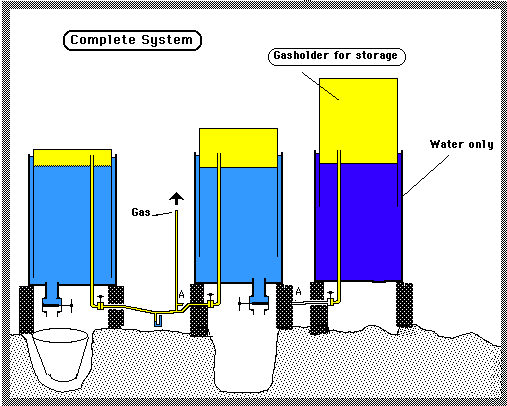 I then had enough gas to roast a chicken and do a complete dinner, and invited friends round to celebrate. The total cost was really very little - probably about £100 - and I was now independent of the gas sellers. It felt like having a small oil well in the garden. Materials Regrets I have some other regrets. I didn't manage to work a fridge with the gas. The Public Works Department had piles of old kerosene fridges which would have been suitable. However they had been called in because they had caused too many house fires in government owned houses. I explained that I didn't intend to use any kerosene burner but they refused to let me have one. If I had had one I would probably have made at least one more oildrum digester. Another was that I didn't have a gas lamp. The electricity was so bad that I would have found a gas lamp very useful for marking books in the evening. I partially got round that by running an electric lamp off my car battery using an inverter - sometimes even with engine running. But that wasn't satisfactory. (This was long before solar electricity was as cheap as it is now). Petrol was very cheap - as it often is in oil-producing countries. My main regret is that I didn't explain the system to enough people. In particular I should have shown it to women who would be the main beneficiaries by saving them the labour of collecting firewood. Since I published the web page I have found a group in Mombasa who seem to have been inspired by this project. There may be others. |
|
Planning: I have written a web page on what anyone planning to make gas needs to do in order to do it right - copy out planning page |
|
Practical This must be small enough to carry on a bus or train. I chose a large plastic mineral water bottle (usual cost, full, one pound). Materials We need a substance that is bubbling and a means of demonstrating the gas burning. Bacteria may come from the pond in the Leigh Woods, or the Canford pond where bubbles have been seen in the summer.
The pond mud probably didn't contain the right bacteria. The process didn't work until I added human waste. |
|
Biomass In the past, when there were fewer humans, firewood was the main source of energy for cooking and such things as blacksmithing. For the most part people didn't take more than could be replaced by the natural growth of the forests, or the coppiced trees of special plantations. No extra carbon dioxide was released into the atmosphere. But from quite an early period even Mediaeval technology was removing the forests in this country. From as early as the 14th century there was a shortage of yew branches for making longbows and they needed to be imported from the Baltic. Biogas is a possible replacement. The numbers of humans at present are far too great to rely on firewood and charcoal even for such purposes as cooking, let alone industrial processes. Research money tends to go into other sources of biomass, including Jatropha which can grow in semi-arid areas, using soil that probably couldn't grow food. Alcohol from food is obviously the worst source of all. It tells us something about former President Bush that he favoured that method, which could cause famine and high food prices - 25% of US grain is now going into alcohol production. This is a real scandal. Palm Oil production destroys existing rain forests and all its wildlife such as Orangutans. Biogas can use existing farm wastes which would be disposed of whether there is a biogas process or not. Generally it doesn't increase farm costs but does increase profits. It doesn't detract from food production but may well improve the soil to increase yields. We ought to compare biogas with burning unprocessed biomass. For example Drax power station is trying to get a subsidy from the government for burning biomass - unspecified - instead of coal. When wood and other biomass is burned in power stations we lose the potential soil nutrients, which are conserved in a biogas process. |
|
Role in climate change In Tropical areas I have no doubt that potentially biogas could replace oil products for many uses. See the water hyacinth project There are huge amounts of vegetation available that can be used to produce gas in all climatic zones (except the Arctic). The real danger of the methane process comes in its natural occurrence where it has been produced in the breakdown of vegetation in the tundra regions. That methane is already being released all over the warming Arctic and could prove very dangerous indeed as the more the climate warms the faster the gas will come off. TV has shown us fountains of flame when the ice is broken in Siberia and someone has managed to light the jet of gas. deep sea methane hydrates etc Of course the oil companies are interested. No doubt if they tap this gas they would be careful not to cause a mass release. Let's all hope so. |
Interesting
Reading Mark Lynas - Six degrees Our future on a hotter planet A useful source of information about the implications of allowing carbon dioxide and methane to build up in the atmosphere, and the changes that each level of these gases will produce in habitability of human settlements. Another scary book.   Guardian article Lynas believes serious damage is inevitable |
|
Britain and temperate regions Nevertheless there are quite a few biogas installations in Britain. One of the first was at a Monastery at Portglenone in Northern Ireland. Alas, when I was working in Belfast a few years ago I was not aware of it and so didn't go to see it. I am also aware of some in Dorset on large commercial farms. I think the future of this kind of production is bright. Biogas should definitely be a new source of income for commercial farmers. Ordinary business methods should spread it, quite probably without even the need for government incentives. Carbon Credits would be useful.
The question we should be concerned with is whether ordinary people can use this technology on a smaller scale. In the section on Planning a Digester I point out that before doing anything else one has to identify a source of material to process and a use for the gas and fertiliser. I don't have access to any material other than horse manure from the streets, or the gypsy trader who comes round at Christmas. I just put these on the garden without processing. They are not nearly enough to maintain a steady supply of gas of the quantity I used in Nigeria. The Nigerian installation needed one bucket of chicken manure a day, mixed with an equal amount of water. That did all my cooking. Even if I could solve the temperature problem I still don't have enough material. However, someone keeping chickens in a small way might have enough to make at least some gas. In 2008 I thought about re-creating the oildrum digester, mainly for a proposed film. I discovered that oil drums of the kind I used are not easy to find in this country. In fact I didn't succeed at all. Moreover, the plumbing industry has moved on so much in the last 30 years that I couldn't find the same fittings I used in Nigeria and Kenya. So, I would suggest there is little point in trying to copy it exactly. It is the principle we need to employ. Problems to be solved are:
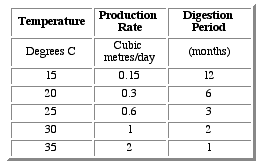
Ideas needed We have the example of L John Fry in South Africa who made biogas on a large scale in an area that has a cold winter - the High Veldt. He heated his mixture with the cooling water of a Ford car engine, circulated the hot water under his digestion tank and generated electricity with the engine. But he was definitely an example of Farm scale biogas, using the manure of a large pig farm. Modern farm installations use methods similar to Fry's. Another method would be to heat the mixture with some of the gas perhaps with a simple gas burner under the tank. But I like Fry's solution which seemed to me elegant in that he got two things out of the same gas: heating and electricity and nothing wasted. Of course in the British Summer heat can come from a solar heat collector of the same kind used to heat water in the house. In fact, if I were back in the Highlands of Kenya that is the method I would use because that would increase the throughput of the tanks. In Musingu I worked on the assumption of the process being complete after two months - though if I had been careful with taking the temperature I might have found that three months would have been better. With temperature up to a steady 35oC I could have reduced that to one month with a bigger daily output from the same tanks. On a large scale that kind of improvement is important. How could we heat a small scale project here? Could a British installation be put in a greenhouse? A Victorian style glass house might be ideal if the temperature is allowed to rise to the appropriate level (but we need to remember these were heated in the Winter with cheap coal). My experience of solar water heating tells me that solar would not be enough in Britain to keep the mixture warm. If we could agree on a suitable design it might well be worth manufacturing it to sell to small scale chicken farmers.
Nevertheless, Biogas has a huge future, indeed by now it has a huge present and its production is increasing all the time. The future is in farm scale and industrial scale biogas. When I first wrote the Oil Drum Digester paper - in the 1980s - it was still a new and brave decision for a farmer to install it to deal with his animal slurry and waste vegetation. Now the number of farm scale plants is increasing rapidly. In some ways I think that the work I did in Africa is no longer important. When I started it biogas was a joke; now it is taken quite seriously. Here is an Observer article on biogas from food waste. In California biogas has become such an important part of farming that there is now an air quality problem from the internal combustion generators. They are producing nitrogen oxides in the Los Angeles region. (My advice is that they should use fuel cells, or Stirling Cycle engines, or even Steam.) However, what I had hoped for was small scale biogas that ordinary people could use. Is there any future in this? One of our major problems in tropical areas is people cutting
down the forests for firewood and charcoal. Biogas can play a
role in reducing the incentive to do this. It's like the use
of petrol in cars. We ought to discourage it but we are not going
to succeed unless there is an alternative in the form of hydrogen
or electric cars and better public transport. We can't stop people
cutting trees if they have no alternative. Necessity is what may bring about the use of biogas. Biogas Africa and
Here
is what might be a useful programme - though only inspecting
it on the ground would show whether it is doing useful work. Compressing biogas for vehicles This is an article about compressing biogas. One should note that energy has to be used to power the compressors. This could be supplied by solar electricity, thus avoiding using some of the gas to compress the rest, or importing oil-derived products. compressing biogas
|


 Geotherapy Index |
 Biogas |
 Home |
