

Welcome to Page 4 of Mom's Book

Jan 24, 1996
As I said away back there somewhere, Edson was a town completely surrounded by forest. Thick, swampy forest. The fires were the big thing, but the forest also produced some of my favorite childhood memories—things that none of my children, except maybe Evelyn, will ever have the pleasure of seeing.
One spring day, when I was seven or eight, we woke to the sounds of birds—maybe thousands of them. All in our backyard. My mother was fond of knitting and she always made soft balls from the scraps of yarn left from her projects. One day we left one of those balls out in the yard and the birds found it and tore it to pieces. We had birds of every color and description scrapping over those bits of yarn, even Baltimore Orioles, which ordinarily would not be using that material in nest building! I wish we had had a movie camera to record that sight. We watched them all morning, trying to identify as many as possible, but even Mom couldn’t tell us what they all were.
The birds were not the only attraction of the forest. All summer long we had bouquets of wild flowers, and it didn’t take us smart aleck kids long to find out we could cadge a nickel, dime or even a quarter from some of the neighbors for a fist full of tiger lilies or marigolds. We also had a muddy swimming hole in the creed, a block or two from home, but as we grew older, we preferred to walk the three miles out to the McLeod River for our swimming. More dangerous, but cleaner and more fun, and besides it was too far away for mom to call us home.
Edson, as a town, or rather, the people, was not good to us. We were the largest family in town, and probably the poorest, and so did not fit in with the town "society". Dad had a job all through the depression, but when I look back on the conditions of his work and workplace—it was appalling. He never had a holiday in all his 50 years of working for the railroad. He worked 6 days a week and if he was ever sick, he lost pay. There was no union in those days and the CN could treat its employees any way they wanted to. After all his years of working dad retired with a pension of $29.42 per month in Dec. 1939. One thing he did have though, was a lifetime railway pass for himself and mom and the younger kids until they were 18. Dad was called a "stationary fireman" and his job was shoveling coal—8 or 9 tons every day—year in and year out—into those furnaces. Maybe its no wonder he had such a vile temper!
But it wasn’t all bad. He wasn’t cranky all the time. And he had a very good singing voice. He would sit in our big wooden rocking chair with two or three of the smallest kids on his knees, and several more standing on, and propelling, the rockers—and sang Scottish songs. The "r’s" rolled, the songs soared. "Roamin’ in the Gloamin’"—"I Ken a Lass"—dozens of the old songs. And he taught us all to love reading. All, that is, of the older ones. I can’t speak for the last few. Candace was born when Dad was almost 66. Mom was 40, and Candace already had a niece (Kay’s daughter, Dorothy) and a nephew (David), both of whom were six months old when she was born.
April 4, 1998
Its two years since I wrote anything in this chronicle, so now I think I will go back and fill in the years you older ones know all about, but the great-grands will remember nothing, and just might like to know. As I write I am sitting in my private room in Royal University Hospital, 80 years and 8 months old, and in hospital for a 3rd time since November 2nd, 1997. I have a type of cancer called multiple myeloma for over 9 years, which has ruined my back bones, and pretty well disabled me, but until the attack on November 1st, I had been living my life pretty well, driving my car, and doing very well. Driving was easier than walking. I am now waiting for a verdict from a flock of doctors on what they will do with me next, so back to the story:
From 1966 on, our fortunes improved rapidly. I wrote a cookbook, and made 250 copies, which I expected to sell for money to go to Montreal for Expo 1967. Well, I was stunned to find that 250 was gone in no time flat, so we rolled off 250 more—sold 100 to Eaton’s, 100 to the Bay and the rest individually. Then another batch—200 to the Co-op, the other 50 to a drug store on Avenue H. In the end we sold over 5,000 copies at a profit of around 9 or 10 thousand dollars. Wealth and riches!! George and I went to expo, and had a wonderful time—me to see the sights of Expo, and George to flirt with the girls. (He was 17.)
By now, the cookbook is passe, as it was all baking, and most people are watching their diets! Anyway, the stencils wore out, and I couldn’t make any more.
George was the last to get married, on his 22nd birthday. That was July 22, 1972. At about the same time both Bill and I got large raises in our salaries, so we were accumulating a fairly good bank account. We used the—oh, back up a bit. We had been investing in a $1,000 bond at $13.50 a month for several (10) years and when it came due it was worth $2,000 so we used that money for our first trip to Great Britain—3 wonderful weeks in 1971. We rented a car and drove all over England, Wales and Scotland. We met some of our Scottish relatives on Dad’s side (my dad) and brought home loads of pictures and souvenirs. Three more trips to Europe followed, in 1973, 1976, and 1979. By then we had met the English side of our connections (Bill’s cousin John). We were at his place when George phoned to tell us Zane had arrived (July 2, 1979) in the world.
The year before, we were at Freeport, in the Bahamas, when George phoned to let us know that Phaedra had made her entrance into the world (Feb. 8, 1978). One year before that we spent 3 glorious weeks in Hawaii. That brings us to 1979, when we, at last, moved out of the house on Avenue I, and into the house on Ruth Street, just a few days before Laurie’s wedding. We had lived on Avenue I for 34 years, ever since we gave up on farming.
We had got the travel bug in 1955, when we loaded up our 1940 Ford and drove out to Alberta, to visit my sister Betty and her family at Redwater, then on to Jasper, and seeing
the mountains up close for the first time in my life. We went from Jasper to Banff and back home through Calgary--the circle drive. In 1956, we had a 1950 Ford, which carried us out to the coast then back home through Washington, (forget—was it Idaho?) and whatever state the "Going to the Sun Highway" runs. What a trip!!
About 1983 or 1984, we took our last long trip. I had to attend two conventions that summer, the first in Halifax, and, with a week in between, the other in Toronto. Number one was with the Canadian Construction Association, and number two, the Institute of Association Executives. So I took my 3 weeks holiday and we went to Halifax 2 weeks before the convention started, rented a car and drove all over the Maritimes, took the ferry (a big ship) across to Newfoundland and drove all over (as much as we could)—right out to the farthest point we could reach. So then we could say we had traveled Canada from as far west as we could go to as far East.
We got back to Halifax in time for the convention, then flew back to Toronto, visited with friends there, then went to Ottawa for a few day’s visit with Cynthia and Bruce, back to Toronto for the convention, then home to Saskatoon—real tired. It was on that trip that I noticed something was wrong with Bill, but not until late fall was it diagnosed. He was developing Alzheimer’s, and you all know what that means. It was the end of our good times. I kept on with my work with the Construction Association, until June, 1985, then I retired to take care of him. By December I could not look after him due to my own health problems—1985 (surgery to remove a spleen gone wild). ITP it was called. So I had to put him in a nursing home. He died April 21st, 1987. I have lived alone in the Ruth Street house ever since.
In January, 1989, I went on a 2 month trip to Australia, New Zealand and Hawaii with sisters Betty and Jessie. We were only a few days into the Australian tour when I developed severe backaches, which kept getting worse. I hung on through the New Zealand trip, with two stops in their hospitals, then when we got to Hawaii, I stayed mostly in the hotels only going out in a wheelchair once in awhile. I had seen most of it before and it hurt too much to travel a lot. When we got back home, I went to my doctor and within a few days, I was in hospital (March 24), diagnosed on April 10, 1989, which would have been our 50th wedding anniversary. Since then I have been on radiation and chemotherapy, except for a 2-year remission. At this moment, I do not know what the future holds for me. But if you have read what goes before and what will follow, you will know that I have at least led a full and busy life, and far more good times than bad. Even the years of poverty had lots of good times. We were too busy to be unhappy!!!!
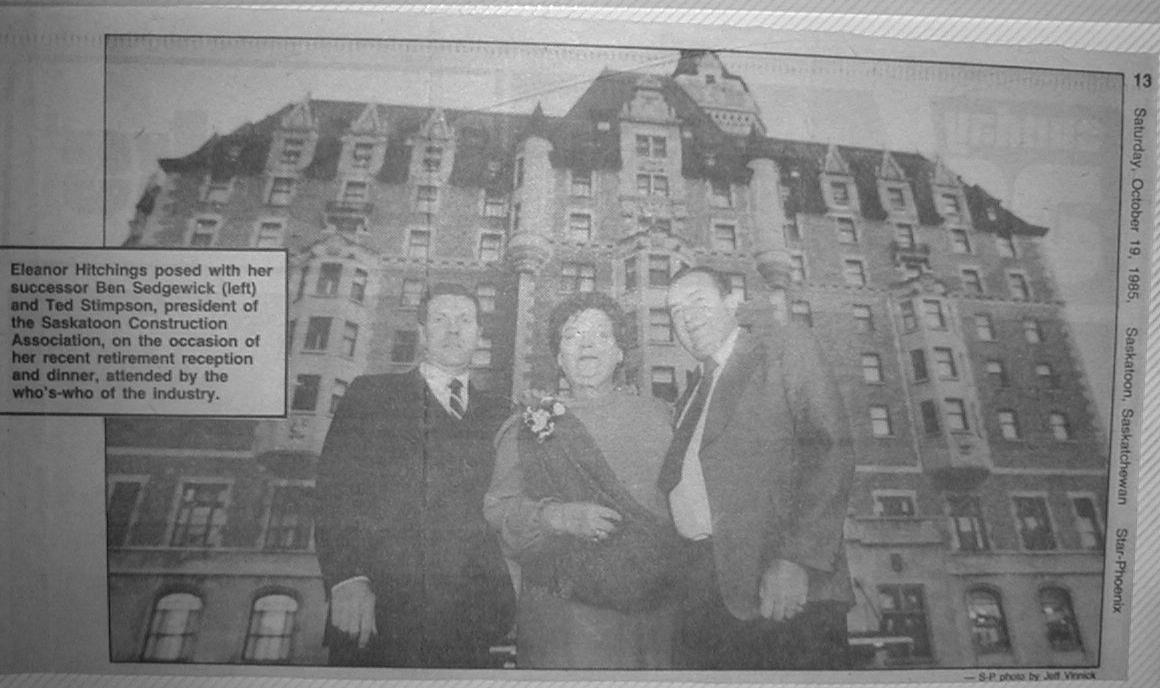

Article and Photo from Saskatoon Star Phoenix, October 19th, 1985, on the Occasion of My Retirement Party.
Mills "Stuff" Written April 6, 1998
Back on Page one I wrote that I would put in anything I know about the Mills (Scottish) side of our family. Well, here goes:
My father, Thomas W. Mills, born Dec. 26, 1874, had a twin brother, William. They were born of all places, in a railway station, the day after Christmas! He could tell us nothing of the circumstances, since his father died when he was 12, and his mother shortly after, which threw the boys on their own. Dad started his railway career as a "call boy" (A call boy was a kid who was sent to notify engineers, firemen, etc., when they were needed for trains. They were paid pennies and had to RUN, no telephones!) in Glasgow, just after his dad died. I think he came to Canada about 1898, working his way across as a firemen (shoveling coal) on a steamer. His railway career was interrupted for awhile. He worked in a lumber camp near Rat Portage, Ontario, which is now Kenora. His twin apparently worked with him and they did not get along together. Dad told us they quarreled and one night William took off with all Dad’s clothes and other possessions and he never heard from him again.
Other brothers were George, Peter, David and James. One sister, Nell. George stayed in Scotland. Peter came to Canada and lived his life in Kenora. David went to South Africa, married Dorothy, became very wealthy—no children. He died, leaving all his wealth to Dorothy. And that was the end of any hopes we might have had. James died at a very young age. We heard nothing from Nell, who was a milliner in Vancouver the last time Dad heard from her.
When our brother, George, was sent overseas during World War II, he made contact with a cousin, Agnes, a descendant of Uncle George, and he met another cousin, Marion McManus, who was Uncle George’s daughter. This was the only branch of Uncle George’s family that we have met. So I will concentrate on them.
I am not sure what relationship Agnes had to Uncle George. She was dead by the time we got to Scotland, but we had been put in touch with her sister and husband, Jean and Stewart Robertson, whom we visited as soon as we reached Scotland in 1971. They had two daughters, May (Benny) Campbell, and Jean (Tommy) Dunn. We spent several great days with them. Benny was chief steward on the Waverly, the last ocean going paddlewheel steamer in the world, and he took us on a one-day cruise down the Clyde, along with May, their two children, Jeannie (11) and John (9), and mother Jean and Stewart. At that time, the Waverly was still in its heyday, white tablecloths and serviettes, polished silver and good china on the tables, and Benny waited on us as though we were royalty! They had an excellent chef and young John stuffed himself to the gills!! I think he was eating from the time the ship started moving until we came back to port in the evening. Benny later brought me a heavy cream jug and sugar bowl, silver, of course, which he said were discards because they had dents in them. I hope it was legal! Phaedra now has them, along with the book about the Waverly, and several postcards.
We had our rental car, and a map of the area. Bill was the "pilot" and I was the navigator. I noticed, on reading the map, that there was an elevated freeway right out to the port where the Waverly started its trip, but Stewart said we didn’t the map, he would show us the way. Well, it was only a few blocks before I discovered he was following the bus route—about 3 times as far, and twice as long in time. It was late when we returned to port, so I told Stewart we would follow the map home. He was a bit miffed, and I heard him say to Jean—"Look at that. They’ve been here only 3 days and think they know better than we do." Young Johnny begged Bill to go faster—he had never been in a "motor" before and loved the speed—60 mph was legal, but cars were shooting past us as if we were standing still. We stuck to the 60. The turn off was about 6 blocks from London Road, where they lived, and Stewart began to relax. He recognized where he was, and conceded that I was pretty good at maps! In the days that followed, he never questioned my ability again, but after 2 more days of travel, he begged off. He wanted a "long lie"—meaning to sleep until 10 or 11 o’clock. Starting off for a 60 or 70 mile drive in one day was too much for him.
The rest of us went to Loch Lomond for a picnic, to Sterling Castle, and various other places the Scotch people had never seen, and they marveled at how much we could see and do in one day! We visited with Jean and Tommy in Glasgow. They could not travel as both of them were working. Jean and Tommy have two daughters, Irene and Yvonne.
May and Benny’s daughter Jean married, divorced and remarried—no children. Johnny married—one daughter, Ashley, and a surprise last year, a son (forgot his name….9 0r 10 now—Scott) Jean and Tommy’s daughter, Irene, married, has 2 children (don’t know their names). Yvonne—a businesswoman—never married. She is about our Colleen’s age.
As I said before I could not find out exactly what relationship their family was to ours. Letters have been written to "Cousin Agnes", Jean’s sister, and Jean thought that our fathers were cousins. If that was correct, it would mean that their grandfathers were brothers stretching the connection quite a bit, but I was happy to own them as "cousins" whatever the degree, and am still writing to them. We visited each time we were over there. We never did find Marion McManus, who was definitely our first cousin.
The last time I was in Britain was in 1985. I went without Bill, as he could not travel then. He was in Sherbrooke Nursing Home while I was away. The trip was paid for by the Saskatoon Construction Association as one of my retirement gifts. Six of my sisters were on that trip too, and we only stopped in Glasgow long enough to have a meal with the Glasgow group. Not long enough for the others to get really acquainted, but I hope some will keep up the correspondence after I am no longer able to do it—and maybe visit them in the future.
Now I am going to fill the rest of this with anecdotes from here and there just as I think of them—with approximate dates, at least, years if possible. The first is about toys from my childhood when ready-mades were too expensive or too scarce. (I’m a bit tired right now, so please excuse writing mistakes. First one:
Stick and Wheel (Early 1920’s)
Materials needed: A lath, 2 or 3 nails and an old wheel about 9 or 10 inches across. The lath was cut to an appropriate length, about waist high for each child and a cross-piece for the bottom about 10 inches nailed together. It looked like a "T". We had a sloping street, ideal for the race. The wheel was poised at the top of the stick, 2 or 3 kids to a race, the starter yells "GO!", the wheel rolls down the stick and the first to roll it to the finish line without losing the wheel, wins. Lots of practice was fun too.
Linoleum Sliders—Winter (1920"s and 30’s)
These were on the go all the time we lived in Edson. Whenever anyone threw out worn linoleum it was grabbed up by the closest kids and cut to suitable sizes for easy toboggans. The hill by the creek was just right for sliding, with the smooth side down. We broke holes in the ice for water on the hill until it froze solid. (the creek that is). We had thug kids then, just as we have now, and the thugs usually managed to steal our "toboggans" before we had them very long. Nowadays, its expensive skate boards, etc.
Once when brother George was about nine, a bunch of these toughs broke into an empty house at the top of our hill and stole the lino from the kitchen floor. Somehow or another one of them blamed George for the theft and Mom had to go to court with him. He was scared stiff. He hadn’t had anything to do with it, of course. He was cleared within minutes, Mom said when she got home. The kids who blamed him got their stories so mixed up that the judge knew they were lying, and finally got the truth from one of the culprits. As an added note, the linoleum was worn out and useless before the kids stole it, but the judge got them on the "break and enter" part, scolded them for lying and put them under a "curfew"—and Mom said their parents got a good talking to as well, and then he got after Mr. Walsh, the owner, for trying to get new lino for old. Some of the Walshes still live at Edson. One of the daughters, about my age, lives in the same place as sister Kay. They are not friends, Kay says. She is too much like her dad.
Old Model-T Car Tires (same years)
The Model-T Fords had large wheels with skinny tires, about 4 inches thick and maybe 30 inches across. I’m not sure about the measurements. Again that useful hill!! A few tires were found, either worn out treads or nail holes, and kids that were small enough and brave enough would curl up inside them at the start line. Someone gave them a push and down the hill they rolled. Sometimes they reached the bottom without falling out, usually got sick, or dizzy or both. But it seemed to be fun. I never tried it. Some of the bolder girls did, but this was mostly for boys.
Hodags
I don’t know where that name came from. There were two toys that were called by the same name. The first needed only a good strong piece of string and a large button. I think kids are still playing with this one. A large button was threaded onto the string and then wound up tight and pulled outward on the largest (2nd finger from the thumb), relaxed, and pulled again and again. I made a wonderful hum! It could be used until the string wore out, but don’t let your hair get tangled in it.
The second kind needed a piece of shingle, which was shaved at each end like an airplane propeller, and a fairly long, strong cord fastened through a hole in one end. I can’t remember if it was the thick end or the thin end. If you try it, you will have to experiment! The string was then wound around the hand (with a glove on is better) then whirled around the head. Going good, it made a sound somewhat like the old airplanes. The boys really loved this one, and with a half dozen or so going at the same time it made enough noise that the principal banned them from the school yard during school days. I think the piece of shingle was about 1 ½ inches wide. Can you still find cedar shingles?
Jacks
Jacks also are still around, but we mostly played with just the ball, which could be bought 3 for 5 cents, and small stones. The stones were all about ½ inch, nice and smooth, and as uniform in shape as we could find. There were plenty of them to be found on the banks of the McLeod River and we always looked for more when we went for our swims. Even the big girls played jacks. The boys did too, when they were sure no one was watching. This was supposed to be strictly a girls game. 12 stones were used.
Dibs and Agates
When I was very young, only boys played marbles. But girls got into it by the time I was nine or ten. Then girls were banned again later, because they beat the boys too many times. Nowadays, we fount out (David and I) that kids don’t even know what Dibs and Agates are. We gave some to 3 kids who lived beside us (Michael, Michelle and Johnny for those of you who know them), and they had never heard of them. They never caught on.
At Edson, the road between our house and the school was very fine powdery dust when it was dry, and thick sticky gumbo clay when wet. We used the wet stuff to make our own dibs. Dibs could be bought for 10 for 1 cent at that time, but they were gooey fun to make. Just roll a right-size ball of that clay until it was as round as could be made, bake them in the oven for a few days, or the sun when it was hot enough, smoothing them occasionally during the drying process, and for only several days work, you could have 2 or 3 hundred dibs. If used before they were perfectly dry—goodbye! A million pieces, more or less. Sometimes we even painted a few. The dibs were always about ½ inch. Agates could be any size, and were glass, anywhere from 3 for 5 cents to the really expensive REAL agate, which we never had. When games were started it was always decided whether it was for "fun" or for "keeps". Sometimes fights developed out of "keeps" because nobody wanted to give up their lost marbles!
Dolls, Etc. 1998

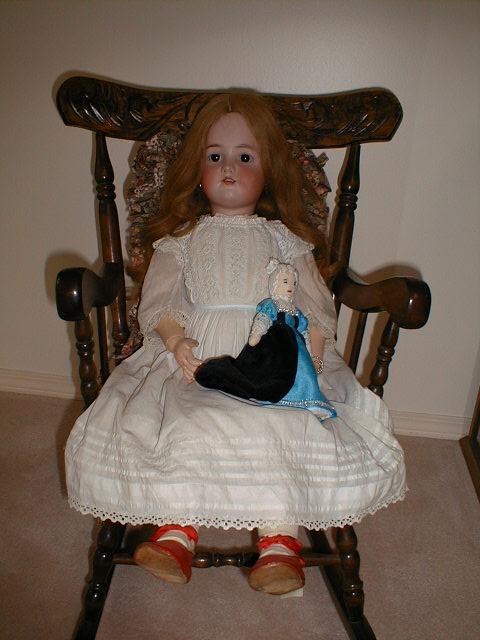
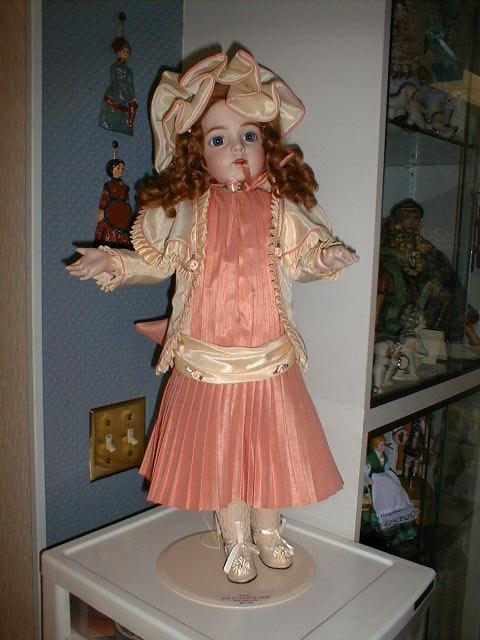
There are many things that never go out—girls still skip ropes and play with dolls, although you seldom see a little girl pushing a doll carriage now. Its all Barbie, apparently after a girl is 3 or 4. Then they go back to the big dolls when they get to be doll collectors, like me! I guess I have always liked dolls. I did have a few very nice ones when I was small—that I wish I had now—my Eaton Beauty, for example, would be worth anywhere from $1,000.00 to $5,000.00, if in mint condition, that is, in box never played with. I remember a few with china heads, arms and legs and kid-skin jointed bodies and some very cheap mama dolls, 2 of which I now have replicas of in my collection, (refinished) thanks to Colleen who found them in a garage sale for 25 cents each. Evelyn, the doll maker, refurbished them beautifully. I dressed them, and I am very proud of them.
When I was about seven, Mom took me to Edmonton on a shopping trip, and there in Eaton’s window, I saw what I considered the most Beautiful Doll in the World. She was about 28 inches tall, dressed in frilly yellow organdie and lace and I thing the price was $5.95 or $6.95. Too expensive. I yearned for it, but of course never got it.
A few years ago, I was with Evelyn on one of her trips to a doll supply store in White Rock, B.C., and there was my beautiful doll--$249.00. I bought it. It didn’t have the dress but I had yellow organdie in my stock, so I dressed it as nearly as I could remember like the one I saw in Eaton’s long years ago, entered it in the Doll Club’s annual dressing competition and won 2nd prize for modern dolls, and Best of Show, with the twin babies Evelyn had made and I dressed in christening gown outfits. As you can see I am still hooked on dolls. My basement workshop is crammed with hundreds of meters of laces, ribbons, lovely fabrics and drawers full of patterns, waiting for my recovery from this present attack, and my release from the hospital.
That’s all the toy things I can think of right now, but as one thing sometimes leads to another, just mentioning that trip to Edmonton has reminded me of another—no connection of course—at the time I was maybe ten years old, and had joined an intermediate young people’s group at the Anglican Church. I was also attending the Baptist Sunday School, but that didn’t matter. Well, there was some kind of children’s affair in Edmonton, and our Anglican group was to attend it—without mothers, just teachers. I had won a prize for memorizing the most Bible texts, and it was to be presented in Edmonton by a Bishop or somebody important. There was maybe 20 in our group, boarding the train about 2 a.m. We were told to go to sleep for the 4 hour trip, but everybody was too excited, so we started singing, hymns, of course. I got an answer to something that had puzzled me—one of the hymns started off with—"There is a green hill far away, Without a city wall, Where our Dear Lord was crucified, Who died to save us all." I got up nerve enough to ask a teacher why a green hill would need a city wall anyway. She laughed at bit at my question, then told me that it really meant "outside" the city wall, which did make more sense, and I think that’s how it is now written.
Anyway, we had a little bit of sleep, went to the biggest church I had ever seen, did our little bits in the program, and I got my prize, which was a 9 X 12 portrait, framed, with a glass front, and I had to carry it around for the rest of the day. (That was my first convention, I guess.) Besides the church stuff, we were taken on a little shopping spree. I only had about 25 cents to spend, so I bought the biggest thing I could find in the 15 cent store for Mom. It was a mixing bowl of Medicine Hat clay, probably 10 or 12 inches across the top and HEAVY. I carried it too, and got it home without breaking either picture or bowl! It should have taught me something about holiday shopping, but I don’t think it did.
One more note about the dolls—1923 or so—a celluloid baby doll, from Japan, about as high as the width of this page, could be bought for 5 cents at any time, at the hardware store. They were easily broken too, to I usually spent my nickels on those, and when I was 6 years old, I make my first doll dress for one of those babies. It was blue cotton print, a scrap from something Mom had made and looked like a plain little shift with a slit all the way down the back. The only sewing was the underarm seams. I was SO proud of it, and it led to lots more sewing so that by the time I was nine, I was able to sew real clothes and do nice embroidery too. That’s how it was that I had made the dress that baby Robert was buried in, in January, 1927, when I was 9 ½ years old.
I made pretty dresses for my little sisters, too. When Ethel was about 3 years old (spring 1934) I made a very pretty dress for her from scraps of green voile print left over from dresses I had made for Edith and myself. I cut nearly all the scraps into strips, sewed them together, hemmed them and gathered them into frills which I sewed onto bleached-out sugar bags for the skirt part, and used the two largest pieces to make the sleeveless top. There is a family picture somewhere showing Ethel in the front row, wearing that dress. I was 16 when I made it, and I remember, when I saw that snap years later, thinking I had surely come long way with my sewing in 10 years. Now, some 64 years later, I make lovely doll costumes and sometimes dresses for little girls in the family (Maria, Alex, Emily, Alysia-Marie, etc.).
