

Welcome to Page 3 of Mom's Book

Then, toward the end of the war, one of the bosses from the Dairy Pool came to the farm and asked Bill if he would come and drive the milk truck for them. Pay was an unheard of $129.30 per month, so he took it. After he had worked for about three months, I made up my mind we were going to get off that farm somehow. David was soon going to go to school and the local school was shut down. Even that one was two miles away, so if it had been open, how could a six year old kid get there". So we started house hunting in the city and found the place on Avenue I—the only one we could get with no down payment. We bought it in March and rented it out until the end of September 1945.

David, Evelyn, Johnny Geisbrecht, Arthur at Grace Ewen’s Farm
Then Bill went to the War Office and with Ted Geall’s help (his boss) he was released from the farm and we moved in on September 26, 1945. After we sold our cattle, horses, and everything else from the farm we had our down payment of $700.00, plus a little bit to buy a new stove and some second-hand furniture, including a sofa, our first. No washing machine. I still washed clothes on a washboard for another two years. Seven years and 3 babies, I washed clothes on a washboard and wrung them out by hand.
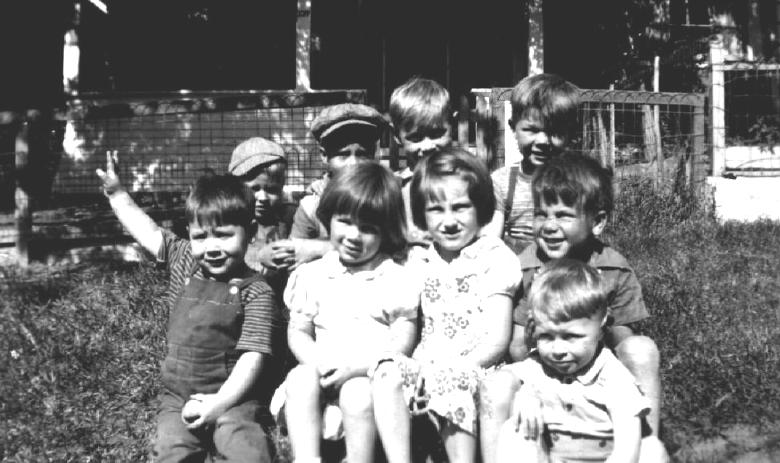
The Avenue I Gang
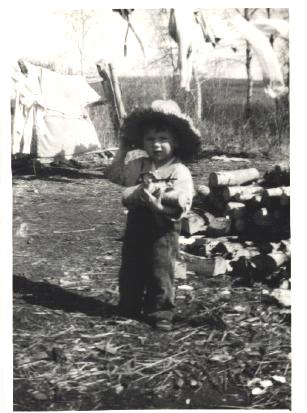
Arthur (about 2 years old)
The washing machine came at last. I was renting out rooms, and to make a little extra, I moved the kids into the back porch and us into the dining room and rented the front room our for the summer months at $25.00 per month. A man and his son took the room and I asked him to pay the whole 5 months in advance, not really expecting that he would. But after I explained about my need for a washing machine, he obliged. Then, armed with cash, I took off and walked the city, looking for a machine. This was just 2 years after the war ended and consumer goods were still in short supply. No luck. I got to Wheaton Electric at about 4 o’clock in the afternoon, exhausted, and when he too said no machine, I started to weep, and told him my whole story, showed him my cash, and he said, "Leave it with me. I’ll find you a washer if there’s one to be had anywhere." He was as good as his word and two days later he let me know he had one for me. It cost exactly $125.00 and they delivered it that day. That Inglis wringer washer lasted for many, many years. I stopped using it when Art and Gloria moved from the airport into a suite on 22nd St., and sold me their automatic washer and dryer. Laurie was a year old (1962).
Those early years were hard. There was never enough money—the $129.30 seemed like a lot at the time, but after paying $50.00 per month on the mortgage there was never
enough for the rest of our needs. We lived in the downstairs and rented out the upstairs rooms for several years to stretch our resources. I kept boarders occasionally, some of them staying for 2 or 3 years, and that helped too. But there was a lot of hard work involved. We did some remodeling on the house and finally got a fairly nice kitchen.
Evelyn at about 6 years old. With Bill in Blue polka dot store bought dress.

By herself in dress cut down from dress I made for Ethel's wedding..

In 1950, just after George was born, my mother and father, and four youngest sisters, (or was it five), moved in with us. Mom had just had a massive operation to remove a huge cancerous tumor, and was doomed to live with a colostomy for the rest of her life. Her doctors would not allow her to leave the hospital until she could live in a place with running water to take care of her colostomy. So we had to take them in. Dad, who knew nothing about land values, sold the homestead for less the its assessed value, never mind market value, so he got about $700.00 for it. They were intending to live with us for only a few months, but this was still only a short time after the 2nd World War, and rental houses were very scarce, especially for large families, so it was 3 ½ years before they found a place to live.
I went to work. I had to. I got a job at Custom Cleaners, sewing on buttons, mending cuffs and split seams, and all the other things dry cleaners used to do to make garments wearable. My pay was $25.00 for a 44 hour week, with suitable deductions if there was no work for Saturday morning, about $.56 per hour. However, it did buy quite a bit in those days. I worked there for 2 years and mom looked after George. They finally found a place in Sutherland, and I quit working for awhile. It was back to boarders for extra money.

No, she wasn't flying the plane. This was at the Forestry Farm. The pilot brought his plane and gave rides for a dollar.
Somewhere during those years—no—it was earlier, when David and Arthur were about 6 and 4, they were mad about Roy Rogers, and all they wanted for Christmas was a fancy set of Roy Rogers guns, complete with holsters and studded belts. To back up a bit, I can’t remember who all was visiting that Christmas, but I remember Mom and Dad were there. Well, we decided to give the boys their guns, and on Christmas morning, they got up early, and stark naked, they went down to see if Santa had left their sole request. They tore them open and strapped them on, still naked, and ran around waking everybody else in the house! They DID own pajamas!
Evelyn’s big Christmas wish one year was for a bride doll. She wrote to Santa and that was her only request. Well, "Santa" couldn’t afford a ready made bride doll, so "she" bought a fairly nice, but cheap, plainly dressed doll to do over. The end of this story was that I was working on the bride doll on Christmas Eve, and Evelyn confessed later that she had crept downstairs and saw me working on the doll that came to her marked from Santa. That ended her belief in Santa. I did not know about this until several years later.
I always tried to make Christmas a happy time, no matter how little we had to spend on it. In 1956, Bill was out of work and there was almost nothing to buy presents. So he went over to a millwork factory which used to be on the corner of Avenue G and 22nd Street, and came home with a big sack full of ends of millwork lumber. He had a bench saw and a few other carpenter tools, and he spent his days making blocks and "timbers" and other shapes. This was to be George’s main gift. He was six that year. Well, Christmas Day turned out to be one of the best we ever had. Everybody got into building castles, trains, corrals, and dozens of other magnificent structures. The blocks stayed around for years. Lego had not yet been invented, but the bag of blocks was better!
We always had a feast for Christmas, no matter how poor we were. You kids will never know how I contrived to get some of them, but I’m sure you do remember the bread pan full of Christmas cake batter and the wooden spoon poised to crack down on fingers stealing nuts from the dough! Did you ever wonder how come I always missed? Well, almost always. I did once, I think accidentally connect with David’s fingers. I don’t remember ever whacking any one else. I hope I didn’t, I never meant to. It was part of the game.
One of the tricks I used to get a bit of money when we were flat, stony broke several days before payday, was to go to Eaton’s and cash a cheque for, say, $40.00, and 2 or 3 days later, cash one at the Bay for the same amount, which would be deposited in the bank to cover the Eaton cheque. By the time the Bay cheque came in, the pay cheque was there to cover it. I couldn’t do that now—the computer age. I never knew it was highly illegal. The (called kiting?) money bought our groceries. Illegal perhaps, but it got us through some tough situations.

Evelyn, David and Arthur
Those early jobs I mentioned, working at Custom Cleaners and later at Mother’s Bakery—I hated. It was while I was working at the bakery that I came to the conclusion that if the fortunes of our family were going to improve, it was up to me to do it. So I also decided that there was no future in working at menial, minimum-wage jobs. So, since I also knew I had a good brain I decided to put it to work. I went to Business College. Don’t think it was easy. I met with a lot of opposition from your dad. He was sure it was a waste of money and nobody would hire me. At that time, fees were paid monthly, $29.50 per month. I started in January, 1956, working at the bakery from 7:00 a.m. to 12:00 noon, come home for a bite of lunch and head for the college at 1:00 p.m. Dad was unemployed so, like it or lump it, he got the job of keeping house. I stayed at the college until 5:00 p.m. every day, getting in an extra hour of typing practice. For three months I kept up the half-day routine, then I got laid off at the bakery because their "permanent" employee came back, and I started full days on April 1st. It was to be an 8-month course, but I speeded it up by studying at home, not taking class time for such things as spelling and rapid cal. About the 1st of May I saw an ad in the paper and it struck me as being exactly the kind of job I wanted. So I applied, was called for an interview and got it. The Canadian Credit Men’s Trust Association. I explained to the boss that I hadn’t finished my course, there were several exams to write, and he gave me time off to do them. I started working on May 15th, wrote the exams at the end of May and a month later I got my certificate—average 86%--with HONOURS!! I stayed with that association for 4 years, then quit because I didn’t like the new boss, and 6 weeks later started with the Saskatoon Construction Association, where I stayed for the next 25 years. I was 68 when I retired.
Since I am writing this for "posterity" its obvious that I will be including things all of you now present will know all about. If you hang onto this book, it might interest future generations. Maybe.

Evelyn at approximately 12 years old.
