TOLKIEN
|
|
Languages |
|
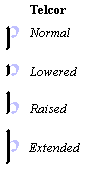
Tengwar Tengwar (which is Quenya for letters) was the system of writing used by Quenya to record the language in written form. Within Tolkien’s mythos, it was created by the Elf Fëanor, a master in the lore of language. There was another writing system invented before by Rúmil, called Sarati (another Quenya word, also meaning letters). The Tengwar was heavily influenced by Rúmil’s Sarati, but the main difference is that the Tengwar is written left to right horizontally, while the Sarati was written left to right vertically. MODIFICATIONS OF THE TELCOR AND LÚVAR The basic Tengwar letters are composed of two distinct parts; these are the telco stem and lúva bow that can be modified in a certain number of ways to produce a variety of characters. Certain tengwa whose telcor and lúvar are organised in a particular way are then assigned to represent a certain group of related consonants: the telcor determines the manner of articulation and the lúvar determines the place of articulation. Exactly what values are assigned to which tengwa can be adjusted to the requirements of a particular language, forming what are called different modes. MODIFICATIONS OF THE TELCOR AND LÚVAR
The Tengwar was later used by other, non-elvish languages of Middle-earth, but this page is only concerned with its classical mode in Quenya. This table gives the tengwar characters with their IPA value in mature (i.e. that spoken at the end of the Third Age of the Sun) Quenya beneath, and their Quenya name to their right in bold, and the English translation of that name beneath in italics. The consonants below the black line in the table are known as the additional consonants, and are not presented in the formal manner that those above the line are, in the vertical columns representing the series (place of articulation) and the horizontal rows representing the grade (manner of articulation).
The
values of certain consonants in the above table (in the part above the line) may
logically seem somewhat out of place. For example; since for the most part,
the calmatéma represents velar consonants, one would expect that the tengwa
representing /h/ to infact have the value of /x/, the velar fricative. Similarly, one might think that
the tengwar of phonetic values /n/ and /j/ in the calmatéma should instead represent velar nasals
(/N/) and approximants (/¦/),
respectively. The reason that these tengwa do not have their expected value is
due to sound change that occurred in the language: /x/ was weakened to /h/, [N] was lost as an individual phoneme, but remained as an
allophone of /n/ before a velar stop. The
phonemic value of the tengwa anna had vanished before Fëanor was born, and so
was sometimes used to represent ‘no consonant’ where a vowel needed to be
palletised, for although a short carrier could theoretically have the two
subscripted dots and a superscripted vowel tehtar, it was not used for
aesthetic reasons because it would look too ‘busy’. The difference between the two tengwa
representing the /r/ sound, órë and rómen was purely aesthetic by the Third Age, however
it was general convention that órë was used before consonants and word finally,
while rómen was used before vowels. As is apparent from the table above, silmë
and essë both have reversed counterparts; these are used when tehtar have to
be added above the consonant. It should also be noted that essë and essë
nuquerna may appear as the following, respectively: K , The tengwa halla originally represented the /h/ sound, but
was later replaced by harma, and so halla was then used to represent the
voicelessness of /r/ and /l/ by being placed before the two consonants, like the transliteration
of these two sounds as hr and hl. Although these voiceless
sounds were usually pronounced voiced in the Third Age, they were still
generally written with this tengwa. The last two tengwa of the table, yanta and
úrë are only used as glides (i.e. the second half) in diphthongs,
since all Quenya diphthongs end in either i or u. Where double consonants appear, they are
pronounced long. When writing such words in the Tengwar, one needn’t
write the consonant twice, but instead place a horizontal bar, somewhat like
the tilde in form, beneath the baseline of the tengwa.
Palletized consonants (those which would
belong to the so-called tylpetéma series) are marked with a
subscripted palletization tehtar in the form of two juxtaposed dots.
When the consonant s follows another
consonant in a Quenya word, this may (but must not necessarily) indicated in
the Tengwar by the addition of an s-hook; a downward hook attached to
the bow of the tengwa.
Ómatehtar (literally vowel-signs) are signs
superscripted over other (usually consonantal) characters to represent the
vowels in Quenya, so unlike in the Roman alphabet vowels are not indicated as
separate characters.
The ómatehtar are placed over the preceding
consonant tengwa, so for example the word calma is written:
However,
if there is no preceding consonant tengwa, the tehtar is placed above a short
carrier (indicated in red), thus the word elen is written:
Long
vowels (those marked with an acute accent in Roman transliteration) are
placed above a long carrier (indicated in red), irrelevant of the form of the
word, so the word súrë is written:
As
stated above, the tengwa yanta and úrë are used to represent the glides of
dipthongs since they represent consonantal sounds, and are therefore not
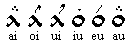
syllabic, thus giving a dipthong. For the diphthongs ending in i,
yanta is used as the tengwa over which the ómatehtar is placed, and for those
ending in u, úrë is the consonantal tengwa.
The example that follows is the Quenya poem, Namárië by JRR Tolkien from The Fellowship of the Ring, Book II, Chapter VIII written in the Tengwar.
|
||||||||||||||||||||||||||||||||||||||||||||||||||||||||||||||||||||||||||||||||||||||||||||||||||||||||||||||||||||||||||||||||||||||||||||||||||||||||||||||||||||||||||||||||||||||||||||||||||||||||||||||||||||||||||||||||