Site hosted by Angelfire.com: Build your free website today!

LANGUAGE


Chez Samuelo


Me


Tolkien


Language

Linguistics

The IPA

My Languages

Language Resources


My Creation


Index


The International Phonetic Alphabet


The International Phonetic Alphabet, created by the International Phonetic Association, is a universally agreed system for representing the sounds of any human language in written form. The IPA (International Phonetic Alphabet) is based on the Roman alphabet that has the advantage of being widely familiar but also includes letters and symbols from a variety of other sources.


Since I make regular use of the IPA to exemplify the phonemic inventory of my and other languages, I thought that it deserved its own page as explanation.


THE IPA CHART


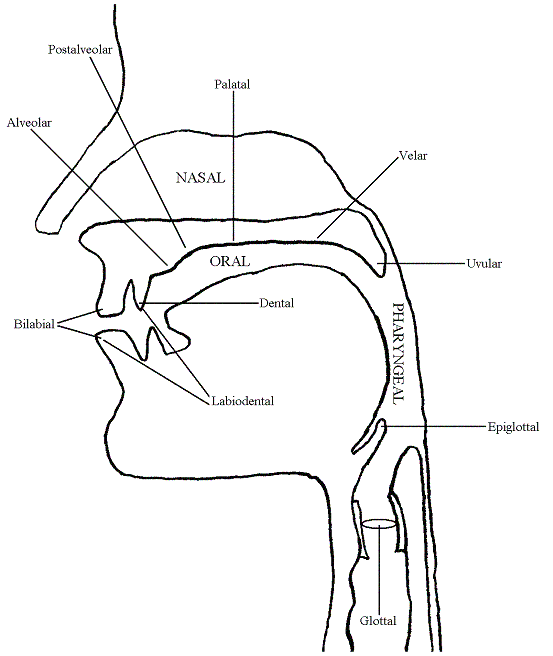
PLACES OF ARTICULATION


The eleven places of articulation for each column are shown from right to left at the top of the table of pulmonic consonants in the IPA chart to simulate front to back within the vocal tract. The diagram below is a cross section of the vocal tract, labelling the various possible points and areas (in capitals) of articulation. Note that retroflex is infact not a point of articulation, but rather a manner. These sounds are produced by curling the tongue backwards so that the tip is touching the palate and then usually bringing it back forward during the articuation of the sound.


EXEMPLIFICATION OF THE SYMBOLS


PULMONIC CONSONANTS


These are the most common type of consonants. They are those that use air from the lungs to produce outward airflow.


Where consonants are presented in two columns, those on the left are voiceless, and those on the right are voiced. Those groups of consonants in only one column are all voiced.


Plosives

These are also known as stops as they are sounds made with a complete and momentary closure of airflow through the vocal tract.


p [pi] pea English, [p2] (he) can French

t [ti] tea English, [tu:n] do German

[al] postpone Hindi

c [cu:k] hen Hungarian

k [k{p] cap English, [kA~] when French

q [qa] our Kekchi

? [ha?a] dance Hawaiian

b [bi] bee English, [bo~] good French

d [dip] deep English, [dip] thief German

† [†al] branch Hindi

Š [Šu:r] knead Hundarian

g [g{p] gap English, [gA~] glove French

Œ [Œar] cave Farsi


Nasals

These are sounds produced by lowering the velum, allowing air to pass through the nasal passages.


m [mi] me English, [mi] put French

F [EFf@sIs] emphasis English

n [ni] knee English, [ni] nest French

[k6i] link in a chain Malayalam

J [VJ@n] onion English, [aJo] lamb French

N [h{N] hang English, [eN] close German

[zei] goodwill Japanese


Trills

These are sounds made by forcing air to pass through the lips, over the tip of the tongue when placed at the alveolar, or over the uvula to produce a vibrating sound.


[mbuen] fruit Kele

r [pero] dog Spanish, [rAntA] shore Finnish

[a] rat Parisian French, [as] bread Swedish


Taps Or Flaps

These are produced like the trills, but instead of allowing a vibration, the tip of the tongue rapidly touches the point of articulation once, thus causing a tap or flap.


4 [bV4@] butter American English, [pe4o] but Spanish

[Sa:a] sweeping Hausa, [a] orchid Japanese


Fricatives

These are also known as continuants and are produced by a continuous airflow through the mouth accompanied by a continuous audible noise.


[e a] he polished Ewe

f [fi:] fee English, [fO~] (they) do French

T [Tif] thief English, [TiNko] five Spanish

s [si:] see English, [si] if French

S [Si] she English, [Sta:k] strong German

[a] kill Standard Chinese

C [CudZ] huge English, [IC] I German

x [lOx] loch Scottish English, [hOx] high German

X [maX@n] do, make German, [XweGo] game Spanish

‘ [‘or] hole Hebrew

h [hi] he English

B [EBE] Ewe Ewe, [XweBes] Thursday Spanish

v [v{t] vat English, [vi] life French

D [DIs] this English, [bODa] wedding Spanish

z [zil] zeal English, [zeRo] zero French

Z [viZn] vision English, [Z2] game French

[aN] assist Standard Chinese

š [šo:d] soil Swedish

G [GAlA] milk Greek, [amiGa] (female) friend Spanish

R [tRwa] three French [Raz@] race German

[or] skin Hebrew

[@Ed] ahead English, [ud] hat Dutch


Lateral Fricatives

These are sounds that are produced by release through the sides of the tongue, with the tip touching the alveolar and continuous audible friction.


K [Kan] church Welsh

[ala] play Zulu


Approximants

These are also called frictionless continuants. They are produced by bringing the articulators close enough together while at the same time leaving a sufficiently large gap between them through which air escapes without causing audible turbulence.


P [n@P6~] ninth Hindi

[id] read English

[Sa:a] sweeping Hausa

j [jEs] yes English, [j2] eyes French

[isa] doctor Korean


Lateral Approximants

These sounds are made by release through both sides of the tongue, without audible friction.


l [lif] leaf English, [li] bed French

Ÿ [vaŸ] sword Tamil, [p{:Ÿa] pearl Swedish

L [fiLLo] son Italian, [LeGa4] arrive Spanish

[aae] dizzy Mid-Waghi


NON-PULMONIC CONSONANTS


These type of consonants are less common.


Clicks

[koo~] dream Xhosa

[ukukola] grind finely Xhosa

! [ukuk!o€a] break stones Xhosa

[kaa~] bone !X

[ukukŽo€a] arm oneself Xhosa


Voiced Implosives


€ [€@ni] field Sindhi

… […Inu] festival Sindhi

› [›@tu] illiterate Sindhi

‹ [‹@nu] handle Sindhi

[a] fire Mam


Ejectives

p [papas] bishop Amharic

t [t1l] fight Amharic

k [kalat] word Amharic

s [sahaI] sun Amharic


VOWELS


In the two columns, the vowels in the left-hand column are unrounded, and those in the right-hand column are rounded. Because of their status as reference points, it is difficult to represent some of the vowel symbols appropriately in terms of particular languages; this is particular true to the mid central vowels [ˆ, 8, 3, ‰, 6].


i [hid] heed English, [li] bed French

I [fIt] fit English

e [let] let English, [le] the (pl) French

E [hEd] head English, [lE] milk French

{ [h{t] hat English

a [pat] paw French

A [fAD@] father English

V [cVp] cup English

7 [t7] silk Vietnamese


M [tM] fourth Vietnamese

1 [g1m] gold Korean

@ [bet@] better English, [kInd@] children German

y [ly] read French, [fys@] feet German

Y [flYs@] rivers German, [nYtta] use Swedish

2 [p2] few French

9 [p9R] fear French


& [s&:] rope Austrian German

Q [bQD@] bother English

O [sO] saw English, [gOt] God German

o [lo] share French

U [pUt] put English

u [sku5] school English

} [b}t] blunt Norwegian


OTHER SYMBOLS


W [WED@] whether Scottish English

voiceless labial-velar fricative

w [wED@] weather English

voiced labial-velar approximant

H [Hit] eight French

voiced labial-palatal approximant

’ [ma’] odour Avar

voiceless epiglottal fricative

[ma] nail Avar

voiced epiglottal fricative

[jaar] centers Agul

epiglottal plosive

‚ [ba‚a] Barbara (dim.) Polish

voiceless alveolo-palatal fricative

[iaa] dress oneself KiChaka

alveolar lateral flap

[al] scarf Swedish

simultaneous S and x


NOTE ON CONTENT


Nearly all of this information on the page was taken from the Handbook of the International Phonetic Association, ISBN number: 0-521-63751-1. This is an excellent book to widen ones knowledge on the subject of phonetics in general, and of course, specifically on its transcription with the IPA.