With these rules the practitioners of any martial art and in the daily life any one, would be benefit espiritually on a better development and betterment of Budo.
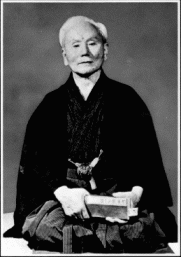
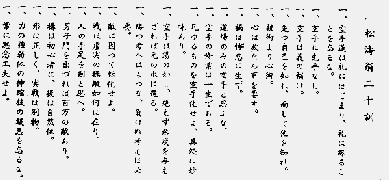
These 20 rules were created by Sensei Gishin Funakoshi for the Karate-Do practitioners and are aplicable on all circunstances, because all the meanings are undestood with one goal in mind : a real practice of Budo.
1. Karate-do wa rei ni hajimari, rei ni owaru koto wo wasuruna.
Karate begin and end with courtesy.
REI means salute, cortesy, sincerity, respect; Karate-ka needs Rei to avoid violence and rage in front of others, a practitioner without Rei could be a dangerous and violent person .
2. Karate ni sente nashi.
There is no first attack in karate.
"Avoid a fighting, meaning victory!" . A Karate-ka never attack first, always defends him/herself; the attack should be used only as a last resource, like in all arts. Budo, and Katas always start with a defending posture. [G. Funakoshi]
3. Karate wa gi no tasuke.
Karate is an assistance to justice.
Karate should be used always in favor of justice, defending all rights and equal aspects of life.
4. Mazu jiko wo shire, shikoshite tao wo shire.
Know yourself before you know others.
The knowledge of him/herself in the main goal of Karate, if your know yourself, your reactions, fears and emotions you will know how victorioous at any moment and circumstance you will be. Those who know themselves and control is the great warrior of warriors!.
5.Gijutsu yori shinjutsu.
Spirit before technique.
With the constant practice all benefits for the spirit will be developed, increasiong our perception.
6. Kokoro wa hanatan koto wo yosu.
Be ready to free your mind.
We should train with full awareness, we should pour all of our spirit and enthusiasm on training, achieving
that way perfection over and over.
7.Wazawai wa getai ni shozu.
Accidents come from NEGLIGENCE.
We should become aware of all of our errors that we can concieve at any moment, in the practice, in the technique and in combat. The unawareness could provoque accidents.
8.Dojo nomino karate to omou na.
Karate training is not only in the dojo.
Karate does not end when you exit the DOJO. Your training countinue with all your lifestyle.
9.Karate no shugyo wa issho de aru.
You will never stop learning karate.
In Karate there is not limit on practice. Like any other martial art is for all our life, with its’ practice we progress with our own union, we fell within ourselves spiritually and physically better with our daily training. With years of practice, we understand the escence and art of Karate.
10.Arai-yuru mono wo karate-ka seyo, soko ni myo-mi ari.
Make karate part of your life and you will find myo.
We shall put all of our efforts in training with all our inner strenght, in order to get our goals, those we are looking for, the same anergy is that we use everyday.
11.Karate wa yu no goto shi taezu natsudo wo ataezareba moto no mizu ni kaeru.
Karate is like hot water. If not given continual heat, it will go cold.
12.Katsu kangae wa motsu na makenu kangae wa hitsuyo
Do not think you must win. Instead, think that you do not have to lose.
The only enemy that you should overcome is YOURSELF. The opponent stimulate you to achieve perfection besides him/her, not in order to know who is better or worst.The desire to win will get you more enemies. Karate is a way of inner combat, not toward anyone.
13.Tekki ni yotte tenka seyo.
Transform yourself according your oponent.
According your opponent, adopt certain movements and techniques to advance and change the combat on your favor.
14.Tattakai wa kyo-jitsu no soju ikan ni ari
The secret of combat is on the art of direction.
There is a need to study the enemy, its abilities and defects of the opponent to change your tactics, according his/her combat; looking for the adecuate distance to percieve their openings, the correct moment of attack and stall on a position, strategically become ofensive or defensive in front of possible attacks and answers.
15.Hito no te ashi wo ken to omoe.
Think that your hands and feet are swords.
The potency, quickness and efectiviness are only examples that we should granted in front of possible attacks and blocking. With constance and daily practice of Karate, our body, legs and arms will become stronger, and trully great swords.
16.Danshi mon wo izureba hyakuman no tekki ari.
Be aware of your actions so as not to invite trouble.
10.000 enemies will be waiting for you when you get out of your home. These enemies you should consider all your mental mistakes, unawareness and without prudency acts. We shall confront them the same way : Karate spirit.
17. Kamae wa shoshinsha ni ato wa shizentai.
The beginner needs Kamae, after should look for Shizen.
First master low stances, then natural posture.
The beginner needs to adopt a defensive stance, same as with constant training [ the defense] will developed mentally, meaning : the body will stay in a natural position, but the mind will be aware and alert!.
18. Look forward the right form, the real combat is another thing .
Kata wa tadashiku jissen wa betsu mono.
Practicing kata is no substitute for the real thing.
Katar should be practice the same ways as thounsand years ago, execute them in perfect realization; in real fight these techniques will be developed counciouslly and spontaneouslly.
19.Chikara no kyojaku, karada no shinshuku, waza no kankyu wo wasaruna.
Do no forget [A] intensity high and low; [B] body expansion and contraction; [C] rithm high and low of the technique.
Do not forget [A]strength and weakness of power, [B]expansion and contraction of the body, [C]slowness and speed of techniques.
Katas are really important, observe these rules, that way, you should realized equally on combat for your perfect application with the opponent.
20. Tsune ni shinen kufu seyo.
Always try to study and express yourself better.
Think of ways to apply these precepts every day.
Within years of Karate practice we will understand better our art and knowledge. It will become a personal and unique perception of the reality, increasing our power and getting us to another mental and physical skills.
Becoming humble and natural are qualities of Great Teachers and Wisemen.


 Tel/fax : 646-177-10-70.